
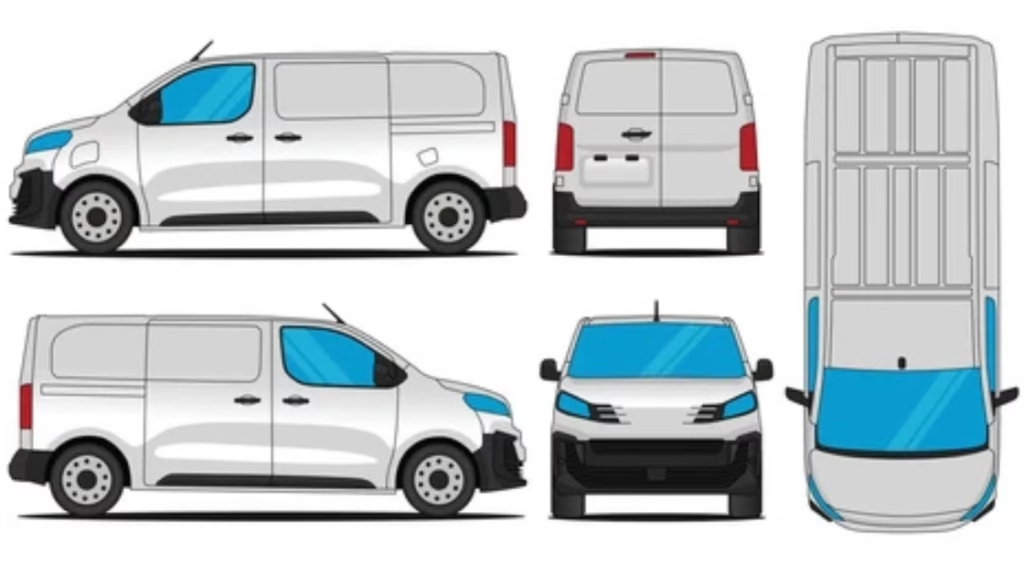
Buying a van can be an important personal or business decision in Canada. Whether you need a vehicle for family transportation, deliveries, trades, contracting, or day-to-day commercial use, the financing structure can have a major impact on your overall cost. The challenge is that not every borrower receives the same rate, and not every van qualifies for exactly the same financing program. van financing Canada
Understanding van financing Canada before visiting a dealership can help you compare offers more confidently, avoid unnecessary costs and choose a repayment structure that fits your budget. At QuickApprovals.ca, borrowers can explore vehicle financing options and begin the application process through QuickApprovals.ca.
What Is Van Financing Canada?
Van financing Canada refers to borrowing money to purchase a van and repaying that amount over an agreed period, usually with interest. Depending on the transaction, financing may be arranged through a bank, credit union, dealership finance department, independent lender or financing intermediary. The Financial Consumer Agency of Canada explains that vehicle financing can be obtained directly through a financial institution or through a dealership that arranges financing with different types of lenders.
The right financing structure depends on several factors, including the vehicle price, whether the van is new or used, your credit history, income, existing debts, down payment, loan term and the intended use of the vehicle. Someone purchasing a van primarily for family transportation may be assessed differently from a business owner purchasing a cargo vehicle for income-producing activities.
This is why passenger van auto loans Canada and cargo van car financing Canada should not automatically be treated as identical financing situations. The vehicle’s use, specifications and ownership structure can influence lender requirements and, in some circumstances, tax treatment.
For business owners, the distinction can be particularly important. The Canada Revenue Agency states that vehicle expenses may include fuel, insurance, maintenance, interest on money borrowed to purchase a motor vehicle and capital cost allowance, subject to applicable rules and limitations.
How Passenger Van Auto Loans Canada Work
When researching passenger van auto loans Canada, the first step is to establish whether the van is primarily a personal vehicle or being acquired for income-producing activities. Passenger vans can serve families, organizations and businesses, but financing decisions should be based on the actual transaction rather than simply the vehicle’s body style.
A lender may consider the purchase price, age and condition of the van, requested loan amount, down payment, borrower credit profile and repayment ability. A newer van may have different financing availability from an older used vehicle. Similarly, a borrower with strong credit and stable income may receive different pricing from someone with limited or damaged credit.
The Canada Revenue Agency generally treats most vans designed primarily to carry people, with a driver and no more than eight passengers, as passenger vehicles for income-tax purposes. However, specific exceptions exist for certain vehicles used predominantly for business purposes.
That distinction means borrowers using a passenger van for business should speak with a qualified tax professional about the applicable rules rather than assuming that every van receives the same tax treatment.
Cargo Van Car Financing Canada for Business Use
For entrepreneurs and companies, cargo van car financing Canada can be a practical way to acquire a vehicle without paying the entire purchase price upfront. Cargo vans may be used for deliveries, construction, plumbing, electrical work, landscaping, moving services and many other income-producing activities.
The financing decision should begin with the economics of the business. Calculate how much the van is expected to contribute to revenue and compare that figure with the proposed monthly payment, insurance, fuel, maintenance and other operating expenses.
The Canada Revenue Agency notes that the type and use of a vehicle can affect the expenses that may be deductible. Certain vans and similar vehicles used predominantly for transporting goods, equipment or passengers to earn income can receive different treatment from ordinary passenger vehicles.
Business borrowers should also maintain accurate records showing business use. Financing approval does not automatically determine tax deductibility, and tax rules can change. The vehicle’s actual use, ownership structure and applicable tax rules should therefore be reviewed independently.
Best Van Loan Rates Canada: What Determines Your Offer?
Searching for best van loan rates Canada is useful, but there is no single rate that every borrower will qualify for. Lenders generally price financing according to risk and transaction characteristics.
Important factors can include:
- Credit history and repayment record
- Income and employment stability
- Existing debt obligations
- Vehicle price and age
- Down payment
- Loan amount
- Repayment term
- Vehicle condition
- Lender underwriting policies
- Personal versus business use
The Bank of Canada reported that the average rate on newly advanced auto loans from chartered banks was 6.55% in June 2026, while the average rate on outstanding auto loans was 6.83%. These are market-level averages, not guaranteed offers for individual borrowers.
Therefore, the best approach to finding best van loan rates Canada is to compare actual offers rather than relying exclusively on an advertised rate. Your approved rate may be higher or lower than a market average depending on your financial profile and the vehicle being financed.
Commercial Van Financing Options Canada: Banks, Lenders and Dealers
There are several commercial van financing options Canada borrowers may encounter.
| Financing Source | Potential Advantage | Important Consideration |
|---|---|---|
| Bank | Established financial relationship | Eligibility and vehicle rules vary |
| Credit Union | Potentially relationship-focused lending | Membership may be required |
| Dealership | Convenient financing at purchase | Compare the offer with outside financing |
| Independent Lender | May serve broader borrower profiles | Rates and fees can vary considerably |
| Financing Broker | May help compare lender options | Understand any applicable fees or compensation |
No category is automatically the cheapest. A bank may be ideal for one borrower, while another may find a more suitable structure through a dealership or independent lender.
The Financial Consumer Agency of Canada recommends shopping around and obtaining quotes from multiple dealers and lenders where possible. It also warns consumers not to assume that a dealership must provide the lowest interest rate available.
How to Apply for Van Financing Canada Step by Step

A strong van financing Canada application starts before the financing form is submitted.
1. Set Your Total Vehicle Budget
Determine the amount you can comfortably afford rather than starting with the maximum amount a lender might approve.
Your real vehicle budget should account for the loan payment, insurance, fuel, maintenance, registration and other recurring expenses. A lender’s approval amount is not necessarily the same as an affordable household or business budget.
2. Decide How Much to Put Down
A down payment reduces the amount you need to finance. It can also reduce the amount of interest paid over the life of the loan because interest is calculated on the outstanding balance.
However, do not empty your savings simply to increase the down payment. A business or household should retain enough cash for emergencies and expected operating expenses.
3. Review Your Credit Information
Before applying, review your credit information for accuracy. TransUnion Canada provides Canadian consumers with access to credit-report and credit-score services.
Correcting inaccurate information before applying can prevent unnecessary complications during underwriting.
4. Prepare Your Documentation
Depending on the lender and application, you may need identification, proof of income, employment information, residence details, banking information and vehicle details.
Business applicants may also need information about the business and its income.
5. Compare Multiple Offers
Compare the same loan amount and approximately the same repayment period whenever possible. A lower monthly payment is not automatically a better financing deal.
6. Review the Agreement Before Signing
Check the interest rate, amount financed, payment schedule, term, fees, optional products and total borrowing cost.
Federally regulated financial institutions have disclosure obligations, and borrowers should carefully review the disclosure information before finalizing the agreement.
Van Financing Canada Eligibility and Requirements
Eligibility for van financing Canada depends on the lender and borrower. There is no universal approval formula used by every financing provider.
A lender may evaluate:
- Credit history
- Income
- Employment or business stability
- Debt obligations
- Down payment
- Requested financing amount
- Vehicle value
- Vehicle age and condition
- Residence information
- Ability to repay
For a business applicant, lenders may also examine the relationship between the vehicle purchase and the business’s financial circumstances.
A complete application is generally easier to evaluate than one containing missing or inconsistent information. If income varies because of self-employment or business activity, organized documentation can help explain the applicant’s financial position.
Borrowers with credit challenges should not automatically assume that financing is impossible. However, broader financing availability can come with higher borrowing costs, and a higher-rate loan should only be accepted if the payment remains genuinely affordable.
Best Van Loan Rates Canada: Interest and Cost Breakdown
The following examples are illustrative calculations only, not guaranteed financing offers.
| Amount Financed | Illustrative Rate | Term | Approx. Monthly Payment | Approx. Total Interest |
|---|---|---|---|---|
| $25,000 | 6.55% | 60 months | $489 | $4,350 |
| $30,000 | 7.99% | 60 months | $608 | $6,500 |
| $35,000 | 9.99% | 72 months | $648 | $11,650 |
| $40,000 | 11.99% | 72 months | $783 | $16,380 |
Actual payments can vary according to the precise interest calculation, taxes, fees, payment frequency and contract terms.
The table demonstrates why best van loan rates Canada should never be evaluated using the interest rate alone. The amount borrowed and repayment period can substantially change the total cost.
The Financial Consumer Agency of Canada similarly warns that longer vehicle loans can reduce regular payments while increasing total interest and negative-equity risk.
Canadian Case Study: Family Passenger Van
Consider a Canadian family purchasing a $38,000 passenger van. They have stable employment, strong credit and a $6,000 down payment, leaving $32,000 to finance before applicable taxes and other transaction costs.
Instead of accepting the first financing proposal, they obtain multiple quotes and compare the interest rate, term and total repayment. One offer has a lower monthly payment but a longer term, while another has a slightly higher payment but substantially lower total interest.
The family chooses the shorter affordable term because the monthly payment fits comfortably within its budget. This illustrates an important principle: passenger van auto loans Canada should be evaluated according to total affordability, not simply the smallest advertised payment.
Canadian Case Study: Cargo Van for a Small Business
A contractor needs a cargo van to transport equipment and supplies. The business owner considers a $42,000 vehicle and compares several cargo van car financing Canada offers.
Instead of borrowing the maximum available amount, the owner contributes a reasonable down payment and keeps sufficient cash reserves for insurance, fuel, tools and unexpected business expenses.
The owner also maintains records of business vehicle use and consults a tax professional about applicable deductions. CRA guidance confirms that qualifying motor-vehicle expenses can include interest, insurance, fuel and maintenance, while capital cost allowance may also apply subject to the relevant rules.
The key lesson is that a commercially useful van should be evaluated as part of the business’s overall cash flow rather than as an isolated monthly payment.
Commercial Van Financing Options Canada: How to Accelerate Approval

Borrowers looking for commercial van financing options Canada can improve the application process by preparing before submitting an application.
First, know the vehicle you want and its purchase price. Second, organize income and employment documentation. Third, calculate your existing monthly debt obligations. Fourth, establish a realistic down payment. Fifth, ensure that the information provided to the lender is accurate and consistent.
Business applicants should also be prepared to explain the purpose of the vehicle. A clear explanation of how the van supports business operations can make the transaction easier to understand.
Avoid submitting incomplete applications simply to obtain speed. Fast processing is valuable only when the financing itself is appropriate.
Critical Van Financing Mistakes to Avoid
The most common mistake is choosing financing solely because the monthly payment appears low. A longer repayment period can make the payment smaller while increasing the total cost.
Another mistake is failing to compare the complete financing package. A lower interest rate may not produce the lowest overall cost if the amount financed, fees or optional products differ.
Borrowers should also avoid:
- Financing more vehicle than their budget supports
- Ignoring insurance and maintenance costs
- Draining emergency savings for a down payment
- Assuming advertised rates are guaranteed
- Comparing loans with different amounts and terms
- Signing without reading the financing disclosure
- Adding optional products without understanding their price
- Ignoring depreciation and negative equity
- Assuming business use automatically makes expenses deductible
- Choosing a lender solely because approval appears faster
The Government of Canada’s consumer guidance recommends considering the complete cost of borrowing and understanding the loan agreement before signing.
FAQs About Van Financing Canada
Is van financing available for both new and used vans?

Yes, financing can be available for both new and used vehicles, but lender policies vary. The vehicle’s age, mileage, condition, value and purchase price can affect eligibility and financing terms. A used van may have different lender requirements from a new van, so borrowers should compare actual offers rather than assuming that one financing program applies to every vehicle.
What credit score is needed for van financing Canada?

There is no universal minimum credit score across all Canadian lenders. Credit history is one factor among several, and lenders may also consider income, debt obligations, vehicle value, down payment and repayment ability. Borrowers with stronger credit may have access to more competitive pricing, while applicants with credit challenges may face higher rates or additional conditions. The most important consideration is whether the resulting payment and total borrowing cost are affordable.
Can a business get cargo van car financing Canada?

Yes, businesses may be able to obtain financing for cargo vans, depending on the lender, vehicle and financial circumstances. The lender may evaluate the business, the applicant’s personal credit, income, existing obligations and the intended use of the vehicle. Business owners should also maintain appropriate records and obtain professional tax advice regarding eligible expenses and deductions.
How do I find the best van loan rates Canada?
Start by comparing multiple actual financing offers. Use the same approximate loan amount and repayment period so that you are making a meaningful comparison. Look beyond the advertised interest rate and examine the total amount financed, fees, payment frequency, term and total repayment. Market averages such as Bank of Canada auto-loan data are useful benchmarks, but they are not personalized offers.
Are commercial van financing options Canada different from regular auto loans?
They can be. The distinction depends on the lender, vehicle and intended use. A van used predominantly for business may be assessed differently from a vehicle purchased solely for personal transportation. Business borrowers may also have different documentation requirements and tax considerations. The financing contract and applicable tax rules should be evaluated separately.
Does a larger down payment guarantee a lower interest rate?
No. A larger down payment reduces the amount borrowed, which can reduce total interest, but it does not automatically guarantee a lower interest rate. Lenders determine pricing using their own underwriting criteria. A borrower should balance the benefit of reducing the loan with the importance of maintaining adequate cash reserves.
Is a longer van loan better because the monthly payment is lower?
Not necessarily. A longer term can reduce the regular payment, but it generally means making payments for longer and potentially paying more interest. It can also increase the risk that the vehicle’s value falls below the outstanding loan balance. The Financial Consumer Agency of Canada recommends considering the total cost and risks associated with long-term vehicle financing.
Can I get van financing if my credit is not strong?
Potentially, although the available options and pricing may differ. Lenders can use different underwriting criteria, so one declined application does not necessarily mean every lender will decline the borrower. However, higher-rate financing can become expensive quickly. If you have credit challenges, compare the total borrowing cost carefully and make sure the payment fits comfortably within your budget before accepting an offer.
Conclusion: Choosing the Right Van Financing Canada Option
The right van financing Canada strategy is not simply about obtaining approval. It is about securing financing that matches the vehicle, your financial circumstances and your ability to repay comfortably.
Whether you are comparing passenger van auto loans Canada, researching cargo van car financing Canada, searching for best van loan rates Canada, or evaluating commercial van financing options Canada, the same fundamentals apply: establish a realistic budget, compare multiple offers, understand the total borrowing cost, review the agreement carefully and avoid choosing a loan solely because the monthly payment looks attractive.
Current Canadian auto-loan data provides useful market context, but your actual financing offer will depend on your individual circumstances and the lender’s underwriting decision. The strongest financing decision is therefore one based on verified terms rather than assumptions.
Before signing, make sure the vehicle payment fits comfortably alongside insurance, fuel, maintenance and other financial obligations. For business vehicles, consider the expected contribution to business operations and obtain professional tax advice where necessary.
If you are ready to explore your options, you can begin with QuickApprovals.ca and compare your financing possibilities before committing to a vehicle purchase.
Internal Links for QuickApprovals.ca
- https://quickapprovals.ca/
- https://quickapprovals.ca/car-loan-rates-comparison-canada/
- https://quickapprovals.ca/low-interest-used-car-loans-canada/
- https://quickapprovals.ca/van-financing-canada/
- https://quickapprovals.ca/cargo-van-financing-canada/
- https://quickapprovals.ca/commercial-van-financing-canada/
The final three URLs are strategic future-content destinations and should be published before being used as live internal links.
Authority Outbound References
- Financial Consumer Agency of Canada — Financing a Car
- Financial Consumer Agency of Canada — Shopping Around for Auto-Financing
- Financial Consumer Agency of Canada — Financial Risks When Buying a Car
- Canada Revenue Agency — Motor Vehicle Expenses
- Bank of Canada — Interest Rates Charged for New and Existing Lending
- TransUnion Canada — Credit Report and Credit Score