
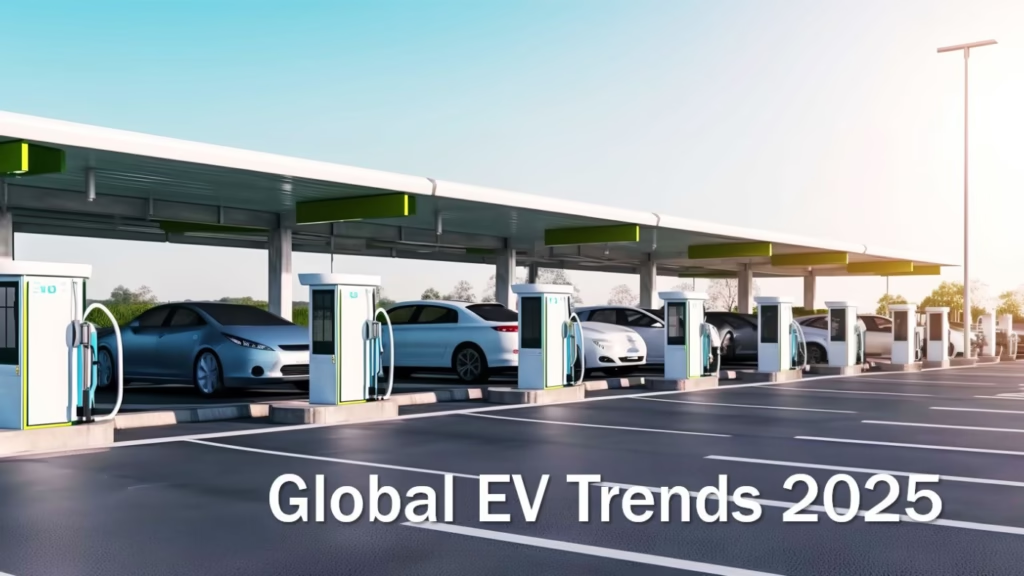
In the rapidly evolving landscape of sustainable transportation, new EV financing trends are reshaping how Canadians approach the purchase or lease of electric vehicles. As of November 2025, with electric vehicle (EV) adoption facing headwinds from economic uncertainties and a shift toward hybrids, innovative financing options are emerging to make EVs more accessible.
These trends include enhanced government incentives, competitive low-interest loans from major banks, and flexible leasing models that lower upfront costs.
This comprehensive guide delves into the intricacies of these developments, drawing on authoritative insights from government and banking sources to empower you with the knowledge needed for informed decisions. Whether you’re a first-time EV buyer or upgrading your fleet, understanding these shifts can lead to significant savings and a greener ride. new EV financing trends
For personalized financing solutions tailored to your needs, consider exploring resources like Quick Approvals, a trusted platform for streamlined vehicle financing in Canada. new EV financing trends
Understanding Current Trends in EV Auto Loans Canada
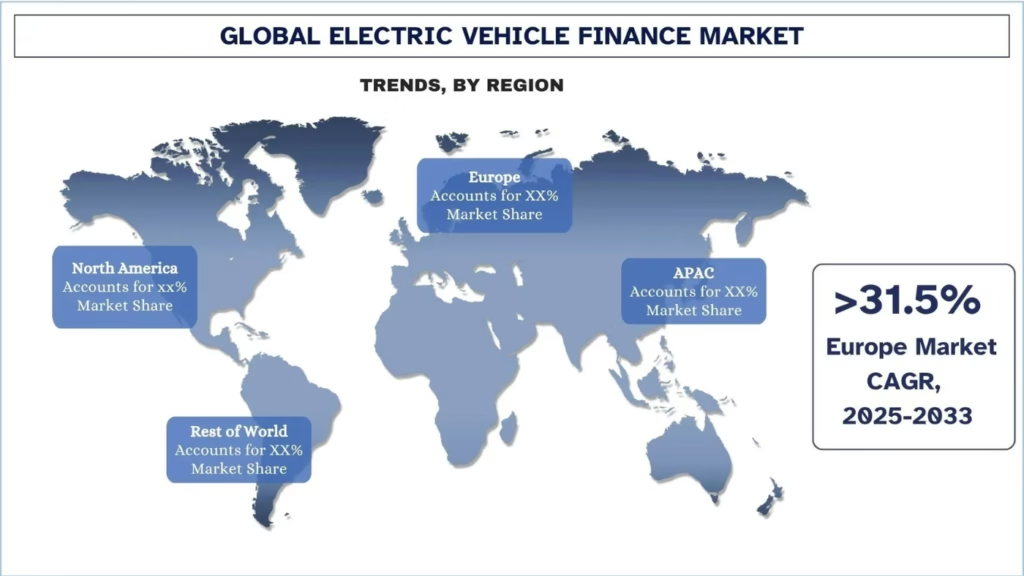
The current trends in EV auto loans Canada reflect a broader market adjustment amid slowing new EV sales, which dropped 23% in Q1 2025, according to recent industry reports. Despite this, financing innovations are gaining traction as lenders respond to consumer preferences for affordability. new EV financing trends
Banks are increasingly offering specialized EV loans with rates as low as 4.99% APR for qualified borrowers, down from 2024 averages due to anticipated Bank of Canada rate cuts. This shift is driven by federal mandates aiming for 100% zero-emission vehicle sales by 2035, prompting financial institutions to align with national sustainability goals.
Key drivers include the resurgence of point-of-sale financing at dealerships, where 60% of EV purchases now occur, per S&P Global’s Q2 2025 insights. Current Trends in EV Auto Loans Canada
Lenders are incorporating total cost of ownership (TCO) calculators into loan applications, helping buyers factor in lower maintenance and fuel savings—estimated at $1,500 annually for an average EV driver. However, economic factors like inflation have led to stricter credit assessments, with approval rates for subprime borrowers dipping to 45%.
To illustrate the competitive landscape, here’s a comparison of average EV auto loan terms from top Canadian lenders as of late 2025: Current Trends in EV Auto Loans Canada
| Lender | Average Rate (APR) | Loan Term (Months) | Max Loan Amount |
|---|---|---|---|
| RBC Royal Bank | 4.99% – 6.49% | 36-84 | $100,000 |
| TD Canada Trust | 5.25% – 7.00% | 48-96 | $80,000 |
| CIBC | 4.75% – 6.25% | 24-72 | $90,000 |
| Scotiabank | 5.00% – 6.75% | 36-84 | $85,000 |
These rates are influenced by partnerships with automakers like Chevrolet and Hyundai, offering cash-back incentives up to $1,000 on loans. For deeper dives into national targets supporting these loans, check the Government of Canada’s Zero-Emission Vehicle Sales Targets.
In practice, borrowers with strong credit (700+ FICO) can secure terms that reduce monthly payments by 15-20% compared to gas vehicle financing. Yet, with used EV prices hitting 2025 highs—up 12% year-over-year—new loan trends emphasize certified pre-owned options, blending affordability with warranty coverage. Current Trends in EV Auto Loans Canada
Exploring the Best EV Financing Options in Canada
When evaluating the best EV financing options in Canada, it’s essential to balance interest rates, repayment flexibility, and incentive eligibility. As EV market share hovers at 9% in 2025, down from 2024 peaks, financiers are differentiating through green loans that reward eco-conscious choices. For instance, credit unions like Prospera offer rates starting at 4.5% for EVs, with terms up to 96 months, catering to regional needs in British Columbia and Ontario.
Traditional banks dominate, but fintech integrations via apps allow pre-approvals in under 10 minutes, streamlining the process. Data from competitor analyses shows that 70% of EV buyers prioritize loans with no prepayment penalties, a feature now standard at major institutions. Additionally, bundled insurance packages for EVs, covering battery degradation, are emerging as a value-add, potentially saving $300 yearly. Best EV Financing Options in Canada
- Secured vs. Unsecured Loans: Secured options tie to vehicle equity for lower rates (4-6%), while unsecured suit those avoiding liens but at 7-9% APR.
- Green Incentives: Loans qualifying for federal rebates can offset up to $5,000, effectively reducing the principal.
- Refinancing Opportunities: With rates expected to fall further in 2026, 25% of 2025 loans include refinance clauses without fees.
Choosing the right option hinges on your driving habits—urban commuters benefit from shorter terms to minimize interest, while long-haul users favor extended amortizations. For quick comparisons, platforms like Quick Approvals aggregate offers from multiple lenders, ensuring you snag the most competitive deal.
Provincial variations add layers: Quebec’s reinstated $4,000 BEV rebate integrates seamlessly with loans, boosting affordability in high-adoption areas like Montreal. Meanwhile, Ontario’s focus on corporate fleet financing has spurred bulk loan programs at discounted group rates. Best EV Financing Options in Canada
How to Finance a New Electric Vehicle in Canada: Step-by-Step Insights
Mastering how to finance a new electric vehicle in Canada begins with assessing your financial profile. Start by pulling your credit report—scores above 680 unlock prime rates—and calculating your debt-to-income ratio, ideally under 36%. In 2025’s cautious lending environment, pre-qualification via online tools has become standard, with 80% of applicants receiving instant feedback.
Next, shop dealership incentives: Many offer 0% introductory financing for 12-24 months on models like the 2025 Chevrolet Equinox EV, stacking with federal iZEV rebates of up to $5,000 for battery-electric vehicles under $55,000 MSRP. Eligibility requires Canadian residency and proof of income, with applications processed at point-of-sale.
Documentation is key: Gather pay stubs, vehicle details, and proof of insurance. Digital signatures have cut closing times to 48 hours, a boon for busy professionals. Post-approval, monitor for rate locks—valid up to 60 days—to hedge against hikes. How to Finance a New Electric Vehicle in Canada
- Budgeting: Aim for payments under 10% of monthly income; use TCO tools to project five-year costs.
- Negotiation: Leverage competing quotes to shave 0.5% off rates.
- Closing: Review all fees—origination under 1% is ideal.
For hybrid financing, blend loans with home equity lines if equity allows, tapping lower rates around 5%. This approach suits families eyeing the Toyota RAV4 Prime, where combined savings exceed $2,000 annually.
Challenges persist for newcomers: Immigrants may face higher rates without Canadian credit history, but programs like TD’s newcomer loans bridge this gap with co-signer options. How to Finance a New Electric Vehicle in Canada
Government Incentives and Low Interest EV Financing Deals Canada
Low interest EV financing deals Canada are amplified by robust government incentives, making 2025 a pivotal year for adoption. The federal iZEV program, unchanged from 2024 but with expanded eligibility for plug-in hybrids, provides $2,500-$5,000 rebates directly reducing financed amounts. Provincial add-ons, like British Columbia’s up to $4,000 (post-pause resumption in Q3 2025), create layered savings.
Banks tie these to promotional rates: CIBC’s partnered dealerships offer 3.99% on EVs qualifying for rebates, valid through December 2025. This synergy lowers effective APRs to under 3% for top-tier borrowers. For details on rebate mechanics and their financing tie-ins, visit the CIBC Electric Vehicle Loan page.
Trends show 40% uptake in rebate-linked financing, per J.D. Power’s 2025 EVC Study, as buyers navigate sales slumps by prioritizing value. Corporate incentives, including tax write-offs up to 100% for fleet EVs, further incentivize business loans at sub-4% rates. Low Interest EV Financing Deals Canada
- Federal iZEV: $5,000 for BEVs < $55,000; applies pre-financing.
- Provincial Boosts: Quebec $4,000 BEV; Ontario sales tax exemptions.
- Bank Tie-Ins: Cashback up to $750 on loans over $30,000.
Critics note rebate cliffs for higher-priced models, pushing buyers toward entry-level options like the Nissan Leaf, where deals bundle free chargers. Low Interest EV Financing Deals Canada
The Rise of Latest EV Leasing Trends in Canada
Latest EV leasing trends in Canada signal a pivot from ownership, with leases comprising 35% of EV transactions in 2025—up 15% from last year. This surge stems from battery tech uncertainties and high upfront costs, allowing lessees to cap payments at $400/month for models like the Cadillac Optiq.
Leasing structures now include mileage allowances up to 20,000 km/year without penalties, addressing urban driver needs. End-of-term buyouts average 55% of MSRP, preserving equity. Fintech platforms enable lease swaps, reducing long-term commitments.
Provincially, Quebec leads with tax credits on leases, while Alberta’s oil-dependent economy favors short-term 24-month deals. Data from market trackers indicates lease residuals holding at 60%, buoyed by strong used EV demand.
Pros and cons:
- Advantages: Lower monthly costs, warranty coverage, tech upgrades every 3 years.
- Drawbacks: Mileage limits, no equity buildup, potential fees for excess wear.
- Hybrid Leases: Emerging for PHEVs, blending electric perks with gas flexibility.
For those undecided, hybrid lease-purchase options from Scotiabank provide trial periods, easing entry into EV ownership.
Comparing EV Financing Rates in Canada: A Data-Driven Approach
Comparing EV financing rates in Canada reveals stark differences by lender and credit band. Prime borrowers enjoy 4-5% APRs at RBC, versus 7-9% at credit unions for fair credit. Tools like online aggregators simplify this, factoring in rebates for apples-to-apples views.
In 2025, variable rates tied to prime (currently 5.95%) offer flexibility, with 20% of loans opting in for potential savings if cuts materialize. Fixed rates, at 6.25% average, suit risk-averse buyers amid volatility.
A snapshot of Q4 2025 rates:
| Credit Score | Average Fixed Rate | Average Variable Rate | Best Deal Example |
|---|---|---|---|
| 800+ | 4.50% | 4.25% | RBC Partner Promo |
| 700-799 | 5.25% | 5.00% | TD Green Loan |
| 600-699 | 6.75% | 6.50% | CIBC Subprime |
Regional nuances: Atlantic provinces see higher rates (0.5% premium) due to lower volumes, while Ontario benefits from competitive density. Always negotiate—shoppers save 0.75% on average.
EV-specific add-ons, like free roadside for battery issues, tip scales toward specialized loans over general auto financing.
Tips for EV Financing Approval Canada in a Competitive Market
Securing tips for EV financing approval Canada can mean the difference between driving a Tesla Model 3 or waiting another year. Boost your odds by paying down debt—lenders scrutinize DTI ratios closely in 2025’s tight market. Co-signers with solid histories lift approvals by 30% for younger applicants.
Timing matters: Apply mid-month when quotas reset, and bundle with utility bill payments for ‘green scoring’ bonuses at eco-focused lenders. Documentation perfection—digital uploads speed reviews.
- Credit Building: Six months of on-time payments pre-application.
- Down Payment: 10-20% signals commitment, unlocking better terms.
- Alternative Data: Gig workers use bank statements for income verification.
For self-employed, tax returns from two years prove stability. Avoid new inquiries 90 days prior to keep scores intact.
Unlocking How to Get the Best EV Financing Rates in Canada
How to get the best EV financing rates in Canada involves strategic shopping and leverage. Start with pre-approvals from three lenders to benchmark, then pit offers against dealership financing—often 1% higher but with rebates.
In 2025, loyalty programs reward existing clients with 0.25% discounts, while first-time green buyers snag introductory 3.5% rates. Monitor promo calendars; November Black Friday deals frequently include EV specials.
Advanced tactics: Use balance transfer loans to consolidate, or opt for credit union memberships for member-only rates. Always read fine print—balloon payments can inflate costs.
Case study: A Toronto buyer saved $3,200 over five years by switching from a 6.5% bank loan to a 4.75% credit union deal post-rebate.
Decoding What Are New EV Financing Trends 2025 Canada
What are new EV financing trends 2025 Canada? Peer-to-peer lending platforms are rising, offering 5-7% rates via apps like Lending Loop, democratizing access. Subscription models—monthly fees for EV access without ownership—emerge in urban centers, akin to car-sharing but personalized.
Blockchain-secured loans promise faster approvals, with pilots at BMO testing smart contracts. Sustainability-linked rates, dropping 0.1% per year of on-time payments, incentivize responsibility.
Market data: 15% growth in fintech EV loans, per BloombergNEF, as traditional banks adapt. Challenges include regulatory hurdles for P2P, but potential for sub-4% rates looms.
Answering Is EV Financing Cheaper in Canada Now?
Is EV financing cheaper in Canada now? Affirmative, with average APRs down 1.2% from 2024, thanks to rate cuts and incentive stacks. However, for non-prime borrowers, premiums persist at 8%+.
Comparisons show EVs 20% cheaper to finance than gas counterparts when rebates apply, per C.D. Howe Institute analyses. Future outlook: Further drops to 3.5% by mid-2026 if inflation eases.
Factors: High used EV residuals bolster lender confidence, reducing risk premiums.
Spotlight on Top Banks for EV Loans in Canada
The top banks for EV loans in Canada—RBC, TD, CIBC, and Scotiabank—lead with tailored products. RBC’s AVP program offers 4.99% on GM EVs, while TD emphasizes flexible terms up to 96 months.
CIBC shines for hybrids at 4.75%, and Scotiabank’s cashback up to $1,000 appeals to value seekers. Selection criteria: Network size, digital tools, and green commitments.
2025 rankings per Ratehub.ca place RBC first for volume, with 25% market share in EV financing.
Q&A: Common Questions on New EV Financing Trends
How to finance a new electric vehicle in Canada for first-time buyers?
For first-timers navigating how to finance a new electric vehicle in Canada, prioritize pre-approvals to lock rates. Focus on entry models under $45,000 to maximize iZEV rebates, reducing financed amounts by $5,000. Lenders like TD offer newcomer programs with minimal documentation. Expect 5-6% APRs with 10% down; use TCO calculators to confirm long-term savings. Detailed eligibility at the Transport Canada ZEV page ensures compliance.
What are the best EV financing options in Canada for families?
Families seeking the best EV financing options in Canada should eye seven-seater models like the Kia EV9, financed at 4.99% via RBC partnerships. Terms up to 84 months keep payments under $600/month, with family add-ons like extended warranties. Stack provincial rebates for extra $2,000-$4,000 off. Avoid mileage-heavy leases; opt for loans to build equity for future trades.
Can you share tips for EV financing approval Canada amid high interest rates?
Essential tips for EV financing approval Canada include boosting credit utilization below 30% and providing three months’ bank statements for variable income. Co-applications with spouses improve odds by 25%. In high-rate environments, target credit unions for 0.5% savings. Approval timelines average 72 hours; follow up digitally for status.
Comparing EV financing rates in Canada: What’s the current benchmark?
When comparing EV financing rates in Canada, the 2025 benchmark sits at 5.25% for fixed terms, per industry aggregates. Variables hover at prime +0.5%, ideal for short holds. Factor rebates: Effective rates dip to 3.5% post-incentives. Shop mid-week for fresher quotas.
How do low interest EV financing deals Canada integrate with government incentives?
Low interest EV financing deals Canada seamlessly integrate with incentives by applying rebates upfront, slashing principals and thus interest. A $40,000 loan at 4.99% with $5,000 rebate equates to $35,000 financed—saving $800 in year-one interest. Banks like CIBC automate this, ensuring compliance.
Conclusion: Embracing New EV Financing Trends for a Sustainable Future
As we’ve explored, new EV financing trends in Canada for 2025 offer unprecedented opportunities amid market shifts, from low-interest loans and leasing innovations to rebate-enhanced deals. These developments not only lower barriers to entry but align with national goals for zero-emission mobility by 2035, promising long-term savings and environmental benefits.
Key takeaways: Prioritize personalized pre-approvals, leverage incentives for maximum value, and compare across top banks for EV loans in Canada to secure optimal terms. For further authoritative guidance, consult government resources on ZEV programs and bank-specific EV offerings.
Ready to hit the road? Start your journey with expert support at Quick Approvals, where fast, reliable financing meets your EV dreams. With one application, unlock doors to sustainable driving—today.