
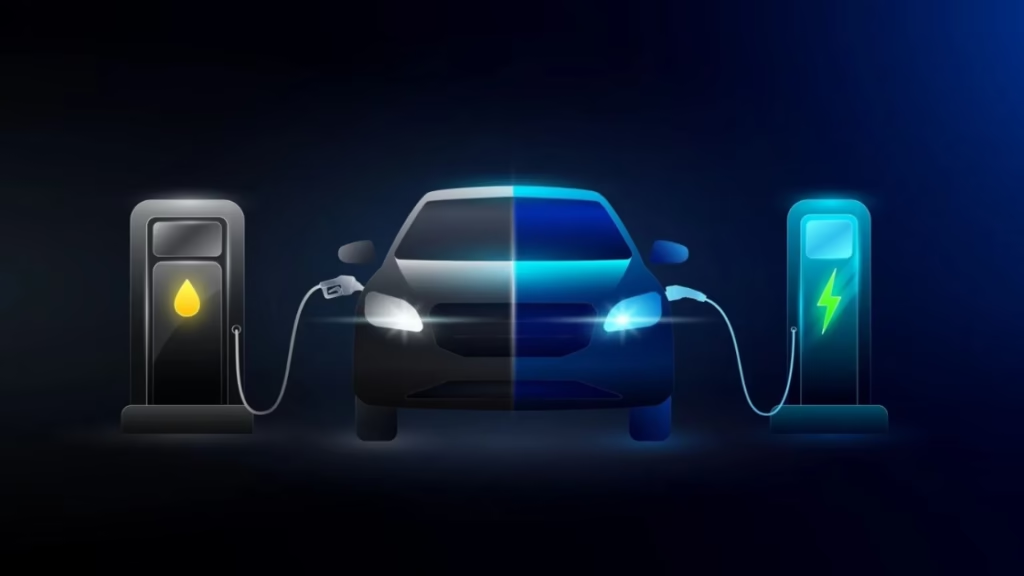
Buying a fuel-efficient vehicle can make financial sense, but the purchase price of a hybrid can still create a significant upfront challenge. For many Canadians, the right financing structure is what turns a more efficient vehicle into a manageable monthly expense. Understanding hybrid vehicle loans Canada before visiting a dealership can help you compare borrowing costs, evaluate incentives, choose an appropriate loan term and avoid focusing only on the monthly payment.
If you are ready to explore financing options, Quick Approvals Canada provides an online starting point for Canadian vehicle financing at https://quickapprovals.ca/. The most important principle is simple: do not choose financing because the payment looks affordable; compare the rate, total borrowing cost, term, fees, vehicle price and any applicable incentive together. hybrid vehicle loans Canada
What Are Hybrid Vehicle Loans Canada?
A hybrid vehicle loan Canada is an auto financing arrangement used to purchase a hybrid vehicle, with the borrower repaying the amount financed over an agreed term plus interest. The financing itself generally works like other auto loans: the lender assesses the borrower and vehicle, determines the terms available, and the borrower makes scheduled payments until the balance is repaid.
Hybrid vehicle loans Canada can be available through dealerships, banks, credit unions, finance companies and automotive financing intermediaries. The Financial Consumer Agency of Canada confirms that Canadians can arrange vehicle financing through dealerships or directly through a financial institution, and recommends comparing the complete cost of competing offers rather than looking only at the payment.
A hybrid can also create a different budgeting calculation because fuel efficiency may affect ongoing ownership costs. However, fuel savings should never be used as a reason to accept an unnecessarily expensive loan. The correct approach is to compare the vehicle’s purchase price, financing cost, insurance, maintenance, expected fuel consumption and available incentives.
For buyers considering hybrid car financing rates Canada, the strongest offer is not automatically the one with the lowest advertised rate; it is the financing package that produces a sustainable payment and reasonable total cost while matching the vehicle and borrower’s financial position.
How Hybrid Financing Works in Canada

When applying for hybrid auto financing Canada, a lender typically evaluates factors such as credit history, income, existing debt obligations, employment or income stability, down payment and the vehicle being financed. A stronger application may provide access to more competitive financing, while borrowers with more challenging credit profiles may still have financing options but could face higher borrowing costs.
Hybrid vehicle loans Canada may be available for both new and used vehicles, although lender policies concerning vehicle age, mileage, price and maximum financing amount can vary considerably.
The financing amount is also influenced by the vehicle’s negotiated purchase price and the amount you contribute upfront. A larger down payment reduces the principal that must be borrowed, which can reduce interest costs and monthly payments.
Trade-in equity can have a similar effect when the trade-in value exceeds any remaining loan balance. For plug-in hybrid auto loans Canada, buyers should also establish whether an applicable government incentive is deducted from the transaction at the dealership or otherwise incorporated into the purchase calculation before finalizing the loan.
Hybrid vs. Plug-In Hybrid: Why the Difference Matters
A conventional hybrid combines an internal-combustion engine with electric propulsion and normally does not require external charging. A plug-in hybrid can generally be charged externally and has a larger battery designed to provide more electric driving capability. This distinction matters when researching hybrid vehicle loans Canada because government incentive eligibility is not necessarily the same for every type of electrified vehicle.
Canada’s 2026 Electric Vehicle Affordability Program provides incentives for eligible zero-emission vehicles and plug-in hybrid electric vehicles. Transport Canada states that eligible plug-in hybrids can receive up to $2,500 in 2026, subject to the program’s eligibility requirements. The program applies to eligible purchases and leases and has specific rules concerning vehicle type, transaction value, manufacturing location and timing.
This means consumers researching plug-in hybrid auto loans Canada should not assume that every hybrid qualifies. A conventional hybrid and a plug-in hybrid can have different incentive treatment. Always verify the specific vehicle and transaction before including an incentive in your affordability calculation.
Hybrid Car Financing Rates Canada: What Determines Your Cost?
There is no single rate that applies to every borrower seeking hybrid car financing rates Canada. The rate offered can depend on credit history, income, debt obligations, vehicle characteristics, loan amount, loan term and lender policy. Promotional manufacturer financing can sometimes be attractive for specific vehicles, while a bank, credit union or independent lender may be more competitive in another situation.
Canada’s broader interest-rate environment also influences borrowing conditions. As of July 15, 2026, the Bank of Canada target for the overnight rate was 2.25%. However, a central-bank policy rate is not the same thing as the rate a consumer receives on an auto loan.
For that reason, hybrid car financing rates Canada should be compared using actual personalized loan offers rather than relying on a general advertised figure. Two borrowers purchasing the same hybrid may receive different rates because their financial profiles and lender risk assessments differ.
Hybrid Loan Cost Example
Consider a hypothetical $35,000 vehicle purchase where the borrower makes a $5,000 down payment, leaving $30,000 to finance. The following illustration uses hypothetical rates solely to demonstrate how the payment and total interest can change.
| Example | Amount Financed | Hypothetical Rate | Term | Approx. Monthly Payment | Approx. Total Payments |
|---|---|---|---|---|---|
| A | $30,000 | 5% | 60 months | $566 | $33,975 |
| B | $30,000 | 7% | 60 months | $594 | $35,642 |
| C | $30,000 | 9% | 60 months | $623 | $37,386 |
| D | $30,000 | 7% | 84 months | $453 | $38,027 |
These figures are illustrative estimates and exclude taxes, fees, insurance and other transaction costs. The example demonstrates an important point about best hybrid vehicle loans Canada: a lower monthly payment does not necessarily mean a cheaper loan. Extending the term can reduce the monthly obligation while increasing the amount paid over the life of the financing. FCAC similarly warns that longer vehicle-loan terms can reduce payments but increase total interest costs.
Step-by-Step Guide to Getting Hybrid Financing
1. Establish Your Realistic Budget
Start with the maximum monthly vehicle cost you can comfortably maintain rather than the maximum amount a lender may approve. A responsible hybrid vehicle loan Canada budget should account for the loan payment, insurance, fuel, maintenance, registration and other regular transportation expenses. Leaving room for unexpected expenses is particularly important because vehicle ownership is a long-term financial commitment.
2. Check Your Credit Position
Before applying for hybrid vehicle loans Canada, review your credit information and make sure the information used by lenders is accurate. Your credit history can influence both approval and the cost of borrowing. If your credit profile has recently improved, documenting stable income and responsible debt management may strengthen your application.
3. Compare Vehicles Before Financing
Do not start with a loan amount and then search for a vehicle that fits it. Start with several vehicles that meet your transportation requirements, compare their purchase prices and operating characteristics, and then determine which one fits your budget. This approach helps prevent a financing structure from encouraging you to purchase a more expensive vehicle than necessary.
4. Obtain Financing Options
You may explore a bank, credit union, dealership financing arrangement, independent lender or financing service. FCAC notes that dealership financing may involve manufacturer finance divisions, banks, credit unions or independent finance companies. For hybrid vehicle loans Canada, obtaining more than one offer can provide a useful benchmark before you negotiate the final transaction.
5. Verify Incentives
If you are purchasing a plug-in hybrid, check whether the exact model appears on the current federal eligibility list. Under the 2026 EVAP, eligible PHEVs can receive up to $2,500, but eligibility depends on specific program rules.
6. Compare the Complete Contract
Before signing, compare the annual interest rate, payment frequency, term, amount financed, total borrowing cost, fees, optional products and early-payment provisions. This is essential when comparing best hybrid vehicle loans Canada, because an attractive headline rate can be offset by other costs or a longer term.
Eligibility and Documentation for Hybrid Vehicle Financing
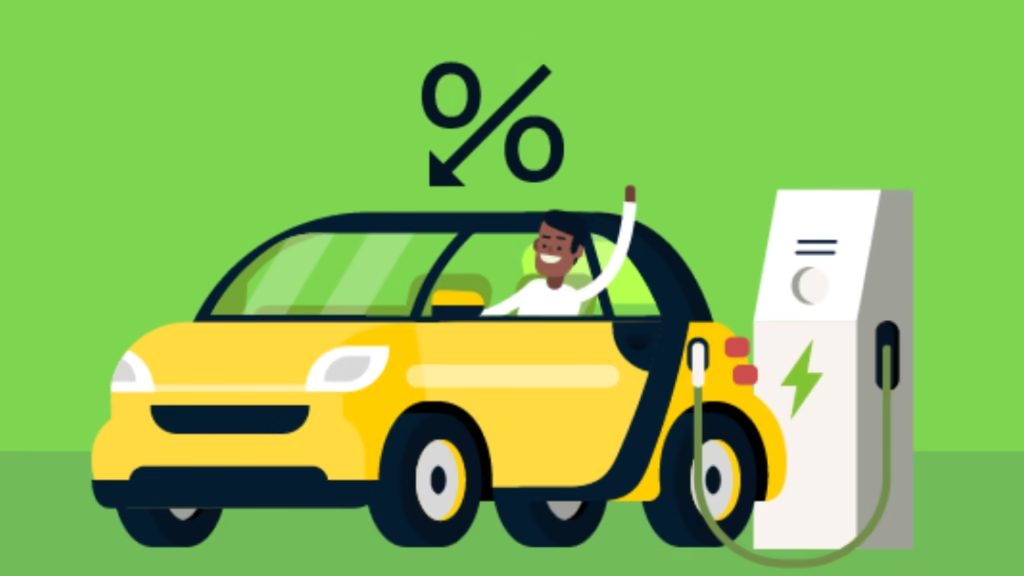
Eligibility for hybrid vehicle loans Canada varies by lender, but borrowers should generally be prepared to demonstrate identity, income and residence and provide information about the vehicle. Depending on the application, lenders may request employment or income documentation, banking information, identification, insurance information and details about the vehicle.
Credit history is another important consideration. Borrowers with strong credit may have access to more competitive rates, while borrowers with limited or damaged credit may need to consider lenders with broader underwriting criteria. A co-borrower or larger down payment may sometimes strengthen an application, but neither should be assumed to guarantee approval.
For plug-in hybrid auto loans Canada, vehicle eligibility for an incentive is separate from credit approval. A borrower can qualify for financing but not qualify for an incentive if the vehicle or transaction does not meet program requirements. Conversely, qualifying for an incentive does not guarantee that a lender will approve the requested loan.
Incentives for Hybrid Financing Canada: What Buyers Should Know
The 2026 federal Electric Vehicle Affordability Program is particularly relevant to plug-in hybrid shoppers. Transport Canada states that the program can provide up to $2,500 for eligible plug-in hybrid vehicles in 2026. Eligible vehicles generally must meet requirements involving transaction value, manufacturing location, safety standards and vehicle status.
The program is designed to apply incentives at the point of sale through enrolled dealerships or authorized sellers rather than requiring consumers to wait for a later reimbursement. Transport Canada also states that financing is not required to receive the incentive; eligible cash purchases, financed purchases and qualifying leases can qualify.
This makes incentives for hybrid financing Canada an important consideration, but buyers should verify the exact model and transaction before relying on an incentive in their budget. The incentive levels are scheduled to decline over the program period, meaning a vehicle eligible for a certain maximum in 2026 may have a lower maximum in a later year.
Banks vs. Lenders vs. Brokers for Hybrid Financing
| Financing Source | Potential Advantage | Potential Limitation | Best For |
|---|---|---|---|
| Banks | Established relationship and conventional lending | May have stricter underwriting | Strong credit profiles |
| Credit Unions | Community-based lending and personalized service | Membership or regional requirements may apply | Eligible local members |
| Dealership Financing | Convenient and integrated with vehicle purchase | Easy to focus on payment instead of total cost | Buyers wanting convenience |
| Independent Lenders | May consider broader borrower profiles | Rates can vary significantly | Non-traditional credit situations |
| Financing Brokers | Can help compare lender options | Terms depend on lenders in their network | Borrowers seeking multiple options |
The best choice depends on the borrower’s circumstances. Best hybrid vehicle loans Canada does not mean one universal lender or financing channel. A strong borrower may prioritize the lowest total cost, while another borrower may place greater importance on flexible approval criteria.
Canadian Case Study: Strong Credit Buyer
Consider a hypothetical Ontario buyer purchasing a $40,000 hybrid and putting $8,000 down. The buyer has stable employment, manageable debt and strong credit. Instead of accepting the first dealership offer, the buyer obtains several financing quotes and compares the effective borrowing cost.
The buyer discovers that one offer has a slightly lower monthly payment but a longer term, while another has a higher monthly payment but substantially lower total interest. The second option fits comfortably within the household budget. Choosing the shorter term may therefore make more sense even though the monthly payment is higher. This illustrates why hybrid car financing rates Canada should always be evaluated alongside loan duration and total repayment cost.
Canadian Case Study: Borrower With Challenging Credit
Now consider a hypothetical Canadian borrower whose credit history includes previous missed payments. The borrower needs a reliable vehicle but cannot qualify for the most competitive prime financing. Rather than applying repeatedly without a strategy, the borrower prepares proof of stable income, establishes a realistic vehicle budget, considers a larger down payment and compares lenders whose criteria may better match the application.
In this situation, hybrid vehicle loans Canada may still be available, but the borrower should be particularly careful about interest cost. A lower-priced hybrid with a manageable loan amount can sometimes be financially healthier than stretching to purchase a more expensive model at a high rate.
How to Improve Your Approval Chances
Preparation can make the hybrid vehicle loan Canada process more efficient. Start by knowing your approximate credit position and monthly budget. Gather current proof of income and identification before submitting an application. Reduce unnecessary outstanding debt where practical, avoid taking on new credit immediately before a major vehicle purchase, and establish how much you can provide as a down payment.
Vehicle selection also matters. A lender may evaluate the vehicle’s age, mileage, price and resale characteristics in addition to the borrower. Choosing a vehicle that fits both your personal requirements and a lender’s financing parameters can reduce unnecessary delays.
For plug-in hybrid auto loans Canada, verify the incentive eligibility before signing the final purchase agreement. Ask the dealership to clearly show the incentive and other credits in the transaction documentation rather than assuming that the advertised vehicle price automatically includes every available benefit.
Expert Tips for Faster Financing Decisions
Prepare Your Documents in Advance
Having identification, income documentation, residence information and vehicle details ready can make an application easier to process. Incomplete information can lead to additional requests and delays.
Know Your Maximum Payment
Do not allow a salesperson or lender to define affordability solely through a monthly payment. Decide your preferred maximum payment before negotiating. Then evaluate whether the proposed term and total cost are reasonable.
Negotiate the Vehicle Price Separately
Whenever possible, understand the negotiated vehicle price before becoming distracted by financing discussions. Separating these decisions makes it easier to see how much you are actually paying for the vehicle and how much financing costs you.
Compare Total Cost
When comparing hybrid vehicle loans Canada, use the same vehicle price, down payment and loan term wherever possible. This makes differences between financing offers easier to identify.
Verify Every Incentive
Government programs can change, and not every hybrid qualifies. Transport Canada’s current vehicle list should be checked for specific eligibility before a buyer assumes an incentive is available.
Critical Mistakes to Avoid
One of the most expensive mistakes is choosing financing based solely on the lowest monthly payment. A longer loan term can make a vehicle appear affordable while increasing the total amount paid. FCAC specifically advises consumers to consider the interest rate, payment schedule, financing fees, amount financed and loan length when comparing auto financing.
Another mistake is assuming that every hybrid receives the same government treatment. The 2026 federal EVAP distinguishes between battery-electric, fuel-cell and plug-in hybrid vehicles, and eligibility depends on specific vehicle and transaction requirements.
Buyers should also avoid ignoring negative equity on a trade-in. If the existing vehicle is worth less than the outstanding loan balance, rolling that difference into a new hybrid vehicle loan Canada can substantially increase the amount borrowed. Finally, do not sign until you understand optional insurance, warranties, protection products, administrative charges and the complete repayment obligation.
Frequently Asked Questions
Are hybrid vehicle loans available in Canada?
Yes. Hybrid vehicle loans Canada can be available through dealerships, banks, credit unions, independent finance companies and other automotive financing channels. Approval and pricing depend on factors such as the borrower’s credit profile, income, debt obligations, vehicle and requested loan structure. The Financial Consumer Agency of Canada confirms that Canadians can arrange car financing through dealerships or directly through financial institutions.
Can I finance a plug-in hybrid and receive a government incentive?
Potentially. Plug-in hybrid auto loans Canada can be used to finance an eligible vehicle, and Transport Canada’s 2026 EVAP provides up to $2,500 for eligible plug-in hybrid vehicles. However, the exact vehicle and transaction must meet the program requirements. Financing itself does not determine eligibility because eligible cash purchases can also qualify.
What are the best hybrid vehicle loans Canada?

The best hybrid vehicle loans Canada depend on your individual financial circumstances. Compare personalized rates, total interest, loan terms, fees and repayment flexibility rather than choosing a lender based solely on advertising. A borrower with excellent credit may prioritize the lowest available rate, while a borrower with challenging credit may need to prioritize approval accessibility and affordability.
Are hybrid financing rates lower than regular car loans?
There is no universal rule that hybrid car financing rates Canada are always lower than rates for conventional vehicles. Rates depend on the borrower, lender, vehicle, promotion and market conditions. A manufacturer may offer promotional financing on a particular hybrid, while another lender may offer a better rate on a different vehicle or borrower profile. Always compare actual offers.
Can I get a hybrid loan with bad credit?
Potentially. Borrowers with damaged or limited credit may still find hybrid vehicle loans Canada through lenders with broader credit criteria. However, less competitive credit can result in higher interest costs. A lower-priced vehicle, larger down payment, stable income and realistic loan amount can help create a more manageable application. Never choose a loan that leaves insufficient room for essential household expenses.
What incentives for hybrid financing Canada are available in 2026?
The federal EVAP provides up to $2,500 for eligible plug-in hybrid vehicles in 2026. The program has specific eligibility requirements and the incentive amount is scheduled to decline over time. Provincial and territorial programs can also change, so buyers should verify current programs for their location.
Should I choose a longer hybrid loan term to lower my payment?
A longer term can lower the monthly payment, but hybrid vehicle loans Canada with longer repayment periods can cost more in total interest. FCAC’s example shows that extending a $25,000 car loan from 36 to 84 months at 5% increases the total cost despite reducing the payment. Consider the shortest term that produces a comfortable and sustainable payment rather than automatically choosing the longest available term.
How can I compare hybrid financing offers properly?
For best hybrid vehicle loans Canada, compare offers using the same vehicle price, down payment and term. Review the interest rate, payment frequency, financing fees, amount financed, total repayment and any optional products. Also verify whether an applicable incentive has been properly reflected in the purchase documentation. This gives you a more accurate picture than comparing monthly payments alone.
Final Thoughts on Hybrid Vehicle Loans Canada
Choosing hybrid vehicle loans Canada is about more than securing approval for a fuel-efficient vehicle. The strongest financing decision balances the purchase price, interest rate, loan term, down payment, total repayment cost, vehicle ownership expenses and any applicable government incentive. In 2026, the federal EVAP adds another important consideration for eligible plug-in hybrid buyers, with incentives of up to $2,500 subject to program rules and available funding.
Before signing, compare multiple financing options, verify the exact vehicle’s incentive eligibility, understand every fee and calculate the total cost of borrowing. If you want to begin comparing financing possibilities, visit https://quickapprovals.ca/ and submit your information for consideration. A well-prepared application and a disciplined comparison process can help you find financing that fits your budget rather than forcing your budget to fit the loan.
Internal Links for QuickApprovals.ca
- https://quickapprovals.ca/
- https://quickapprovals.ca/car-loans-with-early-payoff-options-in-canada/
- https://quickapprovals.ca/car-loan-terms-in-canada/
- https://quickapprovals.ca/car-loans-for-eco-friendly-cars-in-canada/
- https://quickapprovals.ca/car-loan-for-electric-vehicles-canada/
- https://quickapprovals.ca/hybrid-car-loan-calculator-canada/
Authority Outbound References
- Government of Canada — Financial Consumer Agency of Canada: Car Financing
https://www.canada.ca/en/financial-consumer-agency/services/loans/financing-car.html - Government of Canada — Shopping Around for Auto Financing
https://www.canada.ca/en/financial-consumer-agency/services/loans/financing-car/shop-around.html - Transport Canada — Electric Vehicle Affordability Program
https://tc.canada.ca/en/road-transportation/innovative-technologies/electric-vehicles/electric-vehicle-affordability-program - Transport Canada — EVAP Vehicle Eligibility List
https://tc.canada.ca/en/road-transportation/innovative-technologies/electric-vehicles/electric-vehicle-affordability-program-evap/electric-vehicle-affordability-program-vehicle-list - Bank of Canada — Policy Interest Rate
https://www.bankofcanada.ca/core-functions/monetary-policy/key-interest-rate/ - Natural Resources Canada — Financial Incentives by Province and Territory
https://natural-resources.canada.ca/energy-efficiency/home-energy-efficiency/financial-incentive-province