
How Does EV Car Loan Work in Canada, In today’s eco-conscious world, understanding How Does EV Car Loan Work in Canada is essential for Canadians looking to switch to sustainable transportation without breaking the bank. As electric vehicles (EVs) gain popularity amid rising fuel costs and environmental concerns, financing these green machines has become a key consideration for buyers.
This comprehensive guide dives deep into the mechanics of EV loans, from application processes to repayment structures, helping you navigate the landscape with confidence. Whether you’re eyeing a sleek Tesla or a practical Nissan Leaf, grasping the fundamentals ensures you secure terms that align with your budget and lifestyle. For further insights from authoritative sources like government programs and major banks, resources such as the federal Incentives for Zero-Emission Vehicles (iZEV) program overview can provide valuable details on rebates that impact financing. And for quick, tailored options, check out Quick Approvals, a reliable platform for fast loan pre-approvals.
How Does EV Car Loan Work in Canada, The shift toward EVs in Canada isn’t just a trend—it’s a necessity driven by government targets for zero-emission vehicles by 2035. With sales dipping slightly in mid-2025 due to incentive pauses, potential buyers are turning to loans more than ever to bridge the upfront cost gap. This article explores everything from eligibility criteria to interest rate trends, drawing on data from banks and provincial programs to empower your decision-making. By the end, you’ll not only know How Does EV Car Loan Work in Canada but also how to optimize your financing for long-term savings on charging versus gas.
Understanding How Does EV Car Loan Work in Canada
How Does EV Car Loan Work in Canada, At its core, an EV car loan functions much like a traditional auto loan, but with nuances tailored to the unique aspects of electric vehicles. You borrow a lump sum from a lender—be it a bank, credit union, or dealership partner—to cover the vehicle’s purchase price, minus any down payment or incentives. Repayment occurs over a fixed term, typically 36 to 96 months, through monthly installments that include principal and interest. What sets EV loans apart is their integration with green incentives, which can reduce the effective loan amount upfront.
The application process begins with a credit check, income verification, and vehicle appraisal. Lenders assess your debt-to-income ratio, ensuring it stays below 40% to qualify. Once approved, funds are disbursed directly to the dealer, and you drive off with ownership transferring upon full payoff. Unlike leases, loans build equity in the vehicle, allowing resale or trade-in value to offset future costs. In 2025, with EV prices stabilizing around $45,000-$60,000 for mid-range models, loans average $30,000-$50,000, with terms extending up to eight years for lower monthly payments.
Interest accrues daily on the outstanding balance, compounded monthly, so early payments reduce total costs. Many lenders offer flexible schedules—bi-weekly or accelerated—to align with pay cycles, potentially shaving years off the loan. Security is key: The vehicle serves as collateral, meaning default could lead to repossession, but strong borrower protections under Canadian law require fair notice periods.
To illustrate the workflow: How Does EV Car Loan Work in Canada
- Pre-Approval: Submit financial docs online for a soft credit pull, getting a rate quote in minutes.
- Vehicle Selection: Choose an eligible EV and apply incentives at purchase.
- Closing: Sign docs at the dealership; funds transfer instantly.
- Repayment: Auto-debit setup with options for overpayments without penalties.
This streamlined process makes EV ownership accessible, especially as battery tech improves resale values. For newcomers or those rebuilding credit, programs like RBC’s Newcomer Automotive Loan ease entry without a long Canadian history.
Delving deeper, consider the tax implications: Loan interest isn’t deductible for personal vehicles, but EV-specific rebates act like instant discounts. In Quebec, for instance, the Roulez vert program stacks with loans, effectively lowering your financed amount by up to $7,000. Across Canada, expect origination fees of 1-2% and potential gap insurance add-ons for battery coverage.
Real-world example: A Toronto buyer financing a $55,000 Hyundai Ioniq 5 at 5.5% over 60 months pays about $1,050 monthly, totaling $13,000 in interest. With a $4,000 provincial rebate, that drops to $980/month— a 7% savings. Understanding these levers is crucial for affordability.
Moreover, digital tools from lenders like TD simplify simulations, factoring in charging costs (averaging $0.03/km versus $0.15/km for gas). As EV infrastructure expands with 20,000+ public chargers nationwide, loan calculators now include home installation financing, bundling up to $2,000 for Level 2 setups.
In essence, How Does EV Car Loan Work in Canada boils down to balancing upfront incentives with long-term payments, tailored to your financial profile for sustainable mobility.
Exploring the Best EV Car Loans Canada 2025
As we navigate 2025, selecting the best ev car loans canada 2025 requires comparing rates, terms, and perks from top providers. With the Bank of Canada holding rates steady at 4.25%, EV loans hover between 4.99% and 7.99% for prime borrowers, down from 2024 peaks. Credit unions like Prospera offer member-exclusive rates as low as 4.5%, while big banks provide nationwide access.
RBC’s Clean Energy Vehicle Program stands out for its eight-year terms and no-prepayment penalties, ideal for high-mileage drivers. TD Auto Finance integrates seamlessly at dealerships, with renewal options for future EVs. For bad credit, alternative lenders cap at 10-12%, but pair well with co-signers.
Key factors for the best: Best EV Car Loans Canada 2025
- Low APR: Aim under 6% with scores above 720.
- Long Terms: 72-96 months for payments under $600 on $40,000 loans.
- Incentive Stacking: Loans that apply rebates pre-interest calculation.
According to aggregated data, top picks include: Best EV Car Loans Canada 2025
| Provider | Avg. Rate (2025) | Max Term | EV Perks |
|---|---|---|---|
| RBC Royal Bank | 5.25% | 96 months | Special manufacturer rates |
| TD Canada Trust | 5.50% | 84 months | Rebuild credit options |
| Prospera CU | 4.75% | 72 months | Home charger bundling |
| CIBC | 5.00% | 96 months | 0% promo for select models |
This table highlights competitive edges, with CIBC’s green vehicle promos often dipping to 0% for 36 months on eligible Hyundais. Shop around via pre-approvals to lock rates, as volatility from U.S. tariffs could nudge them up by year-end.
Beyond numbers, the best loans offer transparency—no hidden fees—and digital dashboards for tracking. In Alberta, where oil prices fluctuate, fixed-rate EV loans provide stability over variable gas costs. Pair with apps like PlugShare for route planning to maximize ROI.
Ultimately, the best ev car loans canada 2025 align with your province’s incentives, ensuring holistic savings.
EV Financing Options for Electric Vehicles Canada Demystified
EV financing options for electric vehicles canada extend beyond standard loans to include leases, personal lines, and green bonds. Leases appeal for lower upfronts ($300-$500/month), but cap mileage at 20,000 km/year with buyout clauses. Personal loans from banks like Scotiabank offer unsecured flexibility up to $50,000 at 6-8%.
Government-backed options, like BC Hydro’s rebates, fold into financing for seamless application. For fleets, commercial EV loans from Desjardins provide bulk discounts. In 2025, hybrid models qualify for partial incentives, broadening choices.
Pros of diverse options: EV Financing Options for Electric Vehicles Canada
- Leasing: Tax benefits for businesses; easy upgrades every 3 years.
- Loans: Ownership equity; no mileage limits.
- Lines of Credit: Draw as needed for accessories like solar tie-ins.
Choosing depends on usage: Commuters favor loans for longevity, while urbanites opt for leases amid dense charging networks. With EV market share at 12% in Q3 2025, financing evolves to include battery warranties up to 10 years/160,000 km.
EV Financing Options for Electric Vehicles Canada, Explore these via Quick Approvals for personalized simulations, saving hours of legwork.
Are EV Loans Different from Regular Car Loans Canada?
Yes, are ev loans different from regular car loans canada? Subtly so. Both use similar structures—secured, amortized repayments—but EV loans often feature lower rates (0.5-1% discounts) due to green mandates. Lenders like BMO incentivize with waived fees for EVs under $55,000 MSRP.
Differences include: Are EV Loans Different from Regular Car Loans Canada
- Incentives: EV rebates reduce principal; gas loans lack this.
- Depreciation: Slower for EVs (20% year one vs. 25% for ICE), improving equity.
- Collateral: Battery health clauses in some contracts.
Regular loans suit budget hybrids, but EV versions integrate charging credits. In Ontario, EV loans average 5.8% vs. 6.5% for gas, per 2025 benchmarks. Transitioning? Factor total ownership costs—EVs save $1,500/year on fuel.
This distinction underscores why prioritizing EV-specific products yields better outcomes.
Provincial Incentives for EV Purchases Canada and Loan Impacts
Provincial incentives for ev purchases canada vary widely, directly influencing loan affordability. With federal iZEV paused since January 2025, provinces lead: Quebec’s $7,000 Roulez vert for BEVs stacks with loans, slashing financed amounts. BC offers up to $4,000 income-based, while PEI and NB match $5,000.
Provincial Incentives for EV Purchases Canada, Alberta’s $3,000 for low-emission vehicles pairs with utility rebates. Nova Scotia ended its program mid-year, shifting focus to loans. These incentives apply at point-of-sale, reducing your loan principal and interest accrual.
| Province | BEV Rebate | PHEV Rebate | Loan Integration |
|---|---|---|---|
| Quebec | $7,000 | $3,500 | Direct deduction |
| British Columbia | $4,000 | $2,000 | Income-tested |
| Ontario | $0 (federal only) | $0 | Dealer financing |
| Prince Edward Island | $5,000 | $2,500 | Up to $55k MSRP |
| New Brunswick | $3,000 | $1,500 | Ended July 2025 |
Saskatchewan and Manitoba lag with minimal support, pushing reliance on bank promos. Impacts? A $5,000 rebate on a $50,000 loan at 5% over 60 months saves $800 in interest. Always verify eligibility—MSRP caps apply.
Provincial Incentives for EV Purchases Canada, For updates, consult provincial transport sites alongside tools from Quick Approvals.
How to Get 0% Financing for EV in Canada
Achieving how to get 0% financing for ev in canada is challenging but possible through dealership promos. In 2025, models like the Chevrolet Equinox EV or Polestar 2 offer 0% for 60-84 months, but require 20% down and scores over 800. Steps include:
- Boost Credit: Pay down debt; aim for 760+.
- Shop Promotions: Monitor GM, Hyundai sites for seasonal deals.
- Negotiate: Bundle with trade-ins for better terms.
- Pre-Approve: Use banks as leverage.
These are subsidized by manufacturers, covering interest to boost sales amid 35% Q2 dips. Caveat: Shorter terms mean higher payments—$700/month on $40,000. Not universal; Atlantic provinces see fewer offers.
Alternative: CIBC’s green loans dip to 1.99% with excellent profiles. Patience pays—fall clearances often unlock zeros.
Current EV Car Loan Rates Canada 2025
Ev car loan rates canada 2025 average 5.25% for new EVs, per Bank of Canada trends, with primes at 4.5-5.5%. Used rates climb to 6-8%, reflecting depreciation risks. Factors: Inflation at 2.1% stabilizes, but global chip shortages linger.
Big Five banks: RBC 5.25%, TD 5.50%, CIBC 5.00% for greens. Regionally, Prairies average 6.2% due to lower volumes. Fixed vs. variable: 80% choose fixed for predictability.
Pro tip: Refinance post-incentive if rates drop, saving $1,000+ yearly. Track via financial news for Q4 adjustments.
Is Leasing or Buying EV Better in Canada?
Deciding is leasing or buying ev better in canada hinges on horizons. Buying builds equity—$10,000 after three years on a $50,000 EV—ideal for long-haul. Leasing caps at $0.10/km overage but includes maintenance, suiting 15,000 km/year drivers.
Costs: Buy $650/month loan vs. $450 lease, but ownership yields $20,000 resale. Tax perks favor leases for corps. In 2025, with battery life at 200,000 km, buying edges for sustainability.
Hybrid approach: Lease-to-own hybrids both worlds.
Used EV Car Loan Eligibility Canada Criteria
Used ev car loan eligibility canada mirrors new but scrutinizes mileage (under 100,000 km) and battery health (80%+ capacity). Lenders like Vancity require inspections; rates 0.5% higher at 6.25%.
Eligibility:
- Credit: 650+.
- Income: $40k+ annually.
- Down: 10-20%.
Market: Used EVs at $25,000 average, with 2022 models dominating. Warranties transfer, easing approvals.
Federal Rebate for EV Financing Canada Updates
The federal rebate for ev financing canada iZEV offered $5,000 until pausing in January 2025 due to fund exhaustion. As of October, it’s ended, but reimbursements continue for pre-pause sales. Impacts: Higher financed amounts, but provinces fill gaps. Revival rumors swirl for 2026 at $2,000.
Previously, rebates deducted pre-loan, saving $600+ in interest. Monitor RBC’s EV financing page for integrations.
EV Loan Providers in Canada Comparison
Comparing ev loan providers in canada comparison reveals strengths: RBC for terms, credit unions for rates. Deskless? Go digital with Fairstone at 7%.
| Provider | Rate | Fee | Speed |
|---|---|---|---|
| RBC | 5.25% | $0 | Instant |
| TD | 5.50% | $295 | 1 day |
| Fairstone | 7.00% | $0 | 24 hrs |
Choose based on needs—national vs. local.
What Credit Score for EV Car Loan Canada Is Ideal?
For what credit score for ev car loan canada, target 660+ for approval, 720+ for primes under 5%. Below 600? Subprime at 12%. Build via on-time payments; Equifax/TransUnion scores weigh 35% of decisions.
EV twist: Green lenders lenient on scores 600-659 with strong income.
Frequently Asked Questions
How Does EV Car Loan Work in Canada?
An EV car loan provides funds for purchase, repaid monthly with interest. Apply via bank or dealer, get approved based on credit/income, and incentives reduce costs. Terms up to 96 months keep payments low. For details, see the iZEV overview.
What Are the Best EV Car Loans Canada 2025?
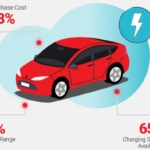
Top picks: RBC at 5.25% for long terms, CIBC for 0% promos. Compare via pre-approvals for your province.
Explain EV Financing Options for Electric Vehicles Canada.

Options include loans (ownership), leases (low upfront), and lines (flexible). Choose based on mileage and budget for optimal fit.
Are EV Loans Different from Regular Car Loans Canada?
Yes—lower rates, rebate stacking, and battery focus distinguish them, saving 10-15% overall.
How Do Provincial Incentives for EV Purchases Canada Affect Loans?
They deduct from principal, cutting interest. Quebec’s $7,000 example saves $1,000+ on a 60-month loan.
Conclusion
Mastering How Does EV Car Loan Work in Canada empowers you to embrace electric mobility affordably in 2025. From navigating paused federal rebates to leveraging provincial perks and securing competitive rates, informed financing turns green dreams into reality. Key takeaways: Prioritize 660+ credit, stack incentives, and opt for flexible terms. As EV adoption surges toward 20% market share, now’s the time to act—explore options at trusted banks and government sites for tailored advice. Ready to get started? Visit Quick Approvals today for swift pre-approvals and hit the road sustainably.