

In the evolving landscape of personal finance in Canada, home equity vehicle purchase has emerged as a strategic option for homeowners looking to finance a new or used car. This approach involves tapping into the equity built up in your home through tools like home equity lines of credit (HELOCs) or home equity loans, allowing you to borrow against your property’s value at potentially lower interest rates than traditional auto financing.
With rising vehicle costs and fluctuating interest rates in 2026, understanding this method can help you make informed decisions that align with your financial goals. Whether you’re eyeing a family SUV or an efficient sedan, leveraging home equity can provide flexibility, but it requires careful consideration of risks and benefits to ensure it fits your overall budget and long-term stability.
This comprehensive guide delves into the intricacies of using home equity for car buying, drawing from reliable sources to offer practical insights. For those seeking quick and efficient approval processes, resources like Quick Approvals can streamline your journey, connecting you with tailored financing solutions in Canada.
Exploring How to Use HELOC to Buy a Car in Canada

How to Use HELOC to Buy a Car in Canada, One of the most popular ways to facilitate a home equity vehicle purchase is through a Home Equity Line of Credit (HELOC). In Canada, a HELOC allows homeowners to borrow up to 65% of their home’s appraised value, minus any outstanding mortgage balance, providing a revolving line of credit that can be drawn upon as needed. This flexibility makes it ideal for covering the cost of a vehicle without the need for a lump-sum loan upfront.
To get started, first assess your home equity by subtracting your remaining mortgage from your property’s current market value. For example, if your home is worth $700,000 and you owe $400,000 on your mortgage, you could potentially access up to $195,000 through a HELOC (65% of $700,000 is $455,000, minus $400,000). Once approved, you can withdraw funds directly to pay for the car, either in full or as a down payment.
The application process typically involves providing proof of income, a home appraisal, and credit history. Lenders like major banks evaluate your debt-to-income ratio and credit score, aiming for a minimum score of 680 for favorable terms. Approval can take a few weeks, so plan accordingly if you’re timing a vehicle purchase.
Interest on a HELOC is variable, often tied to the prime rate plus a margin (e.g., prime + 0.5%). As of January 2026, with the Bank of Canada prime rate at around 4.45%, HELOC rates hover between 4.95% and 5.45% for well-qualified borrowers. Payments are interest-only during the draw period (usually 10 years), offering lower initial costs compared to fixed auto loans.
However, remember that your home secures the loan, so defaulting could risk foreclosure. Always borrow only what you can repay comfortably, factoring in potential rate increases.
- Calculate your available equity accurately using online tools or a professional appraiser.
- Shop around for HELOC offers from banks and credit unions to secure the best rate.
- Consider combining a HELOC with manufacturer incentives for additional savings on the vehicle.
- Track withdrawals meticulously to avoid overspending beyond the car purchase.
Beyond the basics, integrating a HELOC into your home equity vehicle purchase strategy can also involve strategic repayment planning. For instance, if you anticipate a bonus or tax refund, you can pay down the principal faster, reducing interest costs. Some Canadians use this method to upgrade vehicles periodically, reallocating funds as equity rebuilds through mortgage payments.
Addressing Can I Use Home Equity Loan to Buy a Car Canada
Yes, using a home equity loan for a home equity vehicle purchase is entirely feasible in Canada, offering a fixed-rate alternative to HELOCs. Unlike a HELOC’s revolving credit, a home equity loan provides a one-time lump sum, repaid over a set term (typically 5-15 years) with fixed monthly payments including principal and interest.
This option suits those who prefer predictable budgeting, as rates don’t fluctuate with market changes. Current rates in 2026 range from 5.5% to 7%, depending on creditworthiness and lender. To qualify, you’ll need at least 20% equity in your home, stable income, and a good credit history.
Proceed by applying through your bank or a mortgage broker. The process mirrors a mortgage refinance: submit financial documents, undergo a credit check, and possibly a home appraisal. Funds are disbursed upon approval, which you can then use to buy the car outright or finance part of it.
One advantage is potentially lower rates than unsecured personal loans or dealer financing, especially if auto loan rates are higher due to economic factors. However, the longer term means you might pay more interest overall if not managed well.
From insights gathered across Canadian financial platforms, many homeowners opt for this when auto loan rates exceed home equity rates by 2-3%, saving thousands over the loan life.
To maximize benefits:
- Compare quotes from multiple lenders to find the lowest fixed rate.
- Factor in closing costs, which can add 1-2% to the loan amount.
- Avoid borrowing more than the car’s value to prevent negative equity scenarios.
Expanding on eligibility, seniors or retirees with substantial home equity often find this method accessible, as lenders focus on equity rather than employment income. However, ensure the loan term aligns with your vehicle’s expected lifespan to avoid paying for a depreciated asset long-term.
Evaluating Is Using HELOC for Car Purchase a Good Idea
Deciding if a home equity vehicle purchase via HELOC is wise depends on your financial situation. It’s a good idea if you have strong equity, stable income, and discipline to repay quickly, as it offers lower rates (around 5% in 2026) versus auto loans (averaging 7-8%). This can reduce monthly payments and total interest.
For example, financing $40,000 at 5% over 5 years via HELOC might cost $3,000 less in interest than an 8% auto loan. Plus, the flexibility allows early payoff without penalties in many cases.
However, it’s not ideal if interest rates rise, increasing costs, or if you risk overborrowing, as your home is collateral. Cars depreciate rapidly—losing 20% value in the first year—so tying long-term debt to a short-lived asset can be risky.
Financial experts from Canadian banks emphasize weighing this against cash savings or low-rate dealer promotions. If your emergency fund is robust and you plan to keep the car long-term, it could align well.
Key considerations include:
- Your risk tolerance for variable rates versus fixed auto loans.
- Potential tax implications, as HELOC interest isn’t deductible for personal use like car buys.
- Impact on future mortgage renewals, as outstanding HELOCs can complicate switching lenders.
In-depth analysis shows that for budgets allowing aggressive repayment, this strategy builds financial efficiency. Conversely, if job security is uncertain, sticking to unsecured options preserves home security.
Analyzing Pros and Cons of Using Home Equity for Car Purchase
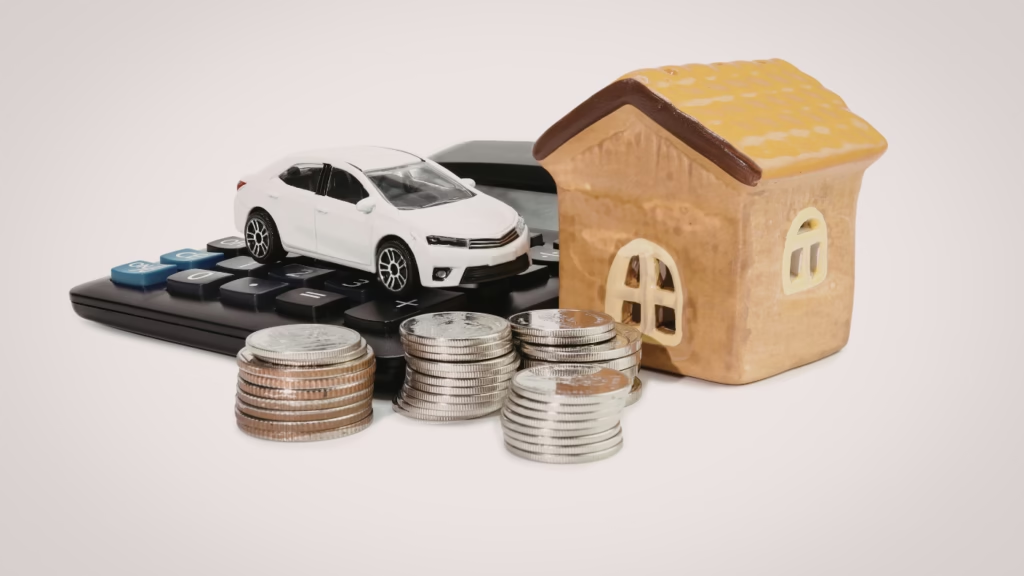
A home equity vehicle purchase comes with distinct advantages and drawbacks that merit thorough examination. Pros and Cons of Using Home Equity for Car Purchase
Pros:
- Lower interest rates: Home equity options often beat auto loan rates by 2-3%, saving on borrowing costs.
- Flexible terms: HELOCs allow interest-only payments initially, easing cash flow for other priorities.
- Larger borrowing capacity: Access up to hundreds of thousands based on equity, ideal for premium vehicles.
- Potential tax benefits if used strategically, though not for personal car buys per CRA guidelines.
Cons:
- Risk to home: Defaulting could lead to foreclosure, unlike auto loans where only the car is repossessed.
- Depreciation mismatch: Cars lose value quickly, potentially leaving you underwater on a long-term loan.
- Variable rates: HELOC interest can rise, increasing payments unpredictably.
- Closing fees: Appraisal and legal costs add to upfront expenses, sometimes 1-2% of the loan.
Balancing these, data from Canadian financial reports indicate that disciplined borrowers save significantly, but impulsive ones face amplified risks. Always consult a financial advisor to model scenarios based on your specifics.
Understanding Using HELOC to Finance Vehicle Purchase Canada
In Canada, using HELOC to finance vehicle purchase Canada involves drawing from your approved credit line to cover car costs. This method is particularly useful for private sales or when dealer financing rates are high.
Steps include securing the HELOC first, then transferring funds via cheque or electronic transfer to the seller. Repayment is flexible, but aim to pay down principal to rebuild equity.
Rates as low as 4.95% in 2026 make this attractive, per major lenders. However, monitor prime rate changes, as the Bank of Canada adjustments directly impact costs.
For electric vehicles, some provinces offer rebates that pair well with low-rate HELOC financing, enhancing affordability.
To optimize:
- Time your draw during low-rate periods.
- Use for fuel-efficient cars to offset rising gas prices.
- Integrate with budgeting apps to track repayments.
Real-world examples from forums like Reddit show Canadians saving 1-2% on interest versus traditional loans, but emphasize the importance of equity buffers.
Comparing HELOC vs Car Loan Canada Comparison
When weighing a home equity vehicle purchase, a heloc vs car loan canada comparison is essential.
| Aspect | HELOC | Car Loan |
|---|---|---|
| Interest Rate | Variable, 4.95-5.95% | Fixed/Variable, 6-9% |
| Collateral | Home | Vehicle |
| Term | Up to 30 years | 3-8 years |
| Flexibility | Revolving credit | Lump sum |
| Risk | Foreclosure possible | Repossession of car |
| Approval | Equity-based | Credit/income-focused |
HELOCs often win on cost and flexibility, but car loans are simpler and less risky for your home. In 2026, with prime at 4.45%, HELOCs edge out for qualified homeowners.
Insights from sites like Ratehub.ca highlight that HELOCs suit those with equity, while car loans appeal to non-homeowners or risk-averse buyers.
Finding the Best HELOC for Buying a Car in Canada
Securing the best heloc for buying a car in canada requires comparing offers from top lenders like TD, RBC, and Scotiabank. Look for low margins over prime (e.g., +0.5%), minimal fees, and high credit limits.
As of January 2026, rates start at 4.95% from providers like nesto.ca and Rates.ca. Prioritize lenders with easy online access and no prepayment penalties.
For authoritative guidance, visit the Financial Consumer Agency of Canada (FCAC) for HELOC details.
Top picks include RBC’s Homeline Plan for competitive rates and TD’s FlexLine for flexibility.
Navigating Tax Implications HELOC Car Purchase Canada
In a home equity vehicle purchase, tax implications heloc car purchase canada are crucial. Per CRA, HELOC interest is not deductible for personal uses like buying a car, as it’s only allowed for income-generating investments.
For details, refer to CRA’s guidelines on interest expenses.
This means no tax breaks, unlike business or investment uses. Factor this into cost calculations.
Seeking Low Interest HELOC to Buy Vehicle Canada
For cost savings, target a low interest heloc to buy vehicle canada. Shop via brokers or online comparators for rates under 5%.
Credit scores above 720 and high equity yield the best deals. Consider locking portions at fixed rates for stability.
Considering Using Home Equity Instead of Auto Loan Canada

Opting for using home equity instead of auto loan canada can lower costs but heightens risks. Ideal if equity is ample and repayment swift.
Exploring Refinance Home Equity to Purchase Car Canada
Refinance home equity to purchase car canada involves increasing your mortgage to cash out equity. Rates around 4-5%, but involves refinancing fees.
Utilizing Second Mortgage for Vehicle Purchase Canada
A second mortgage for vehicle purchase canada provides a lump sum at fixed rates, secured behind your primary mortgage.
Q&A Section
How to Use HELOC to Buy a Car in Canada?

To how to use heloc to buy a car in canada, apply for a HELOC, draw funds, and repay over time. Ensure equity covers costs and budget for variable rates.
Can I Use Home Equity Loan to Buy a Car Canada?

Yes, can i use home equity loan to buy a car canada by taking a lump sum loan against equity, offering fixed payments for predictability.
Is Using HELOC for Car Purchase a Good Idea?

Is using heloc for car purchase a good idea if rates are low and repayment is quick, but avoid if risking home security.
Pros and Cons of Using Home Equity for Car Purchase
The pros and cons of using home equity for car purchase include savings on interest versus home foreclosure risk.
Using HELOC to Finance Vehicle Purchase Canada
Using heloc to finance vehicle purchase canada provides flexibility, but monitor rates closely.
HELOC vs Car Loan Canada Comparison
In a heloc vs car loan canada comparison, HELOCs offer lower rates but higher risks.
Best HELOC for Buying a Car in Canada
The best heloc for buying a car in canada features low margins and no fees.
Tax Implications HELOC Car Purchase Canada
Tax implications heloc car purchase canada: Interest not deductible for personal use.
Conclusion
Summarizing, home equity vehicle purchase offers Canadians a powerful tool for affordable car financing, balancing low rates with careful risk management. Whether through HELOCs or loans, prioritize repayment to safeguard your home. For personalized options, explore Quick Approvals or consult authoritative sources like FCAC and CRA for deeper insights.