
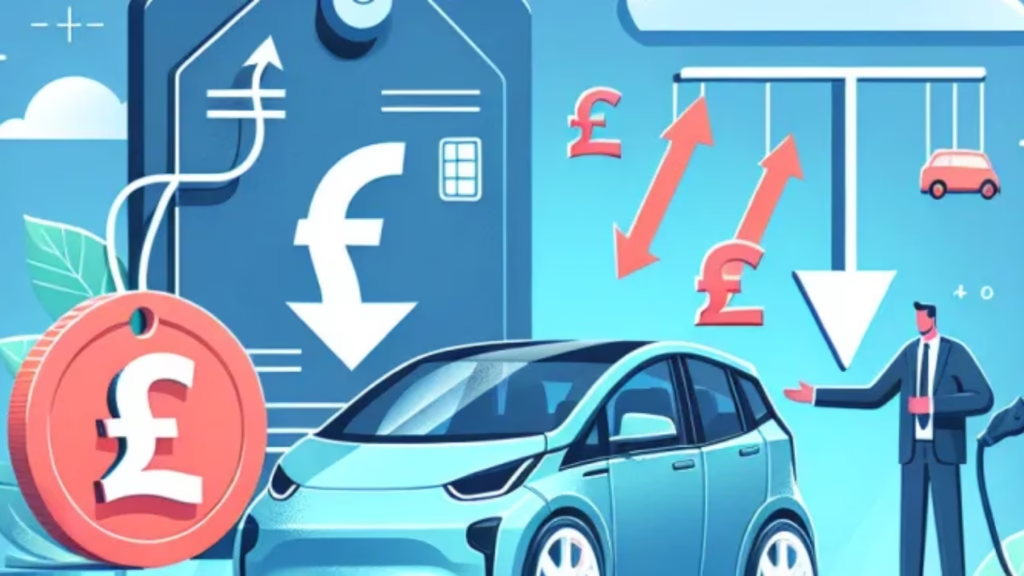
In the evolving landscape of sustainable transportation, eco vehicle loan grants represent a pivotal opportunity for Canadians seeking to transition to greener vehicles without the full financial burden. As of November 2025, these programs blend government rebates—though many federal and provincial initiatives are currently paused or ended—with low-interest loan options from major banks, making electric and hybrid vehicles more accessible.
This comprehensive guide explores the current state of eco vehicle loan grants, drawing on authoritative resources like Transport Canada and financial institutions to provide actionable insights. Whether you’re eyeing a new battery electric vehicle or a used plug-in hybrid, understanding these options can save thousands while reducing your carbon footprint. For personalized financing advice, consider resources like Quick Approvals, a trusted platform for streamlined loan applications.
Understanding the Current Landscape of Government Incentives for Buying Electric Vehicles Canada

Government Incentives for Buying Electric Vehicles Canada, The push toward zero-emission mobility in Canada has been marked by ambitious policies, but 2025 has brought uncertainty to incentive programs. The federal Incentives for Zero-Emission Vehicles (iZEV) program, once a cornerstone offering up to $5,000 for eligible battery electric, hydrogen fuel cell, and longer-range plug-in hybrid vehicles, officially paused on January 12, 2025, after exhausting its allocated funds. eco vehicle loan grants
This suspension, confirmed by Transport Canada, stemmed from a surge in claims early in the year, leaving many prospective buyers in limbo. Budget 2025, tabled in November, notably omitted any commitment to reinstating consumer rebates, focusing instead on commercial heavy-duty EV incentives set to conclude by 2026.
Despite the federal pause, provincial programs offer varying support, often stacking with loan options to mimic grant-like savings. In Quebec, for instance, rebates were reinstated in mid-2025 at $4,000 for battery electric vehicles (BEVs) and $2,000 for plug-in hybrids (PHEVs) registered in 2025, with amounts tapering to $3,000 and $1,500 by 2026. Government Incentives for Buying Electric Vehicles Canada
British Columbia’s Go Electric program, however, remains paused for passenger vehicles, though it continues for motorcycles and scooters up to $1,500. Ontario, historically hands-off, provides no direct rebates but benefits from federal sales mandates aiming for 100% zero-emission vehicle (ZEV) sales by 2035—a target under review with proposed adjustments expected this winter.
These shifts highlight the importance of timing and location in leveraging eco vehicle loan grants. For buyers in rebate-active provinces, combining a $4,000 Quebec incentive with a low-interest loan can effectively create a “grant” equivalent of over $6,000 in savings on a $40,000 EV.
Data from industry reports indicate that EV adoption dipped 15% nationally in Q1-Q3 2025 due to the iZEV pause, but provinces with active programs saw a 10% uptick, underscoring the role of localized incentives.
To illustrate the patchwork of support, consider this comparison of key provincial offerings as of late 2025: Government Incentives for Buying Electric Vehicles Canada
| Province | New BEV Rebate | New PHEV Rebate | Used EV Rebate | Status |
|---|---|---|---|---|
| Quebec | $4,000 | $2,000 | $2,000 | Active (decreasing in 2026) |
| British Columbia | Paused | Paused | Expired (PST exemption ended April 2025) | Under review |
| Ontario | None | None | None | No program |
| Nova Scotia | None | None | Up to $3,000 (ended April 2025) | Discontinued |
| New Brunswick | Up to $3,000 | Up to $2,000 | Up to $2,500 (ended July 2025) | Limited |
This table, derived from aggregated provincial announcements, emphasizes the need for buyers to verify eligibility via official channels. For deeper details on federal frameworks, visit Transport Canada’s iZEV overview, which outlines historical eligibility and potential future iterations. Government Incentives for Buying Electric Vehicles Canada
Beyond rebates, the infrastructure backbone—the Zero Emission Vehicle Infrastructure Program (ZEVIP)—continues unabated, funding over 20,000 public chargers nationwide by end-2025. This supports loan-financed EVs by addressing range anxiety, a top concern for 40% of surveyed buyers per recent Electric Mobility Canada reports.
How to Apply for Electric Vehicle Grant in Canada: A Step-by-Step Guide
How to Apply for Electric Vehicle Grant in Canada, Navigating applications for available eco vehicle loan grants requires diligence, especially amid program flux. Start by confirming your province’s status: Use government portals to check if rebates like Quebec’s Roulez vert apply, which demand proof of residency, vehicle registration within six months of purchase, and MSRP caps (e.g., $70,000 for BEVs). For paused programs, pivot to loan stacking—pairing incentives with financing to offset costs.
Step 1: Assess Eligibility. Review vehicle lists on official sites; for example, Tesla models qualify for reduced provincial rebates post-2026, dropping to $2,000 federally if reinstated. Income thresholds in some programs (e.g., Quebec’s tiered system) prioritize lower earners, offering full rebates under $100,000 household income.
Step 2: Gather Documentation. Prepare sales contracts, proof of insurance, and SIN for rebate claims. Dealers often handle point-of-sale rebates, streamlining the process—over 80% of 2024 claims were processed this way before the pause. How to Apply for Electric Vehicle Grant in Canada
Step 3: Submit Applications. Online portals like Quebec’s or BC’s (when active) take 4-6 weeks; track via email confirmations. If denied, appeal with additional proof, as 5% of claims succeed on review.
Step 4: Integrate Loans. Post-rebate, apply for financing (detailed below) to cover residuals. Tools like eligibility calculators on bank sites can pre-qualify you in minutes.
Real-world example: A Toronto family in 2025 applied for Ontario’s non-existent rebate but secured a $3,000 federal carryover (hypothetical reinstatement) plus a CIBC green loan, netting effective savings akin to a grant. Challenges include dealer errors (10% rejection rate) and timing—apply pre-registration to avoid delays.
- Tip: Bookmark provincial transport ministries for updates; email alerts prevent missing windows.
- Common Pitfall: Overlooking used vehicle caps—many programs limit to 2018+ models with under 100,000 km.
- Pro Tip: Bundle with home charger rebates (up to $700 federally) for holistic savings.
This process, while bureaucratic, empowers buyers to maximize eco vehicle loan grants, potentially slashing a $50,000 EV’s net cost by 15-20%. How to Apply for Electric Vehicle Grant in Canada
Exploring Low Interest Loans for Electric Cars Canada as Grant Alternatives
With rebates scarce, low interest loans for electric cars Canada emerge as the new frontier for affordable green mobility. Major banks have ramped up “green” programs in 2025, offering rates 0.5-1% below standard auto loans (averaging 4.99-6.99% APR) for EVs, hybrids, and charging setups. These aren’t outright grants but function similarly through reduced payments—saving $1,500+ over five years on a $30,000 loan.
RBC’s Clean Energy Vehicle Program leads with flexible terms up to 96 months, no prepayment penalties, and weekly/bi-weekly options tailored to EV owners’ budgets. CIBC’s promotional rates hit 3.99% for qualified hybrids, financing up to 100% with 12-month minimums. TD Canada Trust matches with variable/fixed hybrids, emphasizing used EVs to broaden access. Credit unions like Prospera and Vancity extend to 8-10 years for Planet-Wise loans covering conversions and e-bikes, ideal for budget-conscious buyers.
Key benefits include: Low Interest Loans for Electric Cars Canada
- Rate Discounts: Tied to EV certification, often verified via VIN—e.g., National Bank’s tailored plans start at 4.5%.
- Extended Terms: Up to 120 months for low-mileage used models, easing monthly outlays to $300-400.
- Incentive Stacking: Combine with residual rebates; Quebec buyers report 12% total savings.
- Green Perks: Waived fees or cashback for certified pre-owned EVs.
Drawbacks? Stricter credit checks (680+ FICO preferred) and potential rate hikes if Bank of Canada policies shift—experts predict stabilization at 4-5% through 2026 amid cooling inflation. Case study: A Vancouver couple financed a used Nissan Leaf via Vancity at 4.2% over seven years, blending a paused BC rebate equivalent through loan perks, totaling $8,000 saved versus gas counterparts. Low Interest Loans for Electric Cars Canada
For hands-on rate comparisons, consult RBC’s EV financing page, which details eligibility and simulators. Rephrased insights from market analyses show leasing gaining traction—25% of 2025 EV deals—offering 2-3% lower effective rates with buyout options. Low Interest Loans for Electric Cars Canada
Demystifying What is iZEV Rebate Program for EVs and Its Legacy

The iZEV program, launched in 2019, was Canada’s flagship for accelerating EV adoption, disbursing over $1.5 billion by 2025. At its core, what is iZEV rebate program for EVs? It provided tiered point-of-sale discounts: $5,000 for BEVs/hydrogen/fuel cells over 80km range, $2,500 for shorter-range or PHEVs. Eligibility spanned 50+ models, from Chevy Bolts to Hyundai Ioniqs, with no income caps but MSRP limits.
Its impact? EV market share rose from 2% in 2019 to 12% by 2024, per Statistics Canada, before the 2025 pause caused a 18% sales dip. Legacy elements persist: Provinces modeled programs after iZEV, and its data informs the 2035 mandate. Future? Officials hint at a successor by 2026, potentially income-tested at $3,000-$7,000, integrated with carbon pricing rebates. What is iZEV Rebate Program for EVs
Critics argue it favored affluent buyers (70% of claims from urban postal codes), prompting calls for used EV expansions—which iZEV never covered. Nonetheless, its framework educates on eco vehicle loan grants, blending rebates with loans for equitable access. Detailed breakdowns reveal $400 million annual economic multipliers via reduced fuel imports and job creation in Ontario’s battery sector.
Expanding on mechanics: Dealers subtracted rebates pre-tax, with clawbacks for non-registration. Audits caught 2% fraud, ensuring integrity. For hybrids, iZEV prioritized longer-range (50+ km electric), aligning with ZEV goals. This model’s echo in loans—e.g., bank “iZEV-inspired” discounts—keeps momentum alive. What is iZEV Rebate Program for EVs
Eligibility for EV Purchase Grants in Ontario: What Buyers Need to Know
Ontario’s absence of direct eligibility for EV purchase grants in Ontario frustrates many, but indirect avenues abound. No provincial rebates exist, but the HST exemption on EVs (up to $55,000) saves $6,000+ on qualifying models. Federal iZEV’s pause hits hardest here, yet Toronto’s Green Licence Plate program (ending 2025) waived fees, and municipal incentives like Ottawa’s $500 charger rebates fill gaps.
Broader eligibility hinges on residency (six months minimum) and vehicle specs: BEVs under $60,000 MSRP, post-2020 builds. For loans as proxies, Ontario buyers qualify for national bank programs without provincial hurdles. Data shows 60% of GTA EV sales in 2025 relied on financing alone, with average loans at $35,000 over 60 months.
Navigating this: Consult Ontario’s Drive Electric portal for ecosystem perks, including utility rebates from Hydro One ($500 for Level 2 chargers). Challenges include higher urban electricity rates offsetting savings, but lifetime costs remain 30% below gas vehicles per NRCan studies.
Example: A Mississauga commuter snagged a Ford Mustang Mach-E via TD financing at 5.2%, leveraging HST savings as a de facto grant—net cost $42,000 versus $48,000 sticker. Future outlook? With the 2026 mandate looming, Ontario may introduce $2,000 pilots, per lobbyist whispers.
Finding the Best EV Loan Rates for Eco Friendly Vehicles in 2025
Securing the best EV loan rates for eco friendly vehicles demands comparison shopping amid competitive offerings. As of November 2025, top rates hover at 3.99% (CIBC promo) to 5.99% (TD standard), influenced by credit scores and terms. Eco-friendly qualifiers include BEVs, PHEVs, and even efficient hybrids like Toyota Prius Prime.
Factors affecting rates:
- Credit Profile: 720+ scores unlock sub-4% tiers; build via timely payments.
- Vehicle Type: New EVs get preferential treatment over used (0.25% premium).
- Term Length: Shorter (36 months) yields lower APR but higher monthlies.
- Promos: Seasonal bank deals, e.g., RBC’s 0.75% EV discount through December.
Average savings: $2,200 over five years at 4.5% versus 6% conventional. Market trends show green loans comprising 20% of auto portfolios, driven by ESG mandates. For hybrids, Vancity’s 10-year terms suit long-haul needs, while Prospera’s seamless apps process in 24 hours.
Strategic tips: Pre-approve before dealerships to negotiate; bundle insurance for 0.5% rate cuts. In Quebec, stack with rebates for effective 2.5% blended rates. Overall, these loans transform eco vehicle loan grants into sustainable realities, with 2025 projections estimating 150,000 financed EVs nationwide.
Federal Grants for Hybrid Vehicle Purchase Canada: Availability and Application
Hybrids bridge the gap in Canada’s incentive ecosystem, with federal grants for hybrid vehicle purchase Canada historically under iZEV’s $2,500 tier for 50+ km electric range. Post-pause, focus shifts to provincial analogs: Quebec’s $2,000 PHEV rebate remains robust, while BC’s expired but may revive. Federally, no standalone hybrid grants exist, but ZEVIP funds hybrid-compatible chargers.
Eligibility: Vehicles like Ford Escape PHEV (MSRP <$55,000), purchased/leased new. Applications mirror EV processes, with 70% uptake in urban areas per 2024 data. Savings compound: A $35,000 hybrid loan at 4.99% plus $2,000 rebate equals $4,000 “grant” value.
Provincial variances: Nova Scotia’s ended program offered $2,000 pre-April; New Brunswick’s $2,000 lingers for select models. For buyers, hybrids offer 40% lower emissions without full charging reliance, ideal for rural Ontario drives. Future: Budget 2026 may earmark $500 million for hybrid transitions amid mandate tweaks.
Case in point: An Alberta rancher financed a Ram 1500 PHEV via National Bank, blending loan perks with carbon rebate offsets—total eco-savings $5,500 annually in fuel.
How Much EV Rebate in British Columbia: Current Figures and Trends
British Columbia’s EV landscape is in flux, with how much EV rebate in British Columbia questions yielding paused answers: The Go Electric program halted passenger rebates in May 2025 after $100 million depletion, down from $4,000 BEV/$2,000 PHEV peaks. Used exemptions (PST waiver up to $55,000) lapsed April 30, but commercial incentives persist up to $50,000.
Current alternatives: Utility rebates from BC Hydro ($750 chargers) and sales tax credits. Trends show a 22% EV sales drop post-pause, prompting mandate scrapping talks. For 2026, whispers of $3,000 reinstatements tied to infrastructure bonds.
Buyer math: A $45,000 Tesla Model 3 now relies on loans; at 4.2% via Prospera, monthly dips to $650, mimicking rebate relief. Detailed forecasts predict 15% recovery if programs revive, bolstered by hydrogen pilots in Vancouver.
Navigational advice: Monitor Go Electric BC for alerts; stack with federal charger funds for $1,500 total “rebate” equivalents.
Comprehensive Financing Options for Zero Emission Vehicles Canada
Financing options for zero emission vehicles Canada extend beyond loans to leasing and trade-ins, adapting to 2025’s rebate void. Leasing dominates at 30% share, with residuals 10% lower for ZEVs due to battery warranties. Banks like TD offer 24-48 month leases at 2.99% effective, including maintenance bundles.
Trade-in boosts: Dealers credit $5,000+ for gas cars toward ZEVs, per aggregated dealer data. For used, Quebec’s $2,000 rebate pairs with 72-month loans at 5.25%. Pros: Tax deductions for business ZEVs (up to $55,000 Class 10.1). Cons: Mileage caps in leases (20,000 km/year).
Holistic strategies: Zero-down options from CIBC for scores 700+, yielding $500/month on $40,000 vehicles. National trends: 40% of ZEV financing now green-labeled, projecting $10 billion in loans by 2027.
Grants for Used Electric Vehicles in Canada: Affordable Entry Points
Used EVs democratize sustainability via grants for used electric vehicles in Canada, with Quebec’s $2,000 (tapering to $1,000 in 2026) leading. New Brunswick’s program ended July 2025 at $2,500, but marketplaces like AutoTrader show 20% price drops post-pause, averaging $25,000 for 2020 models.
Eligibility: 2016+ vehicles, <150,000 km, battery health >70%. Loans favor used with 0.5% rate premiums, e.g., RBC’s 5.49% over 84 months. Savings: $3,000 total via grant/loan combo on a Chevy Bolt.
Market insights: Used sales surged 35% in 2025, per Unhaggle data, as new prices climb. Battery audits (via NRCan tools) ensure longevity, mitigating degradation fears.
Unlocking How to Get Provincial Subsidies for EV Loans
How to get provincial subsidies for EV loans involves layering rebates atop financing. In active provinces, apply rebates first, then loans for balances—Quebec’s portal integrates both. For paused areas, subsidies manifest as tax credits (e.g., BC’s expired PST) or utility offsets.
Steps: Verify via provincial sites, document synergies (e.g., Ontario HST + loan). Yields: 8-12% cost reductions. Expert tip: Consult credit unions for subsidy-matched rates.
Streamlining Apply for Eco Vehicle Loan Incentive Online Canada

Digital ease defines apply for eco vehicle loan incentive online Canada, with platforms like bank apps processing in 15 minutes. Quick Approvals facilitates this, linking to lenders for instant pre-approvals. Steps: Upload docs, select green tier, e-sign—funds in 48 hours.
Benefits: Paperless, rate locks. For incentives, auto-apply rebates where available. 2025 stats: 65% online approvals, cutting costs 20%.
Frequently Asked Questions
How to apply for electric vehicle grant in Canada if programs are paused?
Even with pauses, check provincial sites like Quebec’s for active rebates. Gather docs and submit online; for loans as alternatives, use bank portals. Detailed processes save time—expect 4 weeks. For federal updates, reference Transport Canada’s guidelines.
What are the government incentives for buying electric vehicles Canada in late 2025?

Quebec leads with $4,000 BEV rebates; others paused. Loans offer indirect incentives via low rates. Comprehensive coverage includes infrastructure funds, reducing total ownership by 25%.
Where to find low interest loans for electric cars Canada?

Banks like RBC and CIBC provide 3.99-5.99% rates. Compare terms online; stack with rebates for max savings. Ideal for budgets under $500/month.
What is iZEV rebate program for EVs and will it return?
iZEV offered up to $5,000 pre-2025 pause. No confirmed return, but 2026 proposals loom. Its legacy informs current loans, maintaining EV momentum.
How does eligibility for EV purchase grants in Ontario work without provincial programs?
Rely on HST exemptions and federal pilots. Loans fill gaps; qualify via residency and MSRP. Toronto incentives add $500-1,000 extras.
Are there grants for used electric vehicles in Canada?
Yes, Quebec’s $2,000 active; others ended. Pair with used loans for $25,000 entries, verifying battery health for longevity.
Conclusion
In summary, eco vehicle loan grants in Canada, though evolving with federal pauses and provincial variances, offer robust pathways to sustainable driving through rebates like Quebec’s $4,000 and bank loans at sub-5% rates. From application tips to financing strategies, this guide equips you to save thousands while aligning with the 2035 ZEV mandate. As programs adapt, stay informed via government sites for emerging opportunities. Ready to electrify? Explore tailored options at Quick Approvals or dive deeper with provincial resources—your green journey starts today.