Buying a vehicle is exciting until the financing terms start changing. You may receive an attractive approval today, but what happens if the lender’s pricing changes before you complete the purchase? That is where a car loan rate lock Canada can become important. A rate lock may allow a lender to hold a quoted or approved interest rate for a defined period, but the exact rules depend on the lender, approval conditions, vehicle, and timing.
Unlike mortgage rate locks, auto-loan rate locks are not governed by one universal Canadian standard. The safest approach is to confirm exactly what rate is being held, how long it remains valid, and what could cause it to change before signing. The Financial Consumer Agency of Canada recommends comparing the interest rate, fees, amount financed, payment schedule, and loan term rather than focusing only on the monthly payment. car loan rate lock Canada
What Is a Car Loan Rate Lock in Canada?
A car loan rate lock Canada arrangement generally means a lender agrees to hold a particular interest rate for an agreed period while the borrower completes the remaining financing steps. The idea is straightforward: if the lender changes its pricing during that window, the borrower may still receive the previously quoted rate, provided all conditions of the approval remain satisfied.
However, consumers should not assume that every auto-loan pre-approval automatically creates a binding rate lock. Some offers may be conditional, expire after a specific period, require the same vehicle and loan amount, or be subject to final underwriting. A fixed-rate loan is different from a rate lock: once a fixed rate is established in the final loan agreement, it generally remains unchanged for the loan term, while a rate lock concerns the period before financing is finalized. car loan rate lock Canada
The most important question is therefore not simply whether a lender says your rate is “locked.” Ask for the terms in writing. Confirm the approved rate, expiry date, vehicle requirements, maximum financing amount, loan term, required documentation, and circumstances that could invalidate the offer.
A borrower who understands these details is in a much stronger position than someone relying on a verbal promise from a salesperson. In Ontario, for example, OMVIC advises consumers to ensure that the rate and other financing terms on the final contract match what was promised and to get important verbal promises in writing. car loan rate lock Canada
Why Lock in an Auto Loan Rate Before Buying?
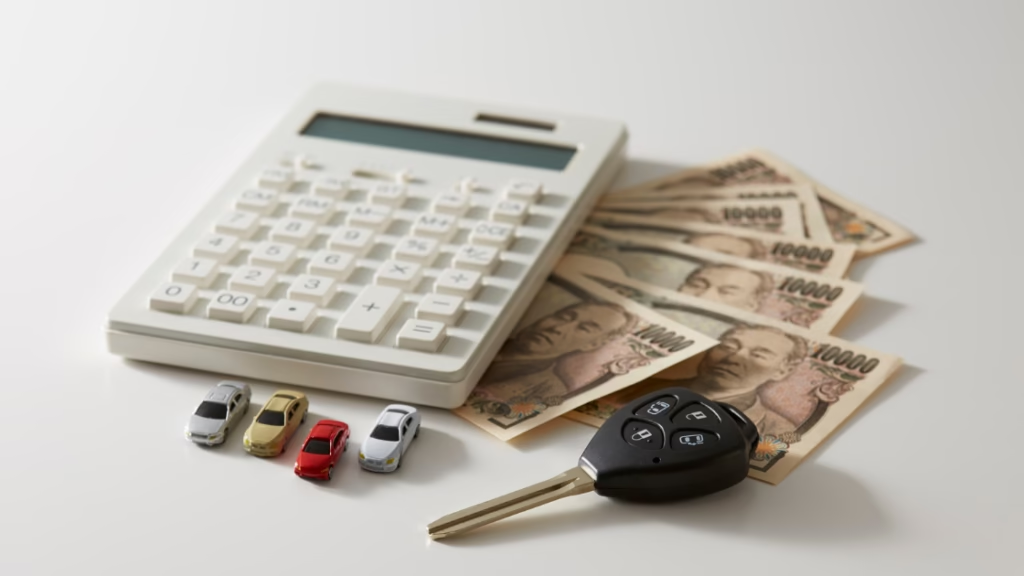
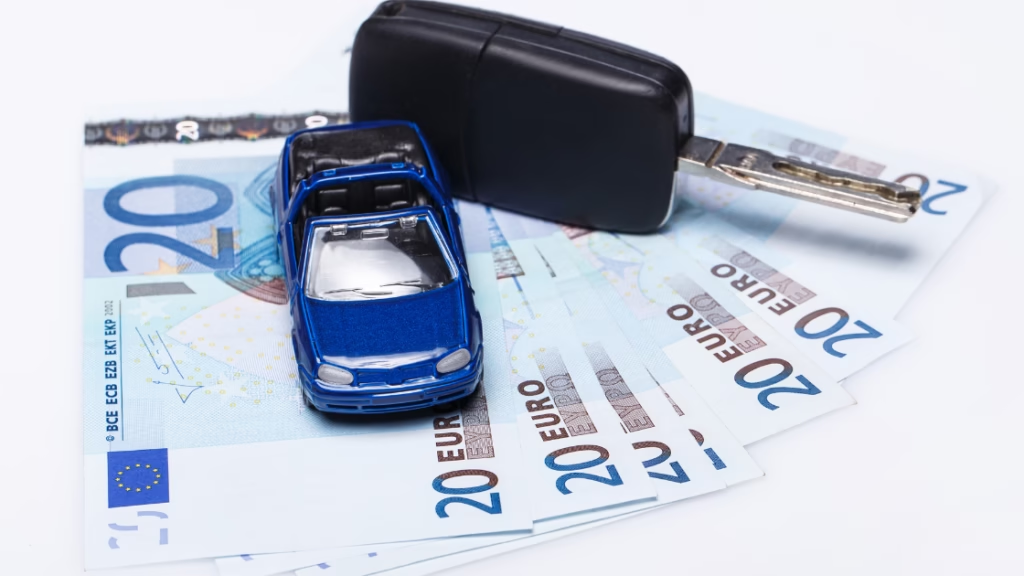
The main benefit of lock in auto loan rate Canada planning is certainty. If your financing approval is valid for a period before the vehicle is delivered, knowing that the lender will honour the agreed rate can make your budget easier to manage. This becomes particularly useful when there is a delay between application, vehicle selection, dealer paperwork, and funding.
Without clear protection, a borrower may discover at the final stage that the financing offer has expired or needs to be re-underwritten. A rate lock can potentially reduce that uncertainty, but only when the lender has expressly confirmed the arrangement. lock in auto loan rate Canada
The broader Canadian interest-rate environment also explains why borrowers pay attention to rate protection. The Bank of Canada’s target overnight rate was 2.25% as of July 15, 2026, while Bank of Canada statistics showed an average rate of 6.55% on newly advanced auto loans in June 2026. These are market-level statistics, not guaranteed offers for an individual borrower. Your actual rate can depend on credit history, income, debt obligations, vehicle characteristics, loan amount, term, lender policies, and other underwriting factors. car loan rate lock Canada
How Long Does a Car Loan Rate Lock Last in Canada?
The answer to how long rate lock lasts Canada is lender-specific. There is no single nationwide period that automatically applies to every car loan. A lender may provide a financing approval that is valid for a particular period, while another may require the borrower to finalize the transaction sooner. Some approvals can also depend on the vehicle being purchased, meaning a change in vehicle price, age, mileage, loan amount, or borrower information could require the lender to reassess the application.
Before relying on a rate lock, ask these questions: how long rate lock lasts Canada
- What exact interest rate is being held?
- When does the rate lock begin?
- What date does it expire?
- Is the rate locked until final funding or only until a particular approval date?
- Does changing the vehicle affect the locked rate?
- Does changing the loan amount affect the approval?
- Can the lender extend the lock if delivery is delayed?
- Is the lock documented in the approval or financing agreement?
- What circumstances allow the lender to change or cancel the offer?
car loan rate lock Canada, These questions are important because an approval and a final loan contract are not necessarily the same thing. Canada’s consumer-financing guidance emphasizes reviewing the final terms, including the interest rate, payment schedule, financing fees, amount financed, and loan length, before signing. how long rate lock lasts Canada
Rate Lock vs Floating Rate in Canada
Understanding rate lock vs floating rate Canada requires separating two concepts: the rate before funding and the rate after the loan begins. A rate lock is generally about preserving an offered rate during a defined pre-funding period. A floating or variable rate, by contrast, can move according to the terms of the loan. The Financial Consumer Agency of Canada explains that fixed rates remain the same for the term of a loan, while variable rates can increase or decrease during the term.
| Feature | Rate Lock | Floating/Variable Rate |
|---|---|---|
| Main purpose | Hold an offered rate before finalization | Allow the rate to change according to loan terms |
| Timing | Usually before final funding | During the active loan |
| Rate certainty | Temporary, subject to conditions | Lower initial rate may come with future movement |
| Main risk | Lock expires or conditions change | Interest rate increases |
| Best question to ask | “Until what date is this rate guaranteed?” | “What determines future rate changes?” |
For a Canadian vehicle buyer, the practical lesson is simple: never assume the words “approved,” “fixed,” and “locked” mean exactly the same thing. Ask the lender to explain the status of the rate in plain language and obtain the answer in writing. rate lock vs floating rate Canada
How to Lock in an Auto Loan Rate in Canada: Step-by-Step
1. Check Your Credit Before Applying
Your first step toward protect against rate increases Canada is understanding the financing profile you are bringing to lenders. Your credit history can influence the financing terms available to you. Canada’s Financial Consumer Agency says consumers can obtain free credit reports from Equifax and TransUnion, and checking your own report does not affect your credit rating.
Review the report for inaccurate balances, accounts you do not recognize, outdated information, or payment history errors. Correcting an issue before submitting a financing application may prevent avoidable delays. TransUnion also provides consumers with a free Consumer Disclosure containing information from their credit file. protect against rate increases Canada
2. Establish a Realistic Vehicle Budget
A rate lock cannot make an unaffordable vehicle affordable. Determine the amount you can comfortably finance after considering the purchase price, taxes, insurance, fuel, maintenance, parking, and other ownership costs. Canada’s consumer guidance specifically recommends looking at the total cost of the vehicle instead of concentrating only on the monthly payment. protect against rate increases Canada
A longer loan term can reduce the payment while increasing the total interest paid. For example, FCAC illustrates that financing a $25,000 vehicle at 5% over 84 months costs substantially more in interest than financing the same amount over 36 months.
3. Compare Multiple Financing Offers
Do not treat the first approval as automatically being the best approval. Compare the interest rate, term, amount financed, fees, payment frequency, and total borrowing cost. You can approach a bank or credit union directly, compare dealership-arranged financing, or use an auto-financing service to explore available options. Canada.ca confirms that consumers can obtain car financing through dealerships or directly through financial institutions.
4. Ask for the Rate-Lock Terms in Writing
Once you receive an attractive offer, ask whether the rate is actually locked. If it is, request documentation showing the rate and expiry date. A verbal statement such as “your rate is guaranteed” is not enough when the final contract may contain different terms.
5. Avoid Unnecessary Changes After Approval
A locked offer may depend on the information originally submitted. Changing the vehicle, financing substantially more money, extending the term, changing employment information, or allowing an approval to expire may trigger another review. Tell the lender before making significant changes. car loan rate lock Canada
6. Confirm the Final Contract
Before signing, compare the final paperwork with the approved financing. Check the interest rate, payment amount, term, amount financed, fees, and total borrowing cost. In Ontario, financing disclosures must be clear and prominent, and required finance information includes the APR, payment, term, cash price, and cost of borrowing. protect against rate increases Canada
Eligibility and Requirements for a Rate-Locked Car Loan

There is no universal lock in auto loan rate Canada qualification standard because each lender sets its own underwriting requirements. However, borrowers should generally expect the lender to assess identity, income, employment, residence, credit history, existing debt, requested financing, and vehicle information. The exact documentation can vary depending on whether the borrower is employed, self-employed, newly established in Canada, or applying with a co-borrower. car loan rate lock Canada
Typical documentation can include government-issued identification, proof of income, employment information, proof of residence, banking information, and vehicle details. The lender may also verify information through a credit bureau. The most important principle is accuracy. OMVIC warns consumers to carefully review the information submitted in a dealer financing application and notes that inflating income or minimizing debts to obtain approval is illegal.
A strong application is not simply one with a high credit score. Lenders evaluate the complete financial picture. Stable income, manageable debt obligations, a realistic loan amount, and accurate documentation can make the underwriting process smoother. If a lender offers a rate lock, ask whether it remains valid if any of those factors change before funding. car loan rate lock Canada
Car Loan Rate and Cost Breakdown: Canadian Example
The following example illustrates why a seemingly small rate difference can matter. Suppose a borrower finances $30,000 over 60 months. Using a standard monthly amortization calculation, a 6.55% annual rate produces an estimated payment of approximately $587.69, while a 7.55% rate produces an estimated payment of approximately $601.85.
| Example | Rate | Term | Approx. Monthly Payment | Approx. Interest |
|---|---|---|---|---|
| Lower-rate scenario | 6.55% | 60 months | $587.69 | $5,261 |
| Higher-rate scenario | 7.55% | 60 months | $601.85 | $6,111 |
| Difference | 1.00% | 60 months | $14.16/month | $850 |
These figures are illustrative and exclude taxes, fees, optional products, and other transaction costs. The 6.55% figure is also broadly aligned with the Bank of Canada’s June 2026 average for newly advanced auto loans, but that average is not a quote or guarantee for a particular borrower.
The lesson is that protect against rate increases Canada does not mean accepting any rate simply because it is locked. A borrower should first determine whether the locked rate is competitive. A guaranteed high rate is still a high rate. The best approach is to compare genuine offers before committing and then determine whether the stronger offer can be held through the purchase process. car loan rate lock Canada
Canadian Case Study: New Vehicle Delivery Delay
Consider a buyer approved for a $35,000 vehicle whose delivery is delayed. The lender originally provides a rate and states that the offer remains valid until a specific date. The borrower should not assume the original terms will automatically continue after that date. Instead, the buyer should contact the lender before expiration and ask whether the financing can be extended.
If the lender confirms an extension in writing, the buyer has clearer evidence of the applicable financing terms. If the lender requires a new approval, the buyer should compare the revised offer with other financing options rather than accepting it automatically. This situation demonstrates why how long rate lock lasts Canada is a practical question, not merely a technical one. car loan rate lock Canada
Canadian Case Study: Dealer Financing vs Direct Financing
Suppose a buyer obtains one financing offer directly from a financial institution and another through a dealership. The dealer-arranged option may be convenient and may provide access to multiple lenders, but convenience does not automatically mean the lowest cost. OMVIC states that dealers may receive compensation from lenders and recommends that consumers understand the financing options available to them.
The buyer should compare the actual rate, term, total amount financed, payment schedule, fees, and borrowing cost. If one offer has a lower rate but expires sooner, the buyer can ask whether the lender will lock or extend it. This is where rate lock vs floating rate Canada considerations become relevant to the timing of the transaction.
Banks vs Lenders vs Brokers for Canadian Auto Financing
| Financing Route | Potential Advantage | Important Consideration |
|---|---|---|
| Bank | Direct relationship and established financial infrastructure | May have specific eligibility and underwriting requirements |
| Credit Union | Can provide personalized financing | Availability and criteria vary by institution |
| Dealership | Convenient and access to multiple lenders | Compare the offers rather than accepting the first option |
| Financing Service/Broker | Can help connect borrowers with multiple financing sources | Confirm lender, rate, fees, and final contract terms |
Canada.ca confirms that dealerships may arrange loans through manufacturer finance divisions, financial institutions, credit unions, or independent finance companies.
The right option depends on your financial circumstances. A borrower with strong credit may prioritize the lowest borrowing cost, while another borrower may place greater value on flexible underwriting or speed. Regardless of the route, the financing agreement should be evaluated on its complete economics rather than the payment alone. car loan rate lock Canada
Expert Tips to Speed Up Approval and Protect Your Rate

The strongest car loan rate lock Canada strategy begins before you submit the application. First, check your credit reports and make sure your personal information is accurate. Second, decide how much you actually need to borrow. Third, prepare income and identification documents before the lender requests them. Fourth, avoid submitting inconsistent information across applications. Fifth, ask every lender about the validity period of its approval and whether the offered rate is locked.
You should also ask whether the lender can honour a lower rate if its pricing improves before funding. A borrower should not assume that a rate lock automatically means the rate can only move in one direction. The written terms determine what happens. Finally, do not let a dealer rush you into signing because an offer is described as “today only.” Compare the actual contract terms first. FCAC recommends obtaining quotes from multiple dealers and lenders and evaluating the complete financing structure before signing.
Critical Mistakes to Avoid With a Car Loan Rate Lock
Assuming Pre-Approval Means Guaranteed Financing
A pre-approval can be useful, but it does not necessarily mean the final loan is unconditional. Confirm whether the approval is conditional and whether the rate has an expiry date. car loan rate lock Canada
Focusing Only on the Monthly Payment
A lower payment can result from a longer loan term. Canada.ca warns that longer terms can increase total interest costs significantly.
Accepting a Verbal Rate Guarantee
If the rate matters to your decision, get it documented. A written approval or contract provides much stronger evidence than an informal conversation.
Ignoring the Expiry Date
A rate that is attractive today may not remain available indefinitely. Put the expiry date on your calendar and contact the lender before it passes.
Changing the Vehicle Without Checking
Changing the vehicle or loan amount may alter the lender’s underwriting decision. Always ask before assuming the original rate still applies.
Comparing Rates Without Comparing Total Cost
A lower rate is important, but the overall deal can also be affected by the vehicle price, financing fees, term, optional products, and other charges. OMVIC requires important financing information to be disclosed in Ontario, including APR, term, cash price, and cost of borrowing. car loan rate lock Canada
FAQs About Car Loan Rate Lock Canada
1. Can I lock in a car loan rate in Canada?

Yes, a lender may offer a rate-hold or rate-lock arrangement, but it is not automatically included with every car-loan approval. The lender determines the conditions, duration, and circumstances under which the offer remains valid. Ask for the rate, expiry date, loan amount, vehicle conditions, and other requirements in writing before relying on the lock. car loan rate lock Canada
2. How long does a car loan rate lock last in Canada?

There is no universal Canadian duration. how long rate lock lasts Canada depends on the lender and the specific approval. Some offers may remain valid only for a defined period, while others may require the vehicle transaction to be completed by a particular date. If delivery is delayed, contact the lender before the approval expires and request written confirmation of any extension.
3. Does a rate lock guarantee my car loan approval?

Not necessarily. A rate lock and loan approval are related but different concepts. An approval may be conditional on verification of income, credit information, vehicle details, loan amount, or other requirements. Even if the rate is held, you should confirm what conditions remain outstanding before assuming the financing is final.
4. Can a lender change my rate after locking it?
It depends on the written terms of the rate-lock arrangement. A lender may reserve the right to change or withdraw an offer if material information changes, the approval expires, the vehicle changes, or required conditions are not met. That is why borrowers should ask specifically what circumstances can invalidate the locked rate.
5. Is a fixed car loan the same as a rate lock?
No. A fixed rate generally means the interest rate remains unchanged during the agreed loan term. A rate lock usually refers to holding an offered rate for a period before financing is finalized. Once a fixed-rate auto loan has been finalized, the applicable contract governs the rate and payment obligations.
6. Should I lock a rate if interest rates might fall?
A lock can provide certainty, but you should understand whether the lender offers any flexibility if rates improve. If the lock prevents you from receiving a lower rate later, compare the benefit of certainty with the possibility of better pricing. The right choice depends on the timing of your purchase, the competitiveness of the offered rate, and the lender’s written conditions.
7. Can a dealer guarantee my car loan rate?
A dealer may arrange financing and communicate financing terms, but the actual lending institution and approval conditions matter. In Ontario, OMVIC advises consumers to understand dealer financing disclosures and to ensure the final contract reflects the agreed terms.
8. What should I do before signing a rate-locked car loan?
Compare the final interest rate, APR where applicable, loan amount, term, payment frequency, total borrowing cost, fees, vehicle price, and optional products. Make sure the final contract matches the financing offer. If anything differs, stop and ask for an explanation before signing. FCAC recommends understanding the complete financing arrangement and comparing offers before committing.
Conclusion: Make Your Rate Lock Work for You
A car loan rate lock Canada can provide valuable certainty when there is a gap between receiving financing terms and completing a vehicle purchase. But the real protection comes from understanding the agreement, not simply hearing the word “locked.” Confirm the exact rate, expiry date, conditions, vehicle requirements, and what happens if delivery or financing is delayed. Compare competing offers before committing, because a locked rate is useful only when the underlying financing is competitive.
If you are comparing Canadian auto financing, Quick Approvals can provide a starting point for exploring vehicle-financing options and connecting with financing specialists. The goal should not simply be to obtain approval quickly. It should be to understand the complete financing package and choose a payment and borrowing cost that fit your budget. lock in auto loan rate Canada, how long rate lock lasts Canada
Internal Links for QuickApprovals.ca
- Quick Approvals – Canadian Auto Financing
- Car Loan Rates Comparison Canada
- Dealer vs Bank Car Loan Canada
- Car Loan Credit Pull Canada
- Digital Auto Loan Application Canada
- Car Loan Approval Time in Canada
Authority Outbound References
- Financial Consumer Agency of Canada – Car Financing Options
- Financial Consumer Agency of Canada – Shopping Around for Auto-Financing
- Financial Consumer Agency of Canada – Financial Risks When Buying a Car
- Bank of Canada – Interest Rates for New and Existing Lending
- OMVIC – Financing Disclosures
- Canada.ca – Getting Your Credit Report and Credit Score