
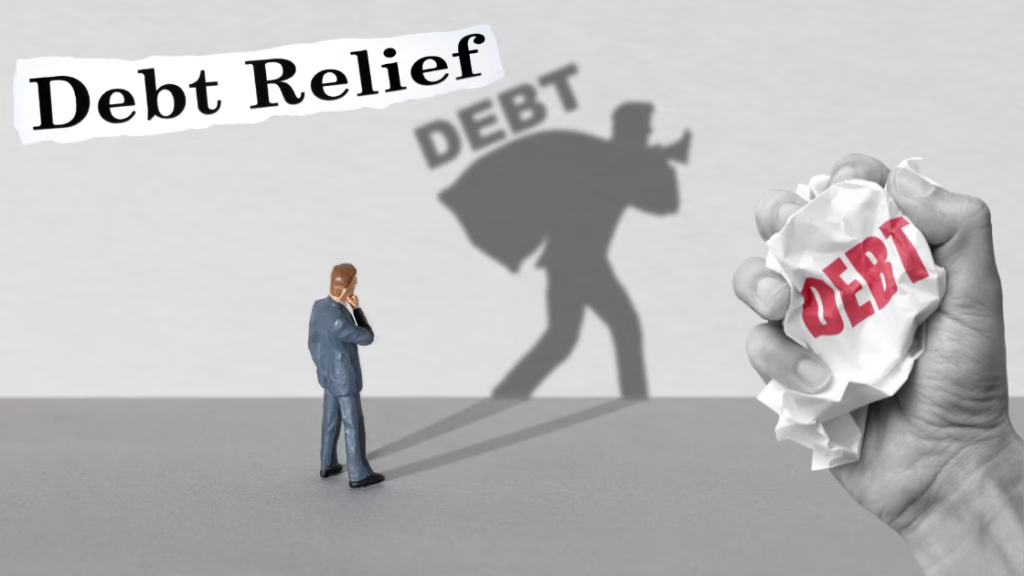
If your vehicle payment has become one of the biggest sources of pressure in your monthly budget, you are not alone. A car can be essential for commuting, family responsibilities and earning an income, yet an expensive loan can quickly become difficult to manage when income falls, expenses rise or other debts accumulate. The good news is that Canadians have several legitimate auto loan debt relief options Canada borrowers can investigate before a missed payment becomes a default.
The right solution depends on whether your problem is a high interest rate, an unaffordable monthly payment, too much overall debt, negative equity or a temporary financial hardship. Options can include negotiating directly with your lender, refinancing, using consolidation for auto loans Canada, working with a credit counsellor, exploring hardship programs car financing Canada, or obtaining professional advice about a consumer proposal when the broader debt situation has become unmanageable.
Government guidance also recommends contacting creditors, reviewing your budget and comparing debt solutions rather than assuming that one solution fits everyone. auto loan debt relief options Canada
What Are Auto Loan Debt Relief Options Canada Borrowers Can Actually Use?
Auto loan debt relief options Canada generally means strategies that help make vehicle debt more manageable without simply ignoring the obligation. The first step is identifying why the loan is creating financial stress. If the interest rate is the problem, refinancing may be worth investigating. If several debts are overwhelming your cash flow, consolidation could simplify payments. If the difficulty is temporary, negotiating directly with the lender may be more appropriate.
A critical distinction is whether your vehicle loan is secured by the vehicle. A standard car loan is generally connected to the vehicle being financed, so failing to meet the agreement can create consequences that differ from unsecured debts. This means borrowers should not automatically assume that a consumer proposal, debt management plan or consolidation arrangement will affect the vehicle loan in exactly the same way as credit cards or personal loans. The specific loan agreement and provincial rules matter.
Before choosing a solution, calculate the remaining principal, interest rate, monthly payment, remaining term, vehicle’s current approximate value and all other outstanding debts. This gives you a realistic picture of whether you need payment relief, lower borrowing costs or broader debt restructuring.
Start With Manage High Car Loan Debt Canada Before It Becomes a Default

Learning to manage high car loan debt Canada borrowers face starts with understanding the complete cost of the loan rather than focusing only on the monthly payment. A lower payment can sometimes be created by extending the repayment period, but that may increase the total interest paid. The Financial Consumer Agency of Canada specifically warns consumers to consider the total cost of borrowing and repayment terms when financing a vehicle.
Create a simple debt snapshot containing: manage high car loan debt Canada
- Current auto loan balance
- Current interest rate
- Monthly vehicle payment
- Remaining months
- Current vehicle value
- Insurance and fuel costs
- Other monthly debt payments
- Net monthly household income
- Essential living expenses
- Available emergency savings
Then calculate how much cash remains after essential expenses and debt payments. If the vehicle payment leaves virtually no room for unexpected expenses, the problem is not simply the interest rate. The vehicle itself may be too expensive relative to your current financial position. manage high car loan debt Canada
This is also where reduce auto debt Canada strategies should begin. Avoid taking on new expensive credit merely to make an existing payment. A temporary payment reduction that creates a larger balance later can delay rather than solve the problem. manage high car loan debt Canada
Option 1: Ask Your Lender About Hardship Programs Car Financing Canada
One of the first actions to consider is contacting the lender before missing payments. Hardship programs car financing Canada borrowers may encounter can vary significantly because lenders have different policies and approval criteria.
Explain the financial problem clearly and ask whether the lender can offer any payment arrangement, temporary relief, revised schedule or other assistance available under your agreement. Do not wait until repeated missed payments have already damaged your credit profile if you know a financial problem is coming. hardship programs car financing Canada
Government guidance recommends contacting creditors to discuss your circumstances. Depending on the creditor and situation, possibilities can include a lower interest rate, extending payments or consolidating debts. However, extending repayment can increase the total interest paid.
When speaking with your lender, ask: hardship programs car financing Canada
- Can my payment schedule be changed?
- Is temporary payment relief available?
- Will interest continue accumulating during any relief period?
- Are there administrative fees?
- Will the arrangement be reported to credit bureaus?
- Will the remaining term change?
- What will the new total repayment amount be?
Get any approved arrangement in writing. hardship programs car financing Canada
Option 2: Consider Consolidation for Auto Loans Canada
Consolidation for auto loans Canada can become relevant when the vehicle loan is only one part of a larger debt problem. Debt consolidation combines multiple debts into one payment, potentially simplifying repayment and, when the new borrowing cost is lower, reducing interest expenses. However, consolidation does not automatically reduce debt. It may also extend repayment and increase the total interest cost.
For example, suppose a borrower has: Consolidation for Auto Loans Canada
| Debt | Balance | Approx. Rate | Monthly Payment |
|---|---|---|---|
| Auto loan | $22,000 | 12% | $490 |
| Credit card | $6,000 | 20% | $150 |
| Personal loan | $5,000 | 15% | $120 |
| Total | $33,000 | — | $760 |
A consolidation product could potentially replace several payments with one payment, but the borrower must compare the new rate, fees, repayment period and total interest. Consolidation for Auto Loans Canada
The key question is not simply, “Will my payment decrease?” It is, “Will this structure improve my financial position without creating a larger problem later?” Consolidation for Auto Loans Canada
Option 3: Explore Auto Loan Refinancing

Refinancing can be useful when your current vehicle loan has become expensive compared with financing you may qualify for today. A borrower whose income has become more stable, credit history has improved or debt has decreased may have a stronger application than when the original loan was approved. auto loan debt relief options Canada
The basic structure is straightforward: a new lender provides financing that is used to pay off the existing loan, and you then repay the new financing according to its terms.
However, refinancing is not automatically a money-saving strategy. Compare:
- New interest rate
- Remaining balance
- New loan term
- Total interest
- Processing or other fees
- Early payout costs
- Vehicle value
- New monthly payment
For example, a borrower with $20,000 remaining at 15% might receive an offer at 10%. If the new agreement also significantly extends the term, the lower payment may not produce the expected overall savings. The Financial Consumer Agency of Canada recommends looking beyond the monthly payment and considering the complete financing cost. auto loan debt relief options Canada
Option 4: Use a Debt Management Plan
A debt management plan may be appropriate when several unsecured debts are contributing to the financial pressure. A credit counsellor can review your budget and approach creditors about an informal repayment arrangement. auto loan debt relief options Canada
According to the Financial Consumer Agency of Canada, a debt management plan can consolidate debts into one affordable monthly payment, and in some cases creditors may agree to reduce or eliminate interest or fees. Borrowers will usually be expected to repay 100% of their debts. Not every creditor has to accept the proposed arrangement.
This distinction is important when dealing with a vehicle loan. Do not assume that a debt management plan will automatically change the terms of a secured auto loan. Ask the credit counsellor exactly which debts can be included and how the vehicle financing would be treated.
Option 5: Consider a Consumer Proposal When Debt Is Overwhelming
A consumer proposal is a formal legal debt solution administered by a Licensed Insolvency Trustee. It is not simply another consolidation loan. auto loan debt relief options Canada
Under Canadian insolvency rules, an eligible individual can make a formal offer to creditors to repay part of the debt, extend repayment or use a combination of both. A consumer proposal cannot exceed five years.
This can be relevant when auto debt exists alongside significant unsecured debts and ordinary repayment strategies are no longer realistic. However, a consumer proposal can have substantial credit consequences, and secured vehicle financing requires particular attention.
The important issue is whether keeping the vehicle and maintaining the associated secured obligation is financially sustainable. A Licensed Insolvency Trustee can assess the complete situation and explain what would happen to different debts and assets.
Government guidance also warns consumers to verify who is providing insolvency advice. Only a qualified Licensed Insolvency Trustee can administer a consumer proposal or bankruptcy.
Option 6: Credit Counselling Can Help You Reduce Auto Debt Canada Strategically
If you are searching for ways to reduce auto debt Canada borrowers can realistically use, professional credit counselling may be helpful even when you are not ready for a formal insolvency process.
A counsellor can help you: reduce auto debt Canada
- Build a realistic household budget
- List all debts
- Prioritize payments
- Identify unnecessary expenses
- Communicate with creditors
- Evaluate consolidation
- Understand debt management plans
- Determine whether professional insolvency advice is necessary
The objective is to replace reactive payment decisions with a sustainable repayment strategy. reduce auto debt Canada
Eligibility and Requirements for Debt Relief
Eligibility depends entirely on the option you pursue. Refinancing and consolidation normally involve lender underwriting, while hardship arrangements depend on the lender’s policies and your circumstances. Credit counselling is generally focused on assessing your financial position rather than simply assigning a credit score.
For financing-related options, expect to provide some combination of:
- Government-issued identification
- Proof of income
- Employment information
- Current loan statement
- Housing information
- Bank statements where required
- Details of other debts
- Vehicle information
- Insurance information
Your credit report is also important. Canadians can obtain their credit reports online for free from Equifax and TransUnion, and checking your own report does not affect your credit rating.
Review the report for inaccurate balances, payment information or accounts you do not recognize before applying for new financing.
Interest Rates and Cost Breakdown
There is no single Canadian interest rate that applies to every borrower seeking debt relief. Your rate can depend on credit history, income, debt obligations, vehicle value, loan amount, lender policies and repayment term.
The following illustration is not a rate quote. It demonstrates why comparing total repayment matters.
| Scenario | Balance | Illustrative Rate | Term | Approx. Monthly Payment* |
|---|---|---|---|---|
| Existing loan | $20,000 | 15% | 60 months | $475 |
| Refinanced loan | $20,000 | 10% | 60 months | $425 |
| Longer-term restructuring | $20,000 | 10% | 72 months | $370 |
*Illustrative principal-and-interest calculations; actual lender payments may differ because of fees, taxes, insurance products and contract terms.
The 72-month option produces the lowest monthly payment in this illustration, but a borrower must calculate total interest before deciding. A smaller payment does not automatically mean a cheaper loan.
Canada’s consumer guidance emphasizes comparing financing offers and understanding the total cost of borrowing before signing.
Canadian Case Study: High Interest but Stable Income
Consider a hypothetical Ontario borrower with $24,000 remaining on a vehicle loan at a relatively high rate. The borrower has stable employment but recently improved their credit profile and reduced credit-card balances.
Instead of immediately selling the vehicle, the borrower obtains the current payout amount, checks their credit reports, calculates the vehicle’s approximate market value and compares refinancing offers.
If a replacement loan provides a materially lower rate without excessive fees or an unnecessarily long term, refinancing could potentially reduce the cost of the remaining debt.
The important lesson is that auto loan debt relief options Canada are not necessarily about escaping the vehicle loan. Sometimes the best outcome is simply replacing an expensive structure with a more sustainable one.
Canadian Case Study: Multiple Debts and a Rising Payment Burden

Imagine a Canadian household with a $21,000 auto loan, $9,000 in credit-card balances and $7,000 in other unsecured debt. The vehicle is necessary for employment, but total monthly debt payments have become difficult to maintain.
Instead of taking another high-cost loan immediately, the household prepares a complete debt inventory and meets with a reputable credit counsellor.
The adviser determines whether a debt management plan is appropriate and whether the vehicle loan can remain outside the plan under its existing terms. If the overall debt is too severe, the household may also be referred to a Licensed Insolvency Trustee for an assessment of formal options.
The lesson is simple: treat the entire financial picture rather than trying to solve one payment in isolation.
Banks vs Lenders vs Brokers for Auto Debt Solutions
| Factor | Banks | Alternative Lenders | Financing Brokers |
|---|---|---|---|
| Traditional underwriting | Often stronger | Often more flexible | Depends on lender |
| Credit flexibility | Varies | Often broader | Can access multiple lender types |
| Rate potential | Can be competitive for stronger profiles | May be higher for higher-risk borrowers | Depends on available lender offers |
| Application assistance | Usually direct | Usually direct | Can provide comparison support |
| Best use | Established borrowers | Borrowers needing broader criteria | Borrowers wanting multiple financing possibilities |
The Financial Consumer Agency of Canada notes that car financing can be obtained through dealerships, financial institutions and independent financing companies. It also recommends shopping around because a dealer does not necessarily have to offer the lowest available rate.
For borrowers considering new financing, the goal should not simply be approval. It should be a loan that remains affordable after accounting for insurance, fuel, maintenance and other household obligations.
Expert Tips to Accelerate a Debt Relief or Refinancing Decision
Prepare Your Numbers Before Applying
A lender, counsellor or financial professional can make a better assessment when your information is complete. Gather the current loan statement, income records, monthly expenses and other debt balances before beginning.
Check Your Credit Reports
Review both major Canadian credit reports for accuracy. Correcting an error can be important before pursuing refinancing or consolidation. Free access is available through Equifax and TransUnion.
Know the Vehicle’s Approximate Value
If the loan balance is significantly higher than the vehicle’s market value, refinancing may be more difficult. Understanding the relationship between the vehicle value and outstanding loan balance helps establish realistic expectations.
Compare Total Cost
Never choose a solution solely because the monthly payment is lower. Compare the interest rate, term, fees, remaining balance and total repayment.
Avoid Unnecessary Applications
The Financial Consumer Agency of Canada notes that applying for loans with different lenders over a short period can affect your credit score. Be strategic about where and when you apply.
Critical Mistakes to Avoid
The most damaging mistake is waiting until the account is seriously delinquent before asking for help. Early communication gives you more opportunity to understand available arrangements.
Another common mistake is replacing an affordable debt with expensive new borrowing. A consolidation loan only helps if the new structure improves the financial position.
Do not judge an offer exclusively by its monthly payment. Extending a loan can reduce the payment while increasing total interest.
Avoid companies making unrealistic promises such as guaranteed debt elimination or guaranteed credit repair. Government guidance recommends researching providers, comparing options and being cautious about companies that charge fees while leaving consumers with substantial debt.
Finally, do not assume that a consumer proposal or debt management plan automatically resolves every obligation connected to a vehicle. Understand how secured financing is treated before making a formal decision.
Frequently Asked Questions
1. What are the best auto loan debt relief options Canada borrowers can consider?
The best option depends on the reason the debt is difficult to manage. Direct negotiation may make sense for temporary hardship. Refinancing can be worth considering when the existing rate is high and your financial profile has improved. Consolidation may help when several debts are creating payment pressure. Credit counselling can provide structured assistance, while a consumer proposal may be considered when broader unsecured debt has become unmanageable. There is no universal solution, so compare the complete financial consequences of each option.
2. Can I refinance my car loan to reduce my monthly payment?

Potentially. Refinancing replaces your existing financing with new financing. A lower rate may reduce both interest and payment, while extending the term can reduce the payment but potentially increase total interest. Before refinancing, compare your current payout amount with the proposed new loan, including fees and the complete repayment period.
3. Does consolidation for auto loans Canada include my car loan?

Not necessarily. Debt consolidation products have different eligibility rules, and a secured auto loan may be treated differently from unsecured credit cards or personal loans. Ask the provider exactly which debts can be included and whether the vehicle financing remains separate. Government guidance recommends understanding which debts can be consolidated and comparing the complete terms before proceeding.
4. Can a lender help if I am temporarily unable to make my car payment?
You should contact the lender as soon as you know there is a problem. Some lenders may have internal assistance or alternative payment arrangements, but availability varies. Ask about the effect on interest, fees, credit reporting and the remaining term. Do not assume that a verbal conversation changes your contractual payment obligations; obtain confirmation of any approved arrangement.
5. Can a consumer proposal eliminate my car loan?
A consumer proposal is a formal legal process for dealing with eligible debts, but vehicle financing can involve security interests and therefore requires individual assessment. If you need to keep the vehicle, discuss the specific loan with a Licensed Insolvency Trustee before making a decision. A consumer proposal can also significantly affect your credit profile.
6. How can I manage high car loan debt Canada without damaging my credit further?
Start by preventing additional missed payments where possible. Review your budget, contact your lender, check your credit reports, stop unnecessary borrowing and investigate whether refinancing or another appropriate arrangement could reduce financial pressure. If multiple debts are involved, credit counselling can help establish a structured repayment strategy. The sooner you understand the numbers, the more choices you may have.
7. How do I know whether I should sell my vehicle instead?
Compare the vehicle’s current value with the loan payout and determine whether replacing the vehicle would genuinely improve your finances. Selling a vehicle does not automatically eliminate a loan if the outstanding balance exceeds the sale proceeds. You may still have to address the remaining deficiency. Consider transportation needs, insurance, replacement costs and the full financial impact before deciding.
8. Where can Canadians find reliable debt-relief information?
Start with authoritative Canadian sources rather than companies promising instant debt elimination. The Financial Consumer Agency of Canada provides information about debt consolidation, credit counselling, car financing and consumer protection. The Office of the Superintendent of Bankruptcy provides information about consumer proposals, bankruptcy and Licensed Insolvency Trustees.
Final Steps for Canadians Looking to Reduce Auto Debt Canada
Finding ways to reduce auto debt Canada borrowers can actually sustain requires more than finding a lower monthly payment. Start by determining exactly what you owe, what the vehicle is worth and how much your household can comfortably allocate toward debt each month.
If the issue is an expensive interest rate, investigate refinancing. If several debts are creating the problem, evaluate consolidation or credit counselling. If the difficulty is temporary, speak with your lender about available hardship assistance. If the overall debt burden has become unmanageable, obtain professional advice about formal insolvency options rather than relying on an unverified debt-relief company.
Quick Approvals provides an online starting point for Canadians exploring vehicle financing and can help applicants understand available financing pathways. Its site describes online applications, financing assistance and options for different credit circumstances. (Quick Auto Loan Approvals)
The most important principle is simple: do not wait for financial pressure to become a crisis. Compare your options, understand the total cost, verify the terms and choose the solution that supports both your transportation needs and your longer-term financial stability.
Internal Links for QuickApprovals.ca
- Quick Approvals – Auto Financing
- Car Loan Refinancing Canada
- Bad Credit Car Loans Canada
- Car Loan Approval Time in Canada
- Car Loan Early Payoff Calculator Canada
- Used Car Financing Canada
Authority Outbound References
- Financial Consumer Agency of Canada — Debt Consolidation
- Financial Consumer Agency of Canada — Getting Your Credit Report and Credit Score
- Financial Consumer Agency of Canada — Getting Help From a Credit Counsellor
- Financial Consumer Agency of Canada — Car Financing Options
- Financial Consumer Agency of Canada — Shopping Around for Auto-Financing
- Office of the Superintendent of Bankruptcy — Consumer Proposals