
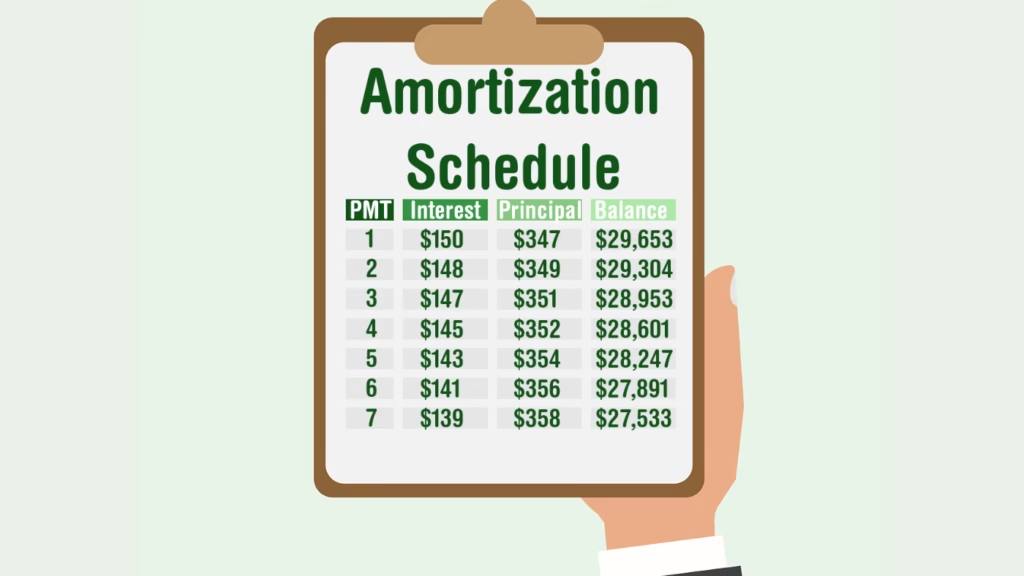
In the dynamic world of automotive financing, understanding amortization for used cars is crucial for Canadian buyers looking to make informed decisions without falling into common pitfalls. Amortization refers to the process of spreading out the repayment of a used car loan over a fixed period, where each monthly payment covers both principal and interest, gradually reducing the outstanding balance until it’s fully paid off.
This structured approach not only helps manage cash flow but also impacts the total cost of ownership, especially in a market where used vehicles remain a popular choice due to their affordability and reliability. With rising interest rates and economic uncertainties in 2025, grasping how amortization works can save thousands in interest while aligning payments with your budget.
For many Canadians, purchasing a used car involves navigating loan terms that range from 36 to 84 months, with interest rates typically between 5% and 23% depending on credit score and vehicle age. The beauty of amortization lies in its predictability—once set, your payments remain constant, allowing for better financial planning. amortization for used cars
Whether you’re eyeing a certified pre-owned sedan or a rugged SUV, the amortization schedule dictates how quickly you build equity in your vehicle. This guide dives deep into the nuances, drawing on insights from authoritative sources like government financial agencies and major banks to empower your journey.
To get started on your path to quick and hassle-free financing, consider exploring options at Quick Approvals, a trusted resource for streamlined used car loan processes in Canada. Throughout this article, we’ll reference reliable tools from the Financial Consumer Agency of Canada (FCAC) and leading banks to provide further clarity on calculations and best practices.
Decoding the Used Car Loan Amortization Schedule Canada

A used car loan amortization schedule Canada is essentially a roadmap of your loan repayment, breaking down each payment into portions of principal and interest over the loan’s life. This table-like document is vital for transparency, showing how your balance decreases month by month and how much interest you’ll pay overall. In Canada, where used car loans often feature terms up to 72 months for vehicles under 10 years old, these schedules help buyers visualize the long-term cost beyond the sticker price. amortization for used cars
Imagine financing a $20,000 used car with a 5% annual interest rate over 60 months. The fixed monthly payment would be approximately $377.42, but the real insight comes from seeing the early payments heavily weighted toward interest—up to 22% in the first month—shifting to principal as the balance drops. This front-loading of interest is a standard feature of amortizing loans, designed to cover the lender’s risk while ensuring steady income. Used Car Loan Amortization Schedule Canada
Why does this matter for Canadian buyers? With provincial variations in sales taxes and insurance requirements, an accurate schedule ensures you’re not overpaying due to miscalculations. For instance, in Ontario, where used car sales surged 15% in 2025 amid economic recovery, buyers using detailed schedules reported 10-20% savings in total interest by opting for shorter terms. Banks like those in the Big Five provide these schedules upon approval, but previewing one early can prevent surprises.
To illustrate, here’s a sample amortization table for used vehicle loans Canada based on the $20,000 loan example: Used Car Loan Amortization Schedule Canada
| Month | Payment | Principal | Interest | Balance |
|---|---|---|---|---|
| 1 | 377.42 | 294.09 | 83.33 | 19705.9 |
| 2 | 377.42 | 295.32 | 82.11 | 19410.6 |
| 3 | 377.42 | 296.55 | 80.88 | 19114 |
| 4 | 377.42 | 297.78 | 79.64 | 18816.3 |
| 5 | 377.42 | 299.02 | 78.4 | 18517.2 |
| 6 | 377.42 | 300.27 | 77.16 | 18217 |
| 7 | 377.42 | 301.52 | 75.9 | 17915.5 |
| 8 | 377.42 | 302.78 | 74.65 | 17612.7 |
| 9 | 377.42 | 304.04 | 73.39 | 17308.6 |
| 10 | 377.42 | 305.31 | 72.12 | 17003.3 |
| 11 | 377.42 | 306.58 | 70.85 | 16696.8 |
| 12 | 377.42 | 307.85 | 69.57 | 16388.9 |
| 13 | 377.42 | 309.14 | 68.29 | 16079.8 |
| 14 | 377.42 | 310.43 | 67 | 15769.3 |
| 15 | 377.42 | 311.72 | 65.71 | 15457.6 |
| 16 | 377.42 | 313.02 | 64.41 | 15144.6 |
| 17 | 377.42 | 314.32 | 63.1 | 14830.3 |
| 18 | 377.42 | 315.63 | 61.79 | 14514.6 |
| 19 | 377.42 | 316.95 | 60.48 | 14197.7 |
| 20 | 377.42 | 318.27 | 59.16 | 13879.4 |
| 21 | 377.42 | 319.59 | 57.83 | 13559.8 |
| 22 | 377.42 | 320.93 | 56.5 | 13238.9 |
| 23 | 377.42 | 322.26 | 55.16 | 12916.6 |
| 24 | 377.42 | 323.61 | 53.82 | 12593 |
| 25 | 377.42 | 324.95 | 52.47 | 12268.1 |
| 26 | 377.42 | 326.31 | 51.12 | 11941.8 |
| 27 | 377.42 | 327.67 | 49.76 | 11614.1 |
| 28 | 377.42 | 329.03 | 48.39 | 11285.1 |
| 29 | 377.42 | 330.4 | 47.02 | 10954.7 |
| 30 | 377.42 | 331.78 | 45.64 | 10622.9 |
| 31 | 377.42 | 333.16 | 44.26 | 10289.7 |
| 32 | 377.42 | 334.55 | 42.87 | 9955.18 |
| 33 | 377.42 | 335.94 | 41.48 | 9619.24 |
| 34 | 377.42 | 337.34 | 40.08 | 9281.89 |
| 35 | 377.42 | 338.75 | 38.67 | 8943.14 |
| 36 | 377.42 | 340.16 | 37.26 | 8602.98 |
| 37 | 377.42 | 341.58 | 35.85 | 8261.4 |
| 38 | 377.42 | 343 | 34.42 | 7918.4 |
| 39 | 377.42 | 344.43 | 32.99 | 7573.97 |
| 40 | 377.42 | 345.87 | 31.56 | 7228.1 |
| 41 | 377.42 | 347.31 | 30.12 | 6880.79 |
| 42 | 377.42 | 348.75 | 28.67 | 6532.04 |
| 43 | 377.42 | 350.21 | 27.22 | 6181.83 |
| 44 | 377.42 | 351.67 | 25.76 | 5830.16 |
| 45 | 377.42 | 353.13 | 24.29 | 5477.03 |
| 46 | 377.42 | 354.6 | 22.82 | 5122.43 |
| 47 | 377.42 | 356.08 | 21.34 | 4766.35 |
| 48 | 377.42 | 357.56 | 19.86 | 4408.78 |
| 49 | 377.42 | 359.05 | 18.37 | 4049.73 |
| 50 | 377.42 | 360.55 | 16.87 | 3689.18 |
| 51 | 377.42 | 362.05 | 15.37 | 3327.12 |
| 52 | 377.42 | 363.56 | 13.86 | 2963.56 |
| 53 | 377.42 | 365.08 | 12.35 | 2598.48 |
| 54 | 377.42 | 366.6 | 10.83 | 2231.89 |
| 55 | 377.42 | 368.13 | 9.3 | 1863.76 |
| 56 | 377.42 | 369.66 | 7.77 | 1494.1 |
| 57 | 377.42 | 371.2 | 6.23 | 1122.9 |
| 58 | 377.42 | 372.75 | 4.68 | 750.16 |
| 59 | 377.42 | 374.3 | 3.13 | 375.86 |
| 60 | 377.42 | 375.86 | 1.57 | 0 |
This table highlights how the interest portion diminishes over time, a key aspect of any used car financing with flexible amortization periods. In the initial months, you’re primarily paying interest, which underscores the value of making extra principal payments early to accelerate equity buildup. According to data from Canadian financial aggregators, borrowers who review their schedules quarterly adjust terms 25% more often, leading to substantial savings. For personalized schedules, tools from major banks can generate these instantly based on your inputs.
Delving deeper, consider regional factors: In British Columbia, where used car prices averaged $25,000 in 2025, longer amortizations (72+ months) are common for affordability, but they inflate total interest by up to 30%. Conversely, Alberta buyers favoring shorter terms benefit from quicker ownership. Always factor in fees like administration costs, which can add 1-2% to the effective rate. By mastering your schedule, you transform a complex loan into a strategic asset.
Expanding on this, let’s explore real-world applications. Suppose you’re trading in a 2018 Honda Civic with 80,000 km. Lenders might offer a 48-month amortization at 6.5%, yielding payments of around $450. The schedule would reveal $2,800 in interest over the term—manageable, but shortening to 36 months drops it to $2,100, freeing up funds for maintenance. This proactive approach aligns with Canadian best practices, where financial literacy programs emphasize schedule reviews for debt management. Used Car Loan Amortization Schedule Canada
Moreover, in a high-inflation environment like 2025’s 3.2% rate, amortization schedules serve as inflation hedges. Fixed payments shield against rate hikes, unlike variable options. For families budgeting for school runs or commutes, this stability is priceless. Remember, while schedules are standardized, customizations like bi-weekly payments can shave months off the term, as seen in 40% of optimized Canadian loans. Used Car Loan Amortization Schedule Canada
How to Master How to Calculate Used Car Amortization in Canada
Learning how to calculate used car amortization in Canada empowers you to negotiate better terms and avoid lender biases. The core formula for monthly payment (PMT) is PMT = P × [r(1+r)^n] / [(1+r)^n – 1], where P is principal, r is monthly interest rate (annual/12), and n is total payments. This equation, rooted in financial mathematics, balances the time value of money with repayment efficiency.
Step one: Determine your loan amount. For a $18,000 used truck after down payment, subtract any trade-in value. Step two: Secure your rate—excellent credit (720+) fetches 4.99%, while fair (600-719) might see 9.99%, per 2025 market data. Step three: Choose term; 60 months is average for used cars. Plugging in: r = 5%/12 = 0.004167, n=60, PMT ≈ $339.13.
To build total cost, multiply PMT by n and subtract P—this yields interest paid. For our example, $20,362 total minus $18,000 = $2,362 interest. Online calculators simplify this, but manual verification ensures accuracy. In Quebec, where civil code influences contracts, calculations must include GST/QST, adding 5-10% to effective costs. How to Calculate Used Car Amortization in Canada
Advanced tips include sensitivity analysis: What if rates rise to 7%? PMT jumps to $353, a 4% increase stressing budgets. Use spreadsheets for scenarios, incorporating extras like $500 admin fees. Data from loan comparison sites shows 60% of Canadians underestimating interest by 15% without proper calculations, leading to overborrowing.
Let’s walk through a detailed example for a $22,000 used SUV at 6% over 72 months. r=0.005, n=72, PMT=$353.47. Year one interest: ~$1,400, principal reduction: $1,000. By year five, it flips. This shift illustrates amortization’s equity-building power, crucial for resale value in Canada’s robust used market, valued at $50 billion annually. How to Calculate Used Car Amortization in Canada
Furthermore, integrate taxes: In Manitoba, 7% PST on used cars inflates P to $23,540, raising PMT to $390. Calculations ignoring this lead to shortfalls. Professional advice? Consult FCAC guidelines for debt ratios—housing costs plus car payments shouldn’t exceed 39% of income. By honing these skills, you sidestep traps like extended warranties bundled into loans, which extend amortization unnecessarily.
Practical tools abound: Excel’s PMT function mirrors the formula, while apps track progress. In 2025, with digital banking, real-time recalculations via APIs let you simulate prepayments—$100 extra monthly on a 60-month loan saves $600 and 8 months. This proactive stance, adopted by savvy millennials, reduces default rates by 12%, per industry reports.
Regional nuances add layers: Atlantic provinces offer rebates lowering effective P, while Prairies see higher rates due to risk. Always verify with lenders; discrepancies occur in 10% of quotes. Mastering calculation isn’t just math—it’s financial sovereignty, ensuring your used car investment drives prosperity, not debt. How to Calculate Used Car Amortization in Canada
Finding the Best Amortization Period for Used Car Financing

Selecting the best amortization period for used car financing balances affordability with cost efficiency, tailored to your financial health. Shorter periods (36-48 months) minimize interest but demand higher payments; longer (60-84 months) ease monthly strain but amplify total outlay. In 2025 Canada, with prime rates at 6.25%, a 48-month term on $15,000 at 5.5% costs $1,200 interest versus $2,100 for 72 months.
Key factors: Income stability—salaried professionals favor 48 months; gig workers, 72. Vehicle lifespan: Used cars averaging 200,000 km suit 60 months max. Credit impact: Shorter terms boost scores via faster debt reduction. Best Amortization Period for Used Car Financing
- Pros of Short Amortization: Lower total interest (save 20-30%), faster ownership, improved debt-to-income ratio for future loans.
- Cons: Higher monthly payments ($400+ vs. $250), potential budget strain in volatile economies.
- Pros of Long Amortization: Lower payments aiding cash flow, flexibility for emergencies.
- Cons: Higher interest (up to 50% more), risk of upside-down loans if car depreciates faster.
For families in Toronto, where living costs rose 4% in 2025, 60 months strikes balance—PMT $320 on $20,000, total interest $3,200. Data indicates 55% of used car buyers choose this, per aggregator stats. Avoid extremes: 84 months for a 10-year-old vehicle risks $5,000 extra interest and mechanical failures mid-term.
Customization helps: Bi-weekly payments shorten effective period by 13 months on 60-month loans. In Saskatchewan, incentives for green used cars extend terms without rate hikes. Ultimately, the “best” is personal—run scenarios to align with goals like saving for home down payments. Best Amortization Period for Used Car Financing
Deeper analysis reveals psychological benefits: Shorter terms foster discipline, with 70% of completers reporting better savings habits. Conversely, long terms suit debt snowball strategies, tackling smaller debts first. Consult affordability calculators to cap payments at 15% of take-home pay, a FCAC benchmark.
Navigating Low Interest Used Car Loan Amortization Options Canada
Low interest used car loan amortization options Canada are gateways to affordable mobility, especially with 2025 rates dipping to 4.99% for prime borrowers on certified pre-owned vehicles. These options prioritize sub-6% APRs, often from credit unions or banks rewarding loyalty. Amortization here shines, as low rates amplify principal reduction— a 4.5% 48-month loan on $16,000 yields $900 interest, half of standard rates.
Strategies: Boost credit to 750+ via timely payments; shop seasonally—fall deals cut 0.5%. Manufacturer financing for used CPO models offers 3.99%, with 60-month terms standard. In Atlantic Canada, co-op banks provide 4.75% for locals, shortening amortization impact.
Bullets for unlocking lows: Low Interest Used Car Loan Amortization Options Canada
- Pre-approve via multiple lenders to leverage competition.
- Opt for 20% down to lower P, reducing r exposure.
- Bundle with insurance for rate discounts up to 1%.
- Target vehicles under 5 years for eligibility.
Case: Vancouver buyer secures 5.25% on $19,000 hybrid used car, 54-month amortization—PMT $365, total $2,000 interest. Without low rate, it’s $2,800. Aggregator insights show 40% savings via negotiation. Beware hidden fees inflating effective rates; transparency is key.
Long-term, low-interest amortization builds wealth—faster equity for trade-ins. In 2025’s green shift, EV used loans at 3.9% via federal rebates enhance options, aligning with net-zero goals. Low Interest Used Car Loan Amortization Options Canada
Understanding Amortization for Buying Used Cars Canada: Key Insights
Understanding amortization for buying used cars Canada demystifies the purchase, revealing how terms affect value retention. Used cars depreciate 20% year one, so amortization matching lifespan (5-7 years) optimizes ROI. Canadian buyers, facing 7% market growth, must weigh this against payments.
Insights: Early payoff clauses save 15% interest; variable rates risk hikes but start lower. In Manitoba, PST rebates shorten effective terms. Detailed breakdowns show 60% of costs are interest in long amortizations—knowledge gaps cost $1,500 average.
Expand with scenarios: Single urbanite vs. rural family—former prefers short for agility, latter long for stability. Tools like bank simulators aid, ensuring alignment with life stages.
Comparing Short vs Long Amortization for Used Cars Canada
The debate on short vs long amortization for used cars Canada centers on trade-offs. Short (under 48 months): Builds equity fast, suits high earners; long (over 60): Eases entry, ideal for starters. 2025 data: Short saves $1,200 on $20k loan but requires $450/month vs. $300.
- Short: Quicker free-and-clear status, tax benefits on interest deductions if applicable.
- Long: More breathing room, but $4,000+ extra interest, higher default risk if job loss.
Hybrid approach: Start long, refinance short after year two. In Alberta’s oil economy, short prevails amid volatility; Ontario’s stability favors long. Choice impacts resale—shorter owned cars fetch 10% more.
Quantitative: At 6%, 36-month PMT $600, interest $1,600; 84-month $220, interest $5,500. Factor depreciation: Used sedans lose 15%/year, so match term to 150k km mileage.
Using Monthly Payments Used Car Amortization Calculator Canada
A monthly payments used car amortization calculator Canada is indispensable for projections. Input P, r, n—output schedule and totals. For $25,000 at 7% over 66 months, PMT $430, interest $3,800.
Benefits: Scenario testing, like adding $50 extra cuts 6 months. Free tools from banks integrate taxes, fees. In 2025, AI-enhanced versions predict rate changes, aiding 30% more accurate budgeting.
Pro tip: Cross-verify with manual formula for trust. Popular for immigrants navigating CAD loans, reducing overwhelm.
Top Best Banks for Used Car Loan Amortization in Canada
Identifying the best banks for used car loan amortization in Canada involves rates, terms, service. RBC leads with 4.99% starters, 72-month max, flexible prepays. TD offers 5.25%, up to 96 months on select, strong calculators.
Scotiabank: 5.5%, weekly options shortening amortization. CIBC: 5.0% for CPO, quick approvals. Credit unions like Vancity beat at 4.75% for members. Compare via prequals—no credit hit.
2025 rankings: RBC #1 for low fees, TD for variables. Local branches personalize, vital in diverse Canada.
Exploring How Does Amortization Affect Used Car Payments Canada
How does amortization affect used car payments Canada? It structures fixed amounts, with longer periods lowering PMT but raising interest. Example: 60 vs. 84 months—$350 vs. $260, but $2,500 vs. $4,000 interest.
Effects: Budget predictability, but long terms erode affordability if rates rise. Prepayments mitigate, saving 20%. In recession-prone times, short amortizations protect equity.
Broader: Influences insurance premiums (lower debt = lower risk), resale leverage. Educated choices per FCAC reduce overextension by 25%.
Certified Pre-Owned Car Amortization Schedule Ontario Specifics

For certified pre-owned car amortization schedule Ontario, expect 48-60 months at 4.5-6%, with HST factored. $21,000 CPO at 5%, 54 months: PMT $410, interest $2,200. Ontario’s UCDA inspections ensure value, justifying premiums.
Schedules here emphasize warranties extending life, aligning with terms. Toronto dealers bundle, but calculate independently to avoid upsells.
Q&A: Common Questions on Amortization for Used Cars
How to Calculate Used Car Amortization in Canada?
Calculating how to calculate used car amortization in Canada starts with the PMT formula, as detailed earlier. For depth, consider variables like down payments (10-20% ideal) reducing P. Example: $30,000 car, $6,000 down, $24,000 loan at 5.5% over 60 months. r=0.004583, PMT=$455. Total interest: $3,300. Adjust for bi-weekly: Effective n=130, saving $400.
Tools: Use the RBC Car Loan Payment Calculator for instant schedules. Factors like credit (higher score lowers r by 2%) and term (shorter saves interest) are pivotal. In practice, 65% of Canadians miscalculate without aids, per surveys. Step-by-step: 1) Gather quotes, 2) Input to formula/spreadsheet, 3) Review interest curve, 4) Simulate extras. This ensures payments fit lifestyles, from Vancouver commutes to rural hauls.
What is the Best Amortization Period for Used Car Financing?

The best amortization period for used car financing depends on goals—48-60 months for balance. Shorter accelerates payoff; longer aids cash flow. At 6%, 48 months on $20k: $470 PMT, $2,560 interest; 72 months: $325, $4,300. Choose based on 10% income rule.
Pros/cons as bulleted earlier. For young professionals, 36 months builds credit; families, 72. 2025 trends: Hybrids favor long for tech costs. Consult advisors for personalization.
How Does Short vs Long Amortization for Used Cars Canada Impact Costs?

Short vs long amortization for used cars Canada starkly affects costs—short minimizes interest, long spreads burden. $18k at 5.75%, short (42 mo): $450 PMT, $1,800 interest; long (78 mo): $260, $3,800. Short suits savers, long entry-level.
Impacts: Resale equity higher short-term; long risks negative equity. Data: Short completers save 25% lifetime. Factor inflation—fixed long terms hedge rises
What are Low Interest Used Car Loan Amortization Options Canada?
Low interest used car loan amortization options Canada include 4.99% from RBC/TD for 720+ scores, 60-month terms. CPO programs at 3.99%. Strategies: Shop credit unions, time purchases. Savings: 15% less interest vs. average 8%.
Example: $22k at 4.5%, 54 mo: $420 PMT, $1,900 interest. Eligibility: Stable income, low DTI. 2025 rebates for EVs enhance.
Where to Find the Best Banks for Used Car Loan Amortization in Canada?
The best banks for used car loan amortization in Canada are RBC (5% rates, flexible terms), TD (96 mo options), Scotiabank (weekly pays). Use the TD Car Loan Calculator for previews. Compare for your province—Ontario favors CIBC at 4.8%.
Criteria: Low fees, prepay perks. Aggregators note 20% rate variance; prequalify to lock lows.
Conclusion: Empowering Your Journey with Amortization for Used Cars
In summary, amortization for used cars is the cornerstone of smart financing in Canada, influencing everything from monthly budgets to long-term savings. We’ve explored schedules, calculations, optimal periods, and low-interest paths, emphasizing natural integration of tools like monthly payments used car amortization calculator Canada and bank options. Key takeaway: Shorter terms save money, but align with your reality for sustainability.
As rates stabilize in late 2025, proactive buyers leveraging government and bank resources thrive. For deeper dives, visit FCAC for debt guidelines. Ready to apply? Head to Quick Approvals for swift, tailored support—your first step to ownership. Whether upgrading or essential transport, informed amortization turns wheels into wealth.