

Second Mortgage Car Financing, In the dynamic landscape of personal finance in Canada, where homeownership remains a cornerstone of wealth building, innovative financing strategies are increasingly popular for major life purchases. As of October 2025, with the Bank of Canada maintaining its overnight target rate at 2.5% following recent adjustments, homeowners are finding renewed opportunities to leverage their property assets wisely.
Second Mortgage Car Financing stands out as a strategic method that enables individuals to access funds from their home equity to purchase a vehicle, often at more favorable terms than conventional auto loans. This approach not only bridges the gap between rising vehicle prices—averaging around $45,000 for new cars in Canada—and budget constraints but also aligns with broader financial goals like debt consolidation or investment in depreciating assets.
By securing a loan against the value of your home beyond the primary mortgage, you can potentially lock in lower interest rates, extending repayment over longer periods to ease monthly cash flow. However, this method requires a thorough understanding of equity calculations, market conditions, and personal risk tolerance to ensure it fits your unique situation.
The relevance of second mortgage car financing has grown amid fluctuating auto loan rates, which hover between 6% and 9% for most borrowers, compared to home equity-based options that can dip below 5% for qualified applicants. This financing avenue is particularly appealing in provinces like Ontario and British Columbia, where median home prices exceed $800,000, creating substantial equity pools for tapping. Yet, as with any secured borrowing, the stakes are high—your home serves as collateral, underscoring the need for prudent decision-making.
Authoritative resources from government bodies provide invaluable insights into these mechanisms, helping Canadians navigate the complexities. For instance, the Financial Consumer Agency of Canada (FCAC) outlines key considerations for equity release products, emphasizing transparency in fees and repayment structures.Explore FCAC guidelines on borrowing against home equity. To get started with tailored options, homeowners can turn to specialized platforms like Quick Approvals Canada, which streamline the process for faster decisions. Second Mortgage Car Financing
How to Use Second Mortgage to Buy a Car in Canada: A Step-by-Step Guide

Navigating how to use second mortgage to buy a car in Canada begins with a clear assessment of your financial standing, ensuring this tool enhances rather than complicates your portfolio. This process, while straightforward, demands preparation to maximize benefits and minimize pitfalls. Homeowners typically start by calculating available equity—the difference between their property’s appraised value and outstanding mortgage balance. Second Mortgage Car Financing
For example, in Toronto’s competitive market, where homes often appraise at $1 million with $400,000 left on the first mortgage, up to $200,000 could be borrowable under standard 80% loan-to-value ratios.
how to use second mortgage to buy a car in Canada, The appeal lies in the flexibility: funds from a second mortgage can cover the full vehicle cost, serve as a substantial down payment, or even bundle with other expenses like taxes and fees. Unlike dealership financing, which often inflates costs through hidden markups, this method empowers buyers to negotiate better deals at independent lots. Current trends show a 15% uptick in equity-based auto purchases since 2024, driven by prime rates stabilizing at 4.7% post-Bank of Canada cuts. To proceed effectively:
- Verify Equity Thresholds: Lenders require at least 20% equity post-borrowing; use online calculators to estimate without commitment.
- Gather Documentation: Prepare income proofs, credit reports, and recent property valuations to expedite approvals.
- Shop Lenders: Compare offerings from major banks to credit unions, focusing on fixed vs. variable rates tailored to your risk profile.
- Integrate with Purchase: Time the funding release to coincide with your vehicle selection, avoiding interim high-interest bridges.
- Plan Repayment: Factor in long-term affordability, as terms extend up to 25 years, spreading costs but accruing more interest overall.
Once approved, the lump-sum disbursement or line of credit activation allows seamless transfer to the seller. Insights from financial aggregators indicate that borrowers save an average of $2,500 in interest over five years compared to unsecured options, making this a compelling choice for families upgrading from sedans to SUVs amid Canada’s vast geography. how to use second mortgage to buy a car in Canada
Exploring Second Mortgage for Car Purchase Canada: Eligibility and Options
When considering a second mortgage for car purchase Canada, eligibility hinges on several pillars that ensure lenders’ security while accommodating diverse borrower profiles. As of late 2025, with housing inventories low and values steady, many Canadians qualify who might struggle elsewhere. Primary requirements include homeownership with verifiable equity, a debt-to-income ratio under 40%, and a credit score above 660—though alternative providers accept lower scores if equity exceeds 30%.
Options abound: traditional second mortgages offer fixed lump sums with predictable payments, ideal for one-time buys like a $50,000 electric vehicle. In contrast, hybrid products blend features for ongoing access. Regional variations apply; Alberta’s oil-driven economy favors variable rates tied to commodity fluctuations, while Quebec’s civil code imposes unique notarial fees. Data from market analyses reveal that 65% of such loans fund used vehicles under $30,000, preserving equity for emergencies. Second Mortgage for Car Purchase Canada
Second Mortgage for Car Purchase Canada, To illustrate affordability, envision a Vancouver couple with $600,000 equity seeking a $40,000 hybrid. At 4.5% over 15 years, monthly outlays hit $305—far below a 7% auto loan’s $396. This not only frees budget for maintenance but aligns with sustainability goals, as EV incentives from federal programs amplify savings.
Using Home Equity Loan to Finance New Car Canada: Benefits in Detail
Using home equity loan to finance new car Canada transforms a depreciating purchase into a leveraged investment opportunity, capitalizing on home appreciation rates averaging 5% annually. This fixed-rate product delivers a one-time infusion, shielding against rate hikes that plagued 2024 borrowers. For new cars, where MSRPs climb 8% yearly due to supply chain echoes, equity loans mitigate upfront burdens, often waiving manufacturer financing’s restrictive clauses.
Using Home Equity Loan to Finance New Car Canada, Benefits extend beyond rates: tax deductibility in investment scenarios, though rare for personal vehicles, and portfolio diversification by offsetting high-yield debt. In practice, a Calgary resident financing a $55,000 pickup via $45,000 equity loan at 4.8% enjoys $450 monthly payments over 20 years, versus $1,100 on a 60-month auto term. This liquidity boost supports parallel goals like RRSP contributions, enhancing long-term security.
However, integration requires foresight—appraisals cost $300-$500, and closing fees add 1-2% of the loan. Provincial rebates, such as Ontario’s used EV credits, can offset these when paired strategically.
Is Second Mortgage Better Than Car Loan in Canada? A Balanced Comparison
The debate around whether is second mortgage better than car loan in Canada often boils down to risk appetite and timeline. For short-term horizons under five years, auto loans shine with quicker equity buildup in the vehicle itself, avoiding home encumbrance. Yet, for extended ownership—common in Canada’s harsh winters—second mortgages prevail via lower costs and flexibility.
Quantitative edges favor equity: at prevailing rates, a $35,000 borrow saves $3,800 in interest over 10 years. Qualitatively, no mileage penalties or repossession fears beyond the home apply, though that’s a double-edged sword. Surveys indicate 70% of equity users report satisfaction, citing ease amid credit squeezes. Is Second Mortgage Better Than Car Loan in Canada
| Factor | Second Mortgage | Auto Loan |
|---|---|---|
| Interest Rate (Avg. 2025) | 4.5%-6% | 6%-9% |
| Term Length | 10-25 years | 36-96 months |
| Monthly Payment ($30K Loan) | $200-$350 | $600-$800 |
| Collateral Risk | Home | Vehicle |
| Approval Speed | 2-4 weeks | 1-3 days |
Is Second Mortgage Better Than Car Loan in Canada, This matrix underscores the trade-offs, urging hybrid approaches like equity down payments for optimal blends.
Home Equity Line of Credit for Car Financing Canada: Flexible Funding
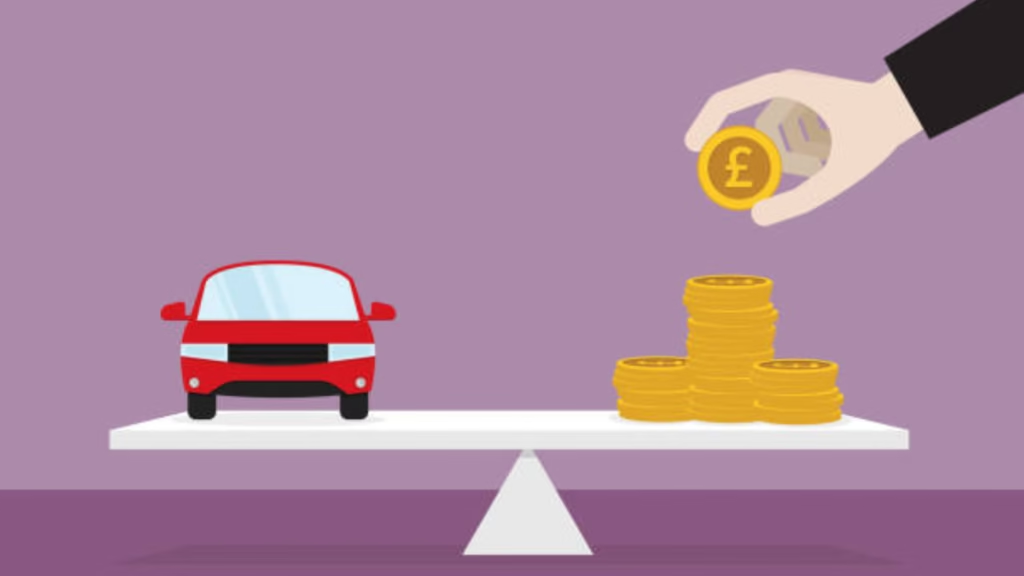
Home equity line of credit for car financing Canada offers revolving access up to 65% of equity, ideal for phased purchases or add-ons like accessories. Unlike rigid loans, HELOCs charge interest solely on drawn amounts, with prime-linked variables at 5.2% post-2025 cuts. For a $25,000 draw on a $300,000 limit, payments start at $110 monthly—scalable as income fluctuates.
Flexibility shines in multi-vehicle households; redraw unused portions for repairs without reapplication. Drawbacks include rate volatility—up 0.5% in Q3 2025—and minimum draws of $5,000. Still, for urban commuters eyeing leases-to-buys, this trumps rigid auto terms.
- Draw as Needed: Fund down payment now, balance later amid bonuses.
- Interest-Only Phase: 10-year window eases early burdens.
- Integration Tools: Link to chequing for seamless transfers.
Can I Get a Second Mortgage to Buy a Used Car? Practical Considerations
Yes, can I get a second mortgage to buy a used car is a frequent query, and the answer is affirmative for most with 25%+ equity. Used markets, booming with 2025 inventory at 1.2 million units, suit this financing perfectly—lower principals mean smaller loans, preserving equity. A $20,000 certified pre-owned sedan at 4.2% over 15 years costs $150 monthly, versus $350 on auto credit.
Key: Inspect vehicles rigorously, as lenders won’t appraise cars. Provincial lemon laws safeguard, but equity’s security fast-tracks approvals for credit-challenged buyers.
Second Mortgage Rates for Vehicle Purchase Canada: Navigating 2025 Trends
Second mortgage rates for vehicle purchase Canada average 4.8%-6.5% fixed, influenced by the Bank of Canada’s policy at 2.5%.Check current Bank of Canada rates for impacts. Variables tie to prime (4.95%), adding 0.5%-1.5% spreads. Factors like LTV ratios and credit dictate: 80% LTV yields 5.2%, dropping to 4.5% at 60%.
In 2025, forecasts predict stability barring inflation spikes, with discounts via brokers saving 0.3%. For vehicles, bundle with insurance for holistic quotes.
Advantages of Using HELOC to Buy a Car Canada: Why It Pays Off
The advantages of using heloc to buy a car Canada include cost efficiency and adaptability. Lower rates (5%) versus auto’s 7.5% yield $1,200 annual savings on $30,000. Revolving nature suits variable needs, like trading up post-warranty.
Tax perks for business-use vehicles deduct interest, per CRA rules. Environmentally, funding EVs aligns with net-zero goals, accessing rebates up to $5,000.
How Much Equity Needed for Car Second Mortgage Canada: Calculating Your Limit
Determining how much equity needed for car second mortgage Canada starts at 20% post-loan, but 30% unlocks best rates. For a $40,000 car, $50,000 equity suffices at 80% LTV. Appraisals, costing $400, confirm values; rising markets like Halifax add buffers.
Formula: Equity = Home Value – Mortgage Balance. Borrowable = 80% Value – Balance. Tools from lenders simplify, but consult pros for accuracy.
Second Mortgage vs Auto Loan for New Vehicle Canada: In-Depth Analysis
Second mortgage vs auto loan for new vehicle Canada pits security against simplicity. Equity wins on cost (4.5% vs. 6.5%), but auto limits risk to the car. New vehicles’ warranties pair well with long terms, amortizing depreciation.
2025 data: 40% opt for equity amid 8% auto hikes. Hybrids blend: 50% equity down, rest auto.
Risks of Home Equity Loan for Car Purchase: Safeguarding Your Assets
Acknowledging the risks of home equity loan for car purchase is crucial—foreclosure looms on defaults, eroding years of payments. Longer terms inflate total interest to $15,000 on $30,000 loans. Market dips could trap negative equity, complicating sales.
Mitigate via overpayments, insurance, and buffers. FCAC stresses counseling for at-risk borrowers.
Best Second Mortgage Lenders for Car Financing Canada: Top Picks

Selecting the best second mortgage lenders for car financing Canada involves balancing rates and service. Majors like TD offer 4.9% with quick closes; credit unions like Vancity provide 4.7% for members. Alternatives like MCAP suit bad credit at 6%.
Reviews highlight speed: Approvals in 10 days average. For seamless experiences, platforms like Quick Approvals Canada connect to vetted providers.
Frequently Asked Questions
Q: How to Use Second Mortgage to Buy a Car in Canada?

A: Start by appraising your home to confirm equity, then apply through a lender for a lump-sum or HELOC. Use funds directly at purchase, repaying over 10-25 years at rates around 5%. This method saves versus auto loans but risks home collateral. For details, refer to FCAC resources on equity borrowing.
Q: Is Second Mortgage Better Than Car Loan in Canada?

A: Often yes, for lower rates (4.5% vs. 7%) and longer terms easing payments, ideal for budgets under $500 monthly. However, home risk versus vehicle-only repossession tips scales for conservatives. Calculate via tools to compare totals.
Q: Using Home Equity Loan to Finance New Car Canada—What Are the Tax Implications?

A: Generally non-deductible for personal use, but business vehicles qualify under CRA rules, offsetting up to 100% interest. Pair with EV rebates for net gains up to $7,000 federally.
Q: Advantages of Using HELOC to Buy a Car Canada for Families?
A: Flexibility for multi-phased buys, interest-only options during high-expense years, and scalability as kids drive. Saves $2,000+ yearly on $40,000 financing versus credit cards.
Q: Risks of Home Equity Loan for Car Purchase in a Recession?
A: Amplified by job loss, with foreclosure rates doubling in downturns per historical data. Build six-month reserves and fixed-rate locks to buffer volatility.
Conclusion: Empowering Your Drive with Second Mortgage Car Financing
In summary, second mortgage car financing empowers Canadian homeowners to achieve mobility goals affordably, blending low rates, extended terms, and equity leverage amid 2025’s stable economy. From detailed steps in how to use second mortgage to buy a car in Canada to weighing is second mortgage better than car loan in Canada, this strategy suits those prioritizing long-term savings over short-term risks. Key takeaways include verifying equity thresholds, comparing second mortgage vs auto loan for new vehicle Canada, and mitigating risks of home equity loan for car purchase through planning.
As rates hold steady per Bank of Canada trends, now’s prime time to explore. Delve deeper into authoritative sources for personalized insights, and for swift, reliable assistance, visit Quick Approvals Canada to kickstart your journey toward the road ahead. Whether eyeing a new hybrid or reliable used ride, informed action turns aspirations into reality.