
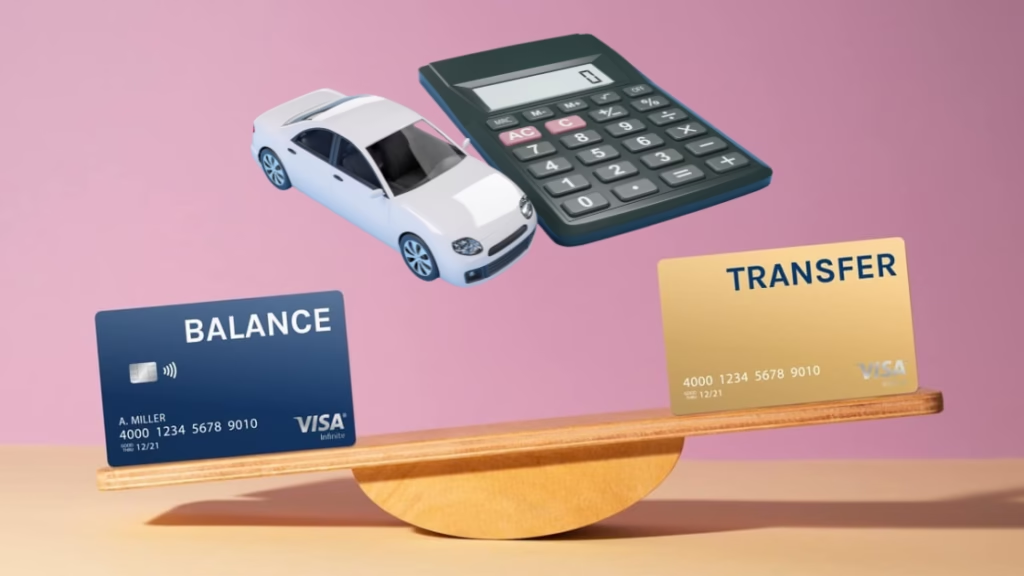
If your current vehicle loan carries a rate that no longer fits your financial situation, you may not have to keep the same financing until the final payment. Car loan balance transfer options Canada can allow eligible borrowers to replace an existing auto loan with financing from another lender, potentially improving the interest rate, payment structure, or repayment timeline. For Canadians whose credit, income, debt obligations, or available lending options have changed since the original loan was approved, reviewing the existing financing can be worthwhile.
The important distinction is that an auto loan balance transfer is generally not as simple as moving a balance from one account to another. In practice, transfer auto loan to new bank Canada usually involves obtaining a new loan that pays out the existing lender, followed by repayment under the new agreement. The new lender must be willing to finance the vehicle, your application must meet its underwriting requirements, and the costs of replacing the original loan must be understood before proceeding.
The Financial Consumer Agency of Canada explains that car financing can be arranged through dealerships, banks, credit unions, and independent finance companies, and recommends looking at the complete borrowing arrangement rather than focusing only on the payment. Car loan balance transfer options Canada
This guide explains how car loan balance transfer options Canada work, what can affect approval, how to calculate potential savings, what fees to investigate, and how to compare banks, lenders, and financing specialists before making a change.
What Are Car Loan Balance Transfer Options Canada?
Car loan balance transfer options Canada generally refer to replacing an existing vehicle loan with new financing from another lender. Instead of continuing to make payments under the original agreement, the new financing is used to satisfy the outstanding balance, subject to the terms of both lenders. After the transfer is completed, your repayment obligation is normally with the new lender.
This is closely related to refinancing, but the terminology can create confusion. A borrower searching for transfer auto loan to new bank Canada may actually be looking for an auto loan refinance. Unlike a credit-card balance transfer, there is usually no universal vehicle-loan feature where you simply enter another lender’s account number and move the balance. The transaction must be approved and documented by the new lender.
The basic process can look like this: Car loan balance transfer options Canada
- You request your current loan’s payout information.
- You compare potential financing from another lender.
- The new lender reviews your credit, income, vehicle, debt obligations, and other information.
- If approved, the new financing is arranged.
- The existing loan is paid out according to the lender’s instructions.
- You begin making payments under the replacement agreement.
The exact process varies by lender and province. If your current lender is federally regulated, federal consumer-protection requirements apply; other lenders may be subject to provincial or territorial rules. Car loan balance transfer options Canada
When Should You Consider Switching an Existing Car Loan?

A switch lenders mid loan Canada strategy may become relevant when your financial circumstances have materially changed since you originally financed the vehicle. For example, perhaps your credit profile has improved after a period of consistent payments, your income has increased, your debt has decreased, or you originally accepted expensive financing because you had limited alternatives.
Another reason to investigate refinance balance to better rate Canada is a meaningful difference between your current financing cost and the terms available to you today. A lower rate can reduce interest expense, but the potential benefit depends on the remaining balance, remaining term, fees, and the rate you actually qualify for.
The Bank of Canada reported that its target overnight rate was 2.25% on September 2, 2026. That figure provides general monetary-policy context, but it is not the rate consumers automatically receive on vehicle loans. Auto-loan pricing is determined by lenders using factors such as borrower risk, vehicle characteristics, loan structure, and funding considerations.
You should therefore avoid assuming that a change in the Bank of Canada’s policy rate automatically means your existing vehicle loan should be transferred. The decision should be based on an actual comparison of your current loan and the replacement offer.
How Does an Auto Loan Balance Transfer Work in Canada?
The transfer auto loan to new bank Canada process begins with understanding exactly what you currently owe. Your original financed amount is not necessarily the amount required to close the loan today. Interest, principal repayments, payment timing, and any applicable contractual charges can affect the current payout figure.
Step 1: Request Your Current Loan Balance
Start by asking your current lender for the outstanding balance or payout amount. Ideally, obtain a document that clearly states the amount required to discharge the existing financing on a specified date.
Also confirm your current interest rate, payment amount, remaining term, payment frequency, and any applicable prepayment or discharge conditions. This information establishes your baseline before you compare a new offer.
Step 2: Review the Vehicle
The vehicle itself can affect whether switch lenders mid loan Canada is possible. Lenders may consider factors such as vehicle age, mileage, condition, market value, loan-to-value position, and whether the vehicle meets their financing criteria.
If the outstanding loan is substantially higher than the vehicle’s current market value, refinancing can become more difficult because the new lender may be unwilling to finance the entire balance.
Step 3: Review Your Credit and Income
A lender evaluating a transfer may review your credit history, income, existing debt obligations, employment or self-employment information, and other application details.
TransUnion notes that lenders can use different credit decision criteria and that credit inquiries are only one factor considered in credit scoring. It also states that scoring models can account for rate-shopping inquiries for auto loans in a way that prevents multiple inquiries from unnecessarily damaging the score.
Step 4: Compare Replacement Financing
The objective of refinance balance to better rate Canada should not be limited to finding a smaller monthly payment. Compare the new interest rate, remaining term, payment amount, fees, total interest, and total amount repaid.
A longer term can lower the monthly payment while increasing the period over which interest accumulates. A shorter term can increase the monthly payment but potentially reduce total interest.
Step 5: Complete the Transfer
Once you accept a suitable offer, the new lender handles the required financing documentation and payout process according to its procedures. Do not assume the old loan is closed merely because the new agreement has been signed. Confirm that the original account has actually been paid out and closed as required.
Eligibility Requirements for Car Loan Balance Transfers
There is no single nationwide approval threshold for car loan balance transfer options Canada. Each lender establishes its own criteria, and approval can depend on your complete financial profile rather than one credit-score number.
Common factors can include:
| Factor | Why It Matters |
|---|---|
| Credit history | Helps the lender assess previous repayment behaviour |
| Current income | Indicates ability to manage the new payment |
| Existing debt | Affects overall affordability |
| Vehicle value | Helps determine collateral position |
| Loan balance | Determines the amount being refinanced |
| Vehicle age and mileage | May affect lender eligibility |
| Payment history | Consistent payments can strengthen an application |
| Residency and identification | Required for identity and application verification |
| Loan-to-value position | Helps determine whether the vehicle supports the requested financing |
A borrower should not assume that excellent credit guarantees approval. Conversely, a borrower with less-than-perfect credit should not automatically assume refinancing is impossible. Lenders can assess applications differently, and the vehicle, income, debt obligations, and overall credit profile can all matter.
Documents You May Need for an Auto Loan Transfer

Preparing documentation before applying can make the switch lenders mid loan Canada process more efficient. Requirements differ among lenders, but applicants may commonly be asked for government-issued identification, proof of income, employment information, vehicle registration or ownership details, insurance information, and details of the existing loan.
For self-employed applicants, additional income documentation may be required. The new lender may also need the current lender’s payout information so it can structure the replacement financing correctly.
Before submitting an application, make sure names, addresses, employment information, income figures, and vehicle details are accurate. Incomplete or inconsistent information can create unnecessary delays.
Interest Rates and Cost Breakdown
The potential financial benefit of refinance balance to better rate Canada depends on mathematics rather than the advertised rate alone. A borrower should compare the remaining cost of the existing loan against the total cost of the proposed replacement loan.
For example, consider an illustrative remaining balance of $20,000: refinance balance to better rate Canada
| Scenario | Balance | Rate | Term | Approx. Monthly Payment | Approx. Total Interest |
|---|---|---|---|---|---|
| Existing financing | $20,000 | 15% | 48 months | $556 | $6,694 |
| Replacement option A | $20,000 | 10% | 48 months | $507 | $4,347 |
| Replacement option B | $20,000 | 8% | 48 months | $488 | $3,411 |
| Replacement option C | $20,000 | 8% | 60 months | $406 | $4,354 |
These are mathematical illustrations, not lender quotations. Actual payment calculations can vary according to the contract, payment frequency, fees, taxes, and other financing terms. refinance balance to better rate Canada
The example also demonstrates why a lower payment does not automatically mean lower borrowing costs. The 8% five-year example produces a substantially lower monthly payment than the original financing, but extending the repayment period changes the total interest calculation.
When reviewing balance transfer fees Canada, include every applicable cost in your comparison. A seemingly attractive rate may provide little benefit if the transaction includes significant charges or if the replacement term is substantially longer.
What Are Balance Transfer Fees in Canada?
Balance transfer fees Canada can mean different things depending on the financing arrangement. Vehicle loans do not necessarily use the same fee structure as credit-card balance transfers. Instead, costs may arise from the existing loan agreement, discharge process, administrative requirements, registration-related procedures, or features of the new financing.
Before accepting a transfer, ask both lenders:
- What is the exact payout amount?
- Are there any charges for paying out the existing loan?
- Are there administration or processing fees?
- Are there lender-specific closing costs?
- Does the new loan include financed fees?
- Will the new term increase total interest?
- Are there restrictions on early repayment?
- What is the total amount repayable?
The Financial Consumer Agency of Canada emphasizes the importance of reviewing disclosure information that explains the total cost of borrowing and other important loan terms.
Bank vs Alternative Lender vs Financing Broker
The right place to investigate car loan balance transfer options Canada depends on your circumstances and the financing channels available to you.
| Financing Channel | Potential Characteristics | What to Compare |
|---|---|---|
| Bank | May offer conventional lending and existing-customer relationships | Rate, eligibility, fees, vehicle criteria |
| Credit union | May offer member-based lending products | Membership rules, rate, terms, service |
| Alternative lender | May consider broader borrower profiles | Rate, fees, term, total repayment |
| Financing broker | May help connect borrowers with multiple lenders | Available lenders, transparency, compensation, final terms |
Canada’s financial consumer agency notes that borrowers can obtain car financing through dealerships or directly through financial institutions, and that different institutions can offer different financing arrangements.
A broker or financing specialist does not eliminate the need for comparison. The actual lender, interest rate, fees, repayment term, and total borrowing cost should still be reviewed carefully before signing.
Canadian Case Study: Improved Credit After the Original Loan
Consider a hypothetical Canadian borrower who financed a vehicle when their credit profile was weaker. The borrower has since made regular payments, reduced other debt, and established more stable income.
Their remaining auto-loan balance is $24,000, and their existing rate is 14%. They receive a replacement offer at 9% for the same remaining term.
The borrower should calculate the remaining interest under both agreements, then subtract any transfer-related costs. If the interest reduction exceeds the costs of replacing the financing, the transfer may produce savings.
However, the borrower should not focus exclusively on the lower payment. If the new lender extends the repayment period considerably, the total cost could be higher despite the lower rate.
This is why refinance balance to better rate Canada is fundamentally a total-cost comparison rather than simply a monthly-payment exercise.
Canadian Case Study: When a Transfer May Not Help
Suppose another borrower owes $18,000 at 9.5% with a relatively short remaining term. A new lender offers 8.5%, but the replacement financing resets the repayment period to several additional years and adds costs.
The new monthly payment might look more comfortable, but the borrower could end up paying more interest over the extended period.
In this situation, the important question is not whether 8.5% is lower than 9.5%. The relevant question is whether the complete new agreement costs less after accounting for the remaining balance, repayment period, fees, and other conditions.
That distinction is especially important when evaluating balance transfer fees Canada and longer-term refinancing offers.
How to Speed Up an Auto Loan Transfer Application
A well-prepared application can reduce avoidable delays. Before beginning the switch lenders mid loan Canada process, gather your current loan statement, recent proof of income, identification, vehicle information, insurance details, and other documents the lender may request.
Use accurate information throughout the application. If your income varies, prepare documentation that demonstrates the pattern clearly rather than relying on a single unusually high month.
It can also help to know your exact payoff amount before comparing offers. Otherwise, you may compare a new loan amount against an outdated balance and misjudge the potential savings.
Finally, review the complete agreement before accepting it. Canada’s consumer-protection framework requires disclosure of important borrowing information in applicable circumstances, but borrowers should still personally verify the rate, amount financed, fees, payment schedule, and total cost.
Credit Inquiries and Switching Auto Lenders
Some Canadians hesitate to investigate car loan balance transfer options Canada because they are concerned about credit inquiries. The effect depends on the type of inquiry and the credit-scoring model being used.
TransUnion Canada states that inquiries associated with shopping for auto-loan terms may be treated by scoring models in a way that reduces the impact of multiple inquiries made within a specific period. It also notes that inquiries generally have less importance than factors such as payment history and balances owed.
Nevertheless, applicants should understand whether a lender is conducting a soft or hard inquiry and should avoid submitting unnecessary applications indiscriminately. Ask the lender what type of credit check will occur before proceeding.
Critical Mistakes to Avoid
Mistake 1: Comparing Only Monthly Payments
A lower monthly payment can be created by reducing the rate, extending the term, or changing the structure of the financing. Always compare total repayment and total interest.
Mistake 2: Ignoring the Existing Payout Amount
Your original loan amount is not necessarily today’s balance. Request current payout information before comparing offers.
Mistake 3: Forgetting Transfer Costs
Even a lower rate may not create meaningful savings if applicable charges consume the difference. Investigate balance transfer fees Canada and any other costs before signing.
Mistake 4: Extending the Loan Without Calculating Total Interest
A longer term can improve monthly affordability but may increase total borrowing costs. Calculate both monthly payment and total repayment.
Mistake 5: Assuming a Policy-Rate Change Equals a New Car-Loan Rate
The Bank of Canada’s policy rate influences broader financial conditions, but it is not a guaranteed consumer auto-loan rate. As of September 2, 2026, the Bank’s target overnight rate was 2.25%.
Mistake 6: Treating Approval as the Same as a Final Offer
An initial assessment is not necessarily the same as a completed financing agreement. Confirm the final lender, rate, amount, term, fees, and conditions before accepting.
Expert Tips for Evaluating a Balance Transfer
Before moving an existing vehicle loan, use a simple five-part test.
First, compare the rates. Determine how much lower or higher the proposed rate is than your current financing.
Second, compare the remaining terms. A lower rate over a much longer period can produce a different financial result.
Third, calculate all costs. Include applicable payout charges, administration costs, financed fees, and other expenses.
Fourth, consider your vehicle’s position. A vehicle’s age, condition, mileage, and current value can affect refinancing eligibility.
Fifth, evaluate your financial objective. If your priority is reducing total interest, a different structure may be appropriate than if your primary goal is reducing monthly cash-flow pressure.
This approach makes transfer auto loan to new bank Canada a measurable financial decision instead of a decision based solely on an advertised interest rate.
Frequently Asked Questions
1. Can I transfer my car loan to another bank in Canada?
Yes, an existing auto loan may potentially be replaced with financing from another lender, provided the new lender approves the application and the transaction meets its requirements. Transfer auto loan to new bank Canada generally means arranging new financing that pays out the existing loan rather than literally moving the old contract to another bank. The borrower should compare the current payout amount, new interest rate, remaining term, fees, and total repayment before proceeding.
2. Is transferring a car loan the same as refinancing?

They are closely related. Car loan balance transfer options Canada generally involve replacing existing vehicle financing with a new financing arrangement, while refinancing is the broader term commonly used for replacing an existing loan with new terms. The exact terminology can differ between lenders. What matters financially is the new agreement: who the lender is, how much is financed, what rate applies, how long repayment continues, and how much the borrower will ultimately repay.
3. Can I switch lenders in the middle of my car loan?

Potentially, yes. Switch lenders mid loan Canada can be possible when another lender is willing to approve replacement financing and the existing loan can be paid out under its contractual terms. The vehicle, outstanding balance, borrower credit profile, income, debt obligations, and lender policies can all affect eligibility. Always obtain the current payout amount and investigate whether the existing agreement contains any applicable charges before applying.
4. Will refinancing my car loan lower my monthly payment?
It can, but a lower payment does not automatically mean lower total borrowing costs. Refinance balance to better rate Canada may reduce the payment if the new interest rate is lower, the term is longer, or both. Extending the term, however, can increase the number of months over which interest is charged. Compare the total amount repaid under your existing financing with the total cost of the replacement agreement before deciding.
5. Are there balance transfer fees for car loans in Canada?
There is no single standard balance transfer fees Canada structure that applies to every vehicle loan. Costs depend on the existing contract, new lender, financing structure, and applicable provincial or federal requirements. Ask for the exact payout amount from your current lender and request a complete breakdown of any charges associated with the replacement financing. FCAC recommends reviewing disclosure information explaining borrowing costs and important loan terms.
6. Can I transfer my car loan if I have bad credit?
Approval depends on the lender and the complete application. A borrower with damaged credit may face fewer financing choices or higher rates, but there is no universal rule that prevents every borrower with imperfect credit from refinancing. The vehicle, current balance, payment history, income, debt obligations, and lender criteria can all matter. The important step is to compare the actual offer rather than assuming that a particular credit profile automatically qualifies or fails.
7. Does switching auto lenders hurt my credit score?
A lender’s credit inquiry can affect a credit file depending on the type of inquiry and scoring model. TransUnion Canada explains that auto-loan rate shopping can receive special treatment in many scoring models so that multiple inquiries within a specific period are not necessarily treated as separate harmful events. Ask prospective lenders whether they use a soft or hard inquiry before submitting an application, and avoid unnecessary applications.
8. How do I know whether transferring my car loan is worth it?
Start with the numbers. Compare your current remaining interest and payments with the proposed replacement loan. Then account for balance transfer fees Canada, any payout costs, the new term, and the total amount repayable. A lower interest rate can be helpful, but the actual benefit depends on how much principal remains and how long the new loan lasts. If the new agreement reduces total borrowing costs without creating unaffordable payments, it may warrant consideration.
Final Checklist Before Switching Your Auto Loan
Before completing a car loan balance transfer options Canada application, confirm all of the following:
- Your exact current loan balance is known.
- You have requested the current payout amount.
- Your existing interest rate is documented.
- Your remaining loan term is clear.
- Your vehicle’s current information is accurate.
- Your income documentation is ready.
- You understand what type of credit inquiry will be performed.
- You have compared the new interest rate.
- You have compared the new loan term.
- You have calculated the new total interest.
- You have investigated balance transfer fees Canada and other charges.
- You understand the new payment schedule.
- You have confirmed who will pay out the existing lender.
- You will verify that the original financing has actually been discharged.
Conclusion: Review the Loan You Have Before Committing to the Loan You Want
Car loan balance transfer options Canada can provide an opportunity to revisit vehicle financing when your financial circumstances have changed. A borrower who has improved their credit, increased income, reduced debt, or found more competitive financing may have a reason to investigate replacing the existing loan.
But the strongest decision-making process is not based on the promise of a lower payment or an attractive advertised rate. Start with your exact current balance, determine the remaining cost of your existing financing, obtain realistic replacement offers, and compare the complete agreements. Pay particular attention to transfer auto loan to new bank Canada, refinance balance to better rate Canada, switch lenders mid loan Canada, and balance transfer fees Canada as parts of one complete cost analysis.
Canadian borrowers also have consumer-protection resources available. FCAC advises consumers to understand borrowing costs and review loan disclosures carefully, while lenders may be subject to different federal, provincial, or territorial regulatory frameworks depending on their status.
If the numbers show that replacement financing genuinely improves your position, exploring your options can be a logical next step. If the savings disappear after fees or a longer repayment period, keeping the existing loan—or considering another strategy—may deserve further analysis. The goal is not simply to move a loan from one lender to another. The goal is to understand the financing you have today and make an informed decision about the financing you will have tomorrow.
Internal Links for QuickApprovals.ca
- https://quickapprovals.ca/car-loan-refinance-canada/
- https://quickapprovals.ca/refinancing-high-interest-car-loan-canada/
- https://quickapprovals.ca/car-loan-rates-comparison-canada/
- https://quickapprovals.ca/car-loan-credit-pull-canada/
- https://quickapprovals.ca/car-loan-soft-credit-check-canada/
- https://quickapprovals.ca/car-loan-terms-in-canada/
Authority Outbound References
- https://www.canada.ca/en/financial-consumer-agency/services/loans/financing-car/financing-options.html
- https://www.canada.ca/en/financial-consumer-agency/services/loans/financing-car/how-are-you-protected.html
- https://www.canada.ca/en/financial-consumer-agency/services/banking/transferring-products-services.html
- https://www.bankofcanada.ca/core-functions/monetary-policy/key-interest-rate/
- https://www.bankofcanada.ca/2026/09/fad-press-release-2026-09-02/
- https://www.transunion.ca/customer-support/faq