Buying a used vehicle can be one of the smartest ways to control transportation costs, but the financing decision can make a major difference to what you ultimately pay. A lower purchase price does not automatically mean a lower total cost if the loan carries a high interest rate or stretches repayment over too many years.
For Canadians searching for low interest used car loans Canada, the goal should be more than finding the smallest monthly payment. You need to compare the interest rate, amount financed, repayment term, fees, vehicle age and total borrowing cost together.
The good news is that borrowers have several ways to improve their financing position. You can compare banks, credit unions, dealerships and alternative lenders, review your credit information before applying, increase your down payment when practical and negotiate based on competing offers. The Financial Consumer Agency of Canada recommends obtaining quotes from multiple dealers and lenders and comparing the interest rate, payment schedule, financing fees, amount financed and loan length.
This guide explains how low interest used car loans Canada work, what influences your offer, how to evaluate best rates for used vehicles Canada, when finance older cars Canada can make sense, how to perform a used car APR comparison Canada, and how to find affordable used auto financing Canada without focusing only on the payment advertised by a salesperson.
What Makes Low Interest Used Car Loans Canada Different?
The phrase low interest used car loans Canada describes financing designed to purchase a pre-owned vehicle at a relatively competitive borrowing cost. However, there is no single rate that every Canadian borrower receives. A lender can consider your credit history, income, existing obligations, down payment, vehicle value, vehicle age, loan term and its own underwriting policies before making an offer.
Used vehicles can also be treated differently from newer vehicles because the lender is financing an asset that has already experienced depreciation. The older the vehicle becomes, the more important its value, mileage, condition and expected resale value can become to the financing decision. That does not mean an older vehicle cannot be financed. It means the available lenders, terms and pricing can differ.
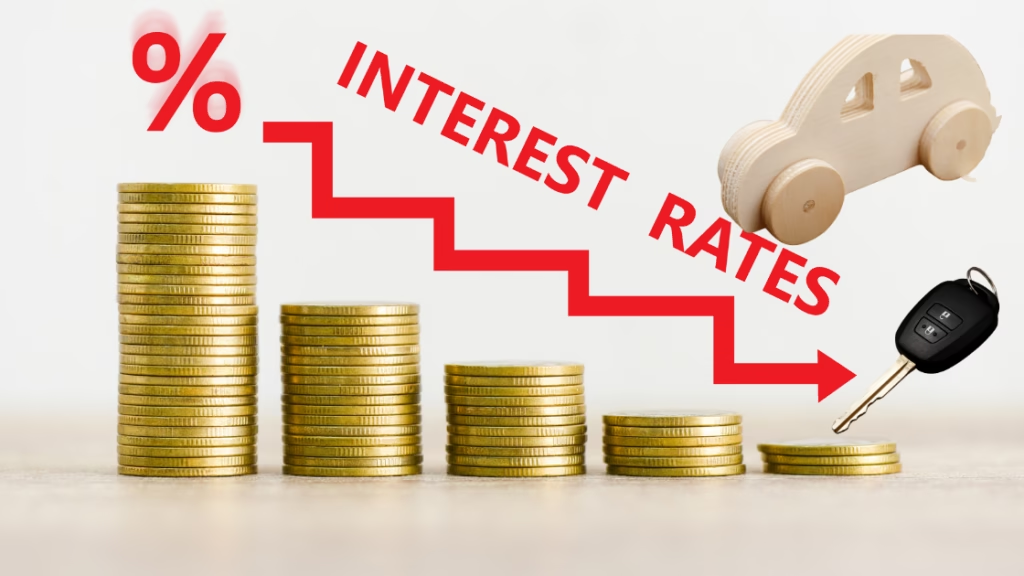
Current Canadian market data provides useful context. Bank of Canada data shows that the average rate on newly advanced auto loans was 6.55% in June 2026, compared with 6.66% in May. The rate on outstanding auto loans was 6.83% in June. These are banking-system averages, not guaranteed offers for individual consumers.
The Bank of Canada’s target overnight rate was also 2.25% as of July 2026. However, consumers should not assume that a 2.25% policy rate translates into a 2.25% car loan. Auto lenders price loans based on numerous factors, including borrower risk, vehicle characteristics, funding costs and lender policies.
How to Find the Best Rates for Used Vehicles Canada

Finding best rates for used vehicles Canada starts before you enter a dealership. The strongest negotiating position comes from understanding what you can afford, reviewing your credit information and obtaining comparable financing offers.
Start by determining how much you actually want to finance. A lender may approve a larger amount than you feel comfortable repaying. Approval is not the same as affordability. Your vehicle budget should account for insurance, fuel, maintenance, registration and other ownership expenses in addition to the loan payment.
Next, compare offers using the same assumptions. If one lender quotes a five-year loan and another quotes seven years, comparing only the monthly payment can produce a misleading conclusion. The seven-year loan may show a smaller payment while producing substantially more interest over the full repayment period.
For best rates for used vehicles Canada, compare at least these factors:
| Factor | Why It Matters |
|---|---|
| Interest rate | Determines the cost of borrowing |
| Amount financed | Affects both payment and total interest |
| Loan term | Longer terms generally increase total interest |
| Payment schedule | Changes when and how frequently you pay |
| Financing fees | Can increase the effective cost |
| Vehicle age | May affect lender eligibility and pricing |
| Down payment | Reduces the amount borrowed |
| Prepayment terms | Determines how easily you can pay the loan faster |
FCAC specifically recommends looking beyond the payment and comparing the complete financing package.
Finance Older Cars Canada: What Changes With Vehicle Age?
When you finance older cars Canada, vehicle age can become an important part of the approval decision. Different lenders establish different maximum vehicle ages, loan-to-value requirements and repayment limits. Some may be comfortable financing an older used vehicle, while others may restrict the age or mileage of the vehicle they will finance.
An older vehicle may have a lower purchase price, which can reduce the amount you need to borrow. That can be beneficial even if the interest rate is not as low as the rate available for a newer vehicle. For example, borrowing $18,000 at a somewhat higher rate can sometimes produce a lower overall financing burden than borrowing $35,000 at a lower rate.
The important question is therefore not simply, “What is the lowest interest rate?” It is, “Which vehicle and financing combination produces a sustainable total cost?”
When you finance older cars Canada, inspect the vehicle carefully before signing financing documents. Consider a vehicle history report, mechanical inspection, maintenance records, accident history, mileage and expected repair requirements. A low loan payment can become expensive if the vehicle immediately requires major repairs.
You should also consider the relationship between the loan term and the vehicle’s remaining useful life. Financing an older vehicle over an unnecessarily long period may create a situation where you continue making payments while the vehicle requires increasing maintenance.
Used Car APR Comparison Canada: Compare the Whole Deal
A used car APR comparison Canada should never be based solely on the percentage displayed in an advertisement. Compare actual financing offers for the same vehicle price, down payment, financed amount and term whenever possible.
For example, imagine a borrower finances $25,000 for 60 months. At 6%, the payment is approximately $483 per month and total interest is roughly $3,999. At 8%, the payment is approximately $507 and total interest is roughly $5,415. At 10%, the payment is approximately $531 and total interest is roughly $6,871.
| Rate | Approx. Monthly Payment | Approx. Total Interest | Approx. Total Repayment |
|---|---|---|---|
| 6% | $483 | $3,999 | $28,999 |
| 8% | $507 | $5,415 | $30,415 |
| 10% | $531 | $6,871 | $31,871 |
| 12% | $556 | $8,349 | $33,349 |
Illustrative calculations for $25,000 financed over 60 months. Actual lender calculations, fees and payment schedules may differ.
This demonstrates why a used car APR comparison Canada can save meaningful money. The difference between 6% and 12% is only six percentage points on paper, but it produces a substantially different total repayment.
The term matters just as much. FCAC’s example shows that a $25,000 loan at 5% costs approximately $26,974 over 36 months but approximately $29,681 over 84 months. The longer term lowers the regular payment but adds significantly more interest.
Affordable Used Auto Financing Canada: Build Your Budget First
The purpose of affordable used auto financing Canada is not simply to obtain approval. It is to structure borrowing that you can comfortably maintain throughout the loan.
Before applying, calculate your maximum comfortable monthly vehicle budget. Then account for expenses that do not appear in the advertised financing payment. Insurance can vary significantly depending on your location, vehicle, driving history and coverage. Fuel costs depend on how much you drive and the vehicle’s efficiency. Maintenance costs can also increase as a used vehicle becomes older.
Suppose a borrower can comfortably allocate $650 per month to vehicle ownership. A salesperson may focus on finding a loan that produces a $650 payment, but that does not mean a $40,000 vehicle is appropriate. Insurance, fuel and repairs could push actual monthly transportation costs considerably higher.
A better approach is to decide what total transportation cost is manageable first and then select the vehicle and financing structure that fit inside that boundary.
This is especially important when evaluating affordable used auto financing Canada because a longer term can make an expensive vehicle appear affordable. The payment may be manageable today while the total repayment becomes unnecessarily high.
Step-by-Step Guide to Getting Low Interest Used Car Loans Canada

1. Review Your Credit Before Applying
Before pursuing low interest used car loans Canada, review your credit information. The Financial Consumer Agency of Canada says Canadians can access their credit reports for free from Equifax and TransUnion, and checking your own report does not affect your credit rating.
Look for incorrect personal information, accounts you do not recognize, inaccurate balances or payment history errors. Correcting inaccurate information before financing can help prevent avoidable complications.
2. Decide How Much You Can Afford
Do not start with the lender’s maximum approval amount. Establish a realistic vehicle budget based on your income and regular expenses.
A larger down payment can reduce the amount borrowed, but do not empty your emergency savings merely to increase the down payment. Maintaining financial flexibility matters after the vehicle purchase.
3. Choose the Vehicle Carefully
Compare several used vehicles rather than becoming emotionally attached to the first one you see. Purchase price, age, mileage, condition and expected maintenance should all be evaluated together.
For borrowers considering finance older cars Canada, the mechanical inspection becomes particularly important.
4. Obtain Comparable Financing Offers
Request financing information from more than one source where practical. Canada.ca recommends shopping around and getting quotes from multiple dealers and lenders.
Compare the offers using the same loan amount and term. Ask for the interest rate, payment schedule, financing fees, total amount financed and total borrowing cost.
5. Negotiate the Financing
If you receive a better offer elsewhere, ask whether the dealer or lender can match or improve it. Do not assume the first offer is the best available option.
In Ontario, OMVIC notes that dealers may receive compensation from lenders for arranging financing and advises consumers to ask about the financing options presented to them.
6. Read the Final Agreement
Before signing, verify the vehicle price, down payment, amount financed, interest rate, payment schedule, term, fees and total borrowing cost.
Do not allow a discussion about monthly payment to replace a review of the complete contract.
Eligibility and Requirements for Affordable Used Auto Financing Canada
Eligibility for affordable used auto financing Canada varies by lender. There is no universal Canadian minimum credit score or single income threshold that guarantees approval.
Lenders may evaluate:
- Credit history and payment behaviour
- Income and employment stability
- Existing debt obligations
- Down payment
- Vehicle price and value
- Vehicle age and mileage
- Loan amount
- Repayment term
- Residency and identification
- Banking and payment information
A typical application may require government-issued identification, proof of income, employment information, residential information and details about the vehicle.
Accuracy matters. Do not inflate income, hide debts or provide information you cannot verify. OMVIC specifically warns that inaccurate credit applications can create serious problems for both consumers and dealers.
A strong application is not necessarily the one with the highest income. It is one that clearly demonstrates that the requested financing is reasonable relative to the borrower’s financial circumstances.
Low Interest Used Car Loans Canada: Realistic Cost Examples
Consider three hypothetical Canadian buyers.
Case Study 1: Strong credit and a newer used vehicle
Sarah wants a $28,000 used vehicle and has $5,000 available for a down payment. She finances $23,000 over 60 months. Because her credit profile is strong and the vehicle is relatively recent, she receives a competitive offer.
Instead of extending the loan to 84 months to create a lower payment, she chooses the shorter term because the payment fits her budget. This reduces the period during which interest accumulates and helps her build equity faster.
Case Study 2: Older vehicle and smaller loan
Michael needs transportation but has a limited budget. He chooses a $16,000 older used vehicle rather than stretching for a newer $30,000 vehicle. The financing rate is not as attractive as the rate available for some newer vehicles, but his smaller principal means the overall amount borrowed is considerably lower.
For someone evaluating finance older cars Canada, this illustrates an important principle: the lowest interest rate is not always the same thing as the lowest total financial burden.
Case Study 3: Comparing offers
Priya finds a $24,000 vehicle and receives two financing proposals. One has a lower payment because it uses a longer term. The second has a slightly higher payment but a shorter term and lower total borrowing cost.
She performs a used car APR comparison Canada rather than choosing based on the payment alone. The second option better matches her budget and reduces the total interest she expects to pay.
These examples are illustrative rather than guarantees. Actual rates, payments and approval decisions depend on individual circumstances and lender policies.
Banks vs Lenders vs Brokers for Used Vehicle Financing
Canadian consumers can obtain car financing through dealerships or directly from financial institutions. FCAC notes that dealership financing may involve manufacturer financing divisions, banks, credit unions or independent finance companies.
| Financing Source | Potential Advantage | What to Check |
|---|---|---|
| Banks | Established relationship and direct financing | Eligibility, rate and vehicle requirements |
| Credit unions | Different underwriting and member-based options | Membership and local policies |
| Dealerships | Convenient and multiple financing relationships | Rate, lender options and dealer compensation |
| Brokers | May compare multiple financing sources | Fees, lender identity and complete loan terms |
| Alternative lenders | May serve broader credit profiles | Higher potential borrowing cost and conditions |
There is no universal winner. The best choice is the financing offer that provides an appropriate combination of rate, term, flexibility and total cost.
For consumers looking for best rates for used vehicles Canada, the key is to compare actual offers rather than assume one lender category will always be cheaper.
How to Accelerate Approval Without Sacrificing the Deal

Fast approval is useful, but speed should never replace careful comparison. The fastest financing offer is not necessarily the cheapest.
Prepare your documents before applying. Have identification, income documentation, employment information, residential details and vehicle information available. Make sure the information is consistent across your application.
Review your credit report beforehand so you can address obvious inaccuracies. Canada.ca confirms that checking your own credit report does not hurt your credit rating.
Also avoid submitting unnecessary applications indiscriminately. OMVIC warns consumers that multiple credit applications can negatively affect a borrower’s credit score, so ask how a lender or dealership intends to handle credit inquiries before authorizing applications.
A useful strategy is to establish your financing position before you become emotionally committed to a particular vehicle. That gives you a clearer budget and stronger negotiating position.
Critical Mistakes to Avoid With Low Interest Used Car Loans Canada
Focusing Only on the Monthly Payment
A payment can be made smaller by extending the loan term. That does not necessarily make the financing cheaper. FCAC warns that longer terms can increase interest costs and negative-equity risk.
Ignoring Total Borrowing Cost
A lower interest rate can still produce an expensive loan if you finance a larger vehicle price, fees or optional products. Always review the complete amount you will repay.
Financing More Vehicle Than You Need
A used vehicle can provide substantial value without requiring you to purchase the newest or most expensive model. Keep the loan amount aligned with your actual transportation needs.
Skipping the Mechanical Inspection
A financing approval says nothing about whether a particular vehicle is mechanically sound. Used vehicles should be evaluated independently from the financing decision.
Accepting the First Financing Offer
You are not required to treat the first quote as the final answer. Compare offers and negotiate where practical.
Adding Optional Products Without Understanding Their Cost
Warranties, protection products and other optional services may have value for some buyers, but understand exactly what they cost and whether they are being financed into the loan.
Extending the Term Just to Qualify
If the only way a vehicle becomes affordable is through a very long repayment term, reconsider the vehicle price. Lower payments can conceal a higher overall cost.
What Canadian Buyers Should Know About Financing Disclosures
Consumers should receive clear information about the cost of borrowing before finalizing financing. FCAC explains that federal, provincial and territorial consumer protection laws require applicable lenders or dealers to provide disclosure statements, depending on the lender and jurisdiction.
In Ontario, OMVIC states that financing arrangements should disclose important information such as the annual percentage rate, monthly payments, term, cost of borrowing, total payments and cash price.
This is why you should request a copy of the financing documentation and read it carefully before signing.
If the advertised payment looks attractive but the rate, term or total cost is unclear, stop and ask questions. A transparent financing offer should allow you to understand what you are borrowing and what you will repay.
Frequently Asked Questions About Low Interest Used Car Loans Canada
1. What is a good rate for low interest used car loans Canada?
There is no single rate that qualifies as good for every Canadian borrower. The appropriate benchmark depends on the borrower’s credit profile, vehicle, loan term, amount financed and lender. Bank of Canada data provides useful market context, with newly advanced auto loans averaging 6.55% in June 2026, but that figure is not a guaranteed consumer rate.
The best approach is to obtain actual offers and compare them under identical assumptions. If two lenders finance the same amount for the same term, the comparison becomes much more meaningful. Also consider fees, payment flexibility and total borrowing cost rather than looking only at the advertised percentage.
2. Can I finance an older used car in Canada?

Yes, older vehicles can be financed, but eligibility varies by lender. Some financing providers may impose restrictions based on vehicle age, mileage, value or loan term. Others may specialize in broader vehicle profiles.
When you finance older cars Canada, the vehicle’s mechanical condition becomes especially important. A lower purchase price may reduce the loan amount, but repair costs can affect your overall transportation budget. Consider an independent inspection and compare the expected maintenance needs with the savings from buying an older vehicle.
3. How can I improve my chances of getting affordable used auto financing Canada?

Start by reviewing your credit information, preparing accurate income documentation, reducing unnecessary debt where practical and choosing a vehicle that fits your budget. A down payment can reduce the amount borrowed, although you should not deplete your emergency savings solely to increase it.
Comparing several financing sources can also improve your negotiating position. The objective of affordable used auto financing Canada should be sustainable borrowing rather than simply obtaining the largest possible approval.
4. Should I choose a longer term to get a lower payment?
A longer term can reduce the regular payment, but it generally increases the total interest paid. FCAC specifically warns that long-term vehicle loans can increase negative-equity risk because the vehicle may depreciate faster than the loan balance falls.
If you need an unusually long term to make the payment affordable, consider lowering the vehicle price or increasing the down payment if financially practical. The goal should be a payment that fits comfortably without unnecessarily extending the debt.
5. Is a dealer loan better than a bank loan?
Neither is automatically better. FCAC explains that consumers may finance through a dealership or directly through a financial institution.
A dealer may provide convenience and access to multiple lenders, while a bank or credit union may provide a direct relationship and another point of comparison. For best rates for used vehicles Canada, obtain comparable offers and evaluate the full financing terms.
6. Does checking my credit report hurt my credit score?
No. The Financial Consumer Agency of Canada states that checking your own credit report or score does not affect your credit rating. You can obtain free credit reports from Canada’s two main credit bureaus.
This makes reviewing your credit information an important preparation step before applying for financing. It allows you to identify potential errors and understand what information lenders may see.
7. How should I perform a used car APR comparison Canada?
Use the same vehicle price, down payment, financed amount and repayment term when comparing offers. Then review the interest rate, payment frequency, fees, total borrowing cost and prepayment conditions.
A proper used car APR comparison Canada should answer one question: which offer gives you the most suitable financing outcome for the total amount you will repay? A lower payment by itself does not answer that question.
8. Can Quick Approvals help me explore used vehicle financing?
Quick Approvals provides an online starting point for Canadians exploring vehicle financing options. You can use the financing process to understand what options may be available based on your circumstances, then compare the resulting terms carefully before making a final decision.
As with any financing provider or intermediary, review the final lender, interest rate, term, fees and total borrowing cost before signing. The purpose of low interest used car loans Canada is not simply fast approval; it is finding financing that is transparent, manageable and appropriate for your financial situation.
Conclusion: Choose the Loan That Costs Less, Not Just the Payment That Looks Smaller
Finding low interest used car loans Canada is ultimately a comparison exercise. The strongest borrowers do not simply ask, “What is my monthly payment?” They ask what interest rate they qualify for, how much they are borrowing, how long they will repay it, what fees apply, how old the vehicle is and how much the entire transaction will cost.
Use best rates for used vehicles Canada as a reason to shop around rather than as a promise that one advertised rate will apply to everyone. If you are considering finance older cars Canada, evaluate the vehicle’s condition, age, mileage and expected maintenance alongside its financing terms. Use a used car APR comparison Canada to compare actual offers on equal terms, and prioritize affordable used auto financing Canada that fits your complete household budget.
Current Canadian market data shows why comparison remains important: the Bank of Canada reported an average newly advanced auto-loan rate of 6.55% in June 2026, while individual borrowers can receive offers that differ significantly from market averages.
Before signing, review the complete disclosure, confirm the total borrowing cost, understand the repayment term and make sure the vehicle itself is financially sensible. FCAC recommends comparing multiple offers and looking beyond payments to the complete financing arrangement.
If you are ready to explore your options, start with Quick Approvals and approach the process with one clear objective: secure a used vehicle that meets your needs without turning an affordable purchase into an unnecessarily expensive debt.
Internal Links for QuickApprovals.ca
- https://quickapprovals.ca/car-loan-credit-pull-canada/
- https://quickapprovals.ca/car-loan-credit-score-requirements-canada/
- https://quickapprovals.ca/car-loan-rates-comparison-canada/
- https://quickapprovals.ca/dealer-vs-bank-car-loan-canada/
- https://quickapprovals.ca/car-loan-approval-time-in-canada/
- https://quickapprovals.ca/car-loans-with-early-payoff-options-in-canada/
Authority Outbound References
- https://www.canada.ca/en/financial-consumer-agency/services/loans/financing-car/shop-around.html
- https://www.canada.ca/en/financial-consumer-agency/services/loans/financing-car/risks.html
- https://www.canada.ca/en/financial-consumer-agency/services/credit-reports-score/order-credit-report.html
- https://www.bankofcanada.ca/rates/banking-and-financial-statistics/interest-rates-for-new-and-existing-lending-by-chartered-banks/
- https://www.omvic.ca/buying/your-rights/financing-disclosures/
- https://www.transunion.ca/product/consumer-disclosure